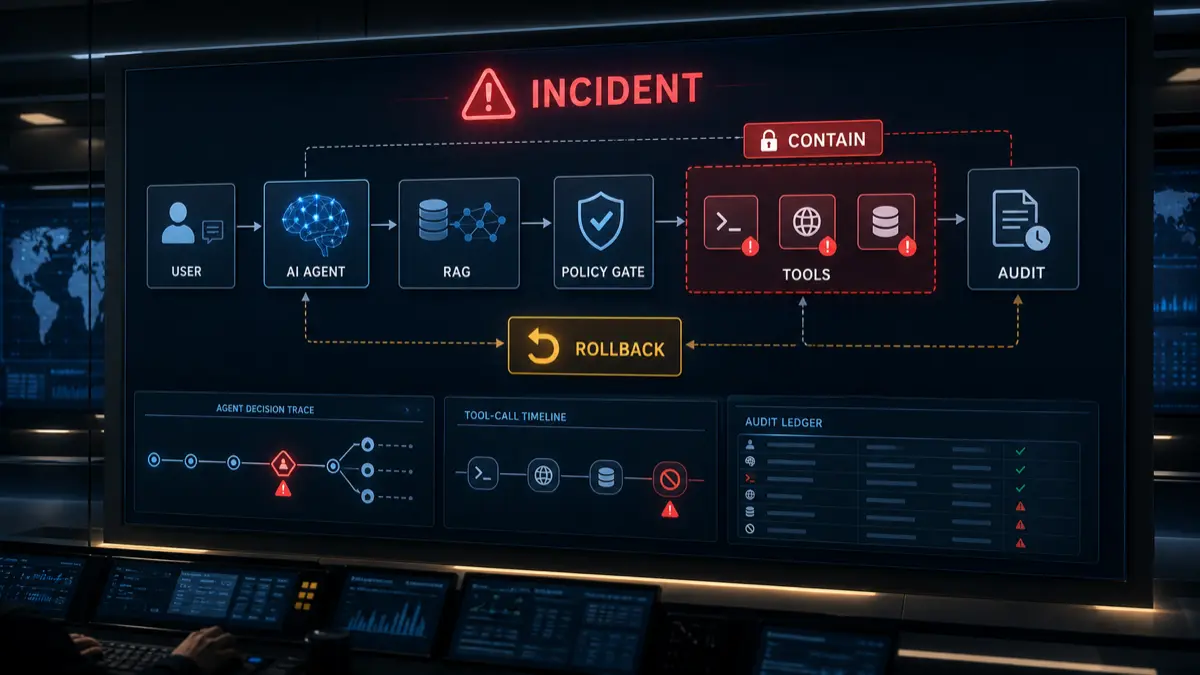
Most enterprise incident response playbooks assume the system is deterministic enough to replay like normal software.
AI breaks that assumption. The same user request can produce different model output after a model update, context change, retrieval change, prompt edit, tool schema change, memory mutation, policy update, or temperature setting. If the AI system can call tools, write records, retrieve confidential data, or trigger workflows, incident response has to capture the full decision chain, not only the final bad output.
The practical question for a CIO, CISO, enterprise architect, AI platform engineer, or product team is:
How should incident response change when an enterprise AI system is probabilistic, context-dependent, and connected to tools?
My answer: AI incident response must be designed as an architecture layer before production. It needs severity rules for AI-specific failure modes, kill switches for model and tool authority, evidence capture across prompts, retrieval, model versions, policies and tool calls, replayable traces, rollback paths for actions and knowledge sources, and post-incident eval updates that prevent the same failure class from returning.
This article extends the control-plane model from AI governance architecture, the abuse-case lens from threat modeling enterprise AI agents, the retrieval controls in RAG governance, the approval-state design in human-in-the-loop approval patterns, and the runtime enforcement pattern in designing a safe tool registry.
Key takeaways
- AI incident response is not only cybersecurity incident response with a model attached. It must account for probabilistic output, context windows, retrieval state, tool authority, policy gates, and model/version drift.
- The minimum evidence unit is the AI decision trace: user identity, agent identity, prompt version, system prompt, retrieved sources, model version, tool contract, policy decision, approval state, output, action result, and correlation ID.
- Containment should degrade authority before deleting evidence. Disable high-risk tools, freeze RAG indexes, force proposal-only mode, revoke agent service tokens, or route outputs through human approval.
- Rollback has two meanings: technical rollback of model, prompt, tool, or index versions, and business rollback of actions already taken by the AI workflow.
- Post-incident work should add eval cases, policy rules, monitoring signals, and ownership fixes. A meeting note is not enough.
- The durable artifact is an AI incident response runbook that maps incident class to severity, evidence, containment, owner, rollback path, notification path, and release gate.
Citation-ready answer
AI incident response is the operating and technical process for detecting, containing, investigating, correcting, and learning from failures in AI systems. It differs from traditional incident response because the cause may live in model behavior, prompt design, retrieval content, memory, tool permissions, approval routing, policy checks, or changing runtime context. A production-ready AI incident response architecture captures replayable decision traces, defines AI-specific severity classes, provides kill switches for model and tool authority, supports rollback of prompts, models, indexes and business actions, and feeds incident evidence back into eval suites and governance controls.
Why normal incident response is not enough
Traditional incident response already gives enterprises a strong base: prepare, detect, analyze, contain, recover, communicate, and improve. NIST SP 800-61 Rev. 3 is explicit about connecting incident response to cybersecurity risk management and improving detection, response, and recovery activities: NIST SP 800-61 Rev. 3.
AI systems need that base, but they add failure modes that do not fit cleanly into a server, endpoint, or SaaS incident.
An AI incident may be caused by:
- a prompt injection hidden inside a retrieved document,
- a RAG index serving stale or over-permissive content,
- an agent tool executing with the wrong identity,
- a model update changing decision behavior,
- a memory entry poisoning future sessions,
- a policy gate allowing a high-risk action in the wrong workflow state,
- a human approval screen hiding the real action impact,
- an output leaking sensitive information through a channel that was never classified,
- a cost loop that keeps calling tools without business value.
The NIST AI Risk Management Framework is useful here because it frames risk work as governance, mapping, measurement, and management across the AI lifecycle. The NIST Generative AI Profile goes further for generative AI, including governance, pre-deployment testing, content provenance, and incident disclosure as primary considerations. For incident responders, the translation is direct: the playbook needs evidence, control owners, and feedback loops that are specific to generative AI systems.
The AI incident response architecture
The architecture should be designed as a set of control points around the AI workflow:
1 | user or system event |
Every production AI workflow should answer five incident-response questions before release:
- What can go wrong?
- How will we detect it?
- What can we shut off without destroying evidence?
- Who owns each containment action?
- How do we prove the same failure class is fixed?
If the team cannot answer those questions, the AI system is not production-ready. It may still be a useful prototype, but it should not have high-impact tool authority.
Severity matrix for enterprise AI incidents
Use business impact and authority, not only model confidence, to classify severity.
| Severity | Example AI incident | Immediate containment | Primary owner |
|---|---|---|---|
| SEV-4 | Incorrect internal summary with no action taken | Mark output, capture trace, add eval case | Product owner |
| SEV-3 | Wrong recommendation used in a low-risk workflow | Disable workflow automation, notify affected team | AI application owner |
| SEV-2 | Sensitive data exposed to an unauthorized user or channel | Freeze retrieval, revoke session, preserve logs, start privacy review | Security and data owner |
| SEV-2 | Agent executes wrong customer, HR, finance, or IT action | Disable write tools, start business rollback, preserve tool evidence | Business process owner |
| SEV-1 | Agent changes IAM, production config, payment, legal, or customer-facing state at scale | Kill high-risk tool authority, revoke service token, invoke crisis process | CISO, CIO, business executive |
| SEV-1 | Prompt injection or tool abuse compromises other systems | Isolate connectors, rotate credentials, start cyber incident process | Security operations |
This matrix deliberately separates “bad answer” from “bad action.” A hallucinated paragraph is not the same incident class as an agent modifying a production permission group.
The minimum evidence schema
AI incident response fails when the team has screenshots but not traces.
For every significant AI workflow, log a structured decision event. Redact sensitive fields, but preserve enough metadata to reconstruct the decision path.
1 | { |
This is not a logging preference. It is the difference between arguing about what the model “probably saw” and knowing what the system actually gave it.
The OWASP AI Agent Security Cheat Sheet makes the same operational point from a security angle: agent systems need monitoring, audit trails, tool-call logs, anomaly detection, and high-risk action metadata: OWASP AI Agent Security Cheat Sheet.
Incident classes that deserve separate playbooks
Do not use one generic “AI issue” bucket. Different incident classes require different containment.
| Incident class | Common symptom | Evidence needed | Best first containment |
|---|---|---|---|
| Prompt injection | Agent follows instructions from retrieved content, email, ticket, web page, or document | retrieved content, prompt trace, tool proposal, output validator result | quarantine source, disable affected retrieval path, force proposal-only mode |
| Data exfiltration | Sensitive content appears in output, logs, tool calls, email, or external channel | data class, user permissions, retrieval docs, output channel, DLP decision | freeze session, disable external send, notify data owner |
| Excessive agency | Agent takes more action than user intent or policy allowed | user request, tool contract, policy decision, approval state | disable high-risk tools, lower risk tier, require human approval |
| Identity confusion | Agent acts under wrong user, service account, tenant, or department | identity token, delegated scope, ABAC attributes, tenant context | revoke token, disable connector, replay authorization checks |
| RAG authority failure | Stale, non-authoritative, or over-permissive document drives answer | source register, index version, document owner, freshness metadata | freeze index, remove source, rebuild index after owner review |
| Model regression | New model/prompt/index changes behavior in production | version diff, eval history, release notes, canary traces | rollback model or prompt alias, stop rollout |
| Tool-chain compromise | Connector, MCP server, plugin, or API behaves maliciously or unexpectedly | tool version, endpoint, credentials, network logs, arguments | isolate connector, rotate credentials, block tool in registry |
| Cost or loop runaway | Agent repeats calls, consumes tokens, floods systems, or hits rate limits | step count, token use, tool frequency, retry state | circuit breaker, max-step kill switch, quota reduction |
The OWASP Top 10 for LLM Applications 2025 is a useful source for recurring LLM application risks, but an enterprise playbook has to translate those risks into local evidence, owners, and containment levers.
Containment: degrade authority before destroying evidence
The first instinct during a serious AI incident is often to delete the agent, purge logs, remove the prompt, or rebuild the index. That can destroy the evidence needed to understand the failure.
Use containment levers that reduce risk while preserving the trace:
| Lever | What it does | When to use it |
|---|---|---|
| Proposal-only mode | AI can draft actions but cannot execute tools | uncertain root cause, suspected excessive agency |
| Tool kill switch | Specific tool is blocked in the registry | harmful tool behavior, connector compromise |
| Risk-tier downgrade | Workflow can only perform low-risk actions | policy bypass, weak approval evidence |
| RAG freeze | Retrieval index becomes read-only or is disabled | prompt injection, stale or unauthorized source |
| Model alias rollback | Production alias points to prior model or prompt version | model regression or prompt release issue |
| Session isolation | Affected sessions cannot reuse memory or context | memory poisoning, user-specific compromise |
| Token revocation | Agent service token or delegated token is revoked | identity abuse or connector compromise |
| External channel block | Email, ticket comment, webhook, or customer channel is disabled | sensitive output or reputational risk |
This is where the safe tool registry matters. If tool authority is not centralized and enforceable, containment becomes a manual hunt across code, prompts, agents, workflow builders, and vendor consoles.
Rollback is not only model rollback
In traditional software, rollback often means redeploying the previous build. In enterprise AI, rollback has more layers.
| Rollback target | What to restore | What to verify |
|---|---|---|
| Model | approved model alias, provider route, inference parameters | eval pass rate, latency, cost, safety behavior |
| Prompt | system prompt, prompt template, examples, tool instructions | regression tests for known incident prompt |
| RAG index | source set, chunking rules, embedding model, metadata filters | document authority, ACL inheritance, freshness |
| Memory | session memory, long-term memory, user notes | poisoning removed, legitimate memory preserved |
| Tool registry | tool schema, allowed scopes, risk tier, rate limit | least privilege, approval route, audit fields |
| Policy-as-code | ABAC rules, thresholds, exception rules | decision replay against incident trace |
| Business state | CRM field, refund, ticket, IAM change, deployment, email | process owner confirms correction |
The business rollback is often harder than the technical rollback. If an AI agent sent the wrong message to customers, approved the wrong refund, changed an HR field, or modified an IAM group, the incident is not over when the model route is fixed.
Replay should be deterministic enough to learn
You cannot make every model response perfectly deterministic, but you can make the incident replay useful.
Capture:
- exact prompt template and system message version,
- user request and session state,
- retrieved document IDs, chunks, scores, and metadata,
- model name, version or alias, route, parameters, and provider,
- tool schema and policy decision,
- approval record and approver identity,
- output validator decision,
- final action result,
- downstream business object state.
Then replay at three levels:
- Trace replay: reconstruct what happened from logs.
- Behavioral replay: run the same case through the current stack.
- Control replay: verify that policy, approval, DLP, and tool gates now block or route the case correctly.
The goal is not to prove the model will never make a similar mistake. The goal is to prove the system now catches the failure class before it becomes a high-impact action.
The AI incident RACI
AI incidents cross ownership boundaries. Write the RACI before the incident.
| Role | Accountable for |
|---|---|
| AI application owner | workflow behavior, user impact, product fix, communication with business users |
| AI platform team | model routing, prompt/version registry, eval pipeline, observability, rollback mechanics |
| Security operations | triage, containment, credential compromise, attacker behavior, SIEM/SOAR integration |
| Data owner | data classification, source authority, RAG content, disclosure impact |
| Business process owner | business rollback, customer or employee impact, operational correction |
| Legal/privacy/compliance | notification obligations, evidence preservation, regulatory interpretation |
| CIO leadership | cross-team escalation, funding, risk acceptance, production authority decisions |
Do not make the AI platform team own every outcome. It owns the shared control plane. The business process owner still owns the process the AI system changes.
Detection signals that actually help
Good AI monitoring is not a dashboard of average response quality.
Useful incident signals include:
- tool call rate above workflow baseline,
- high-risk tool attempts after low-risk user requests,
- repeated policy denials from one user, tenant, agent, or source,
- retrieved documents from unexpected authority classes,
- output DLP hits by channel,
- sudden model refusal or compliance behavior drift,
- abnormal token spend or step count,
- approval bypass attempts,
- repeated correction by human reviewers,
- model, prompt, tool, or index changes correlated with error spikes.
The NCSC’s Guidelines for secure AI system development place logging, monitoring, incident management, update management, and information sharing inside secure AI operation and maintenance. That is the right operational framing: AI security is not done at launch.
Post-incident fixes must become release gates
The weak postmortem says:
“The model made a mistake. We improved the prompt.”
The useful postmortem produces:
- a new eval case for the exact incident,
- at least one generalized abuse case,
- updated policy rules or tool scopes,
- updated RAG source metadata or ownership,
- improved detector thresholds,
- a rollback rehearsal if rollback was slow,
- a dashboard or alert if detection was manual,
- an owner change if accountability was unclear,
- a release gate that blocks reintroduction.
This is where AI incident response becomes LLMOps. Incidents should feed the eval suite, policy-as-code, registry metadata, monitoring rules, and deployment checklist.
Minimum viable AI incident response runbook
Start with a one-page runbook per production AI workflow:
| Runbook field | What to define |
|---|---|
| System ID | unique AI application or agent identifier |
| Risk tier | allowed action class and maximum business impact |
| Owners | application, platform, security, data, business process |
| Incident classes | prompt injection, data leakage, excessive agency, identity abuse, RAG failure, model regression, tool compromise |
| Detection signals | alerts, logs, thresholds, human report channels |
| Evidence location | trace store, prompt registry, model registry, RAG index version, tool registry, approval logs |
| Containment levers | kill switches, proposal-only mode, token revocation, index freeze, channel block |
| Rollback paths | model, prompt, index, policy, tool, memory, business action |
| Notification path | security, privacy, legal, business owner, customer comms if needed |
| Recovery gate | evals, replay, owner signoff, monitoring update |
This runbook should live beside the AI system registry, not in a detached PDF that nobody opens during an incident.
Practical implementation checklist
Before production
- Assign an AI system ID and owner.
- Register model, prompt, tool, RAG, memory, and policy versions.
- Define risk tier and allowed action classes.
- Create structured decision logs with correlation IDs.
- Build kill switches for tool classes and external channels.
- Define retention rules for incident evidence.
- Add baseline evals for prompt injection, data leakage, tool abuse, and policy bypass.
During an incident
- Preserve traces before changing prompts, indexes, tools, or model routes.
- Classify by business impact and action authority.
- Reduce authority with the narrowest safe containment lever.
- Identify affected users, records, actions, and channels.
- Start technical rollback and business rollback as separate workstreams.
- Keep data owner and process owner in the loop.
After recovery
- Replay the incident against the fixed stack.
- Add regression evals and abuse cases.
- Update tool scopes, approval rules, source authority, or policy thresholds.
- Document the root cause at the architecture boundary, not only at the model output.
- Require owner signoff before restoring high-risk authority.
FAQ
What is an AI incident?
An AI incident is a failure in an AI system that creates security, privacy, safety, reliability, compliance, financial, customer, employee, or operational impact. In enterprise AI, incidents can involve model output, retrieval, memory, tool use, approvals, data access, identity, or downstream business actions.
Is a hallucination always an incident?
No. A hallucination becomes an incident when it has material impact or escapes the intended control boundary. A wrong draft caught by a user is usually a quality issue. A wrong answer sent to a customer, used for a financial decision, or executed through a tool may be an incident.
What should be logged for AI incident response?
Log the AI decision trace: user and agent identity, prompt version, model version or route, retrieval sources, memory state references, tool contract, policy decision, approval record, output validator result, action result, timestamps, and correlation ID. Redact sensitive values, but keep reconstructable metadata.
Should we shut down the whole AI platform during an incident?
Usually no. Start with the narrowest containment that stops harm: disable a tool, freeze an index, revoke a token, switch an agent to proposal-only mode, block an external channel, or roll back a model alias. Full platform shutdown is reserved for systemic compromise or unknown blast radius.
Who owns AI incident response?
Security operations should own incident coordination when there is security impact, but AI incident response is shared. The AI platform owns model, prompt, eval, registry, and observability controls. The data owner owns data impact. The business process owner owns action rollback. CIO leadership owns production authority and escalation.
How do we know the fix worked?
Replay the incident trace, run the generalized abuse case, verify policy and tool gates block or route the case correctly, and add the case to the release eval suite. If the fix is only a prompt edit with no test, it is not enough for a high-risk workflow.
Final thought
The most important shift is mental.
AI incident response is not a communications plan for when the model says something embarrassing. It is the operational architecture that makes a probabilistic, context-dependent, tool-using system observable, containable, reversible, and improvable.
If an enterprise AI system can affect real customers, employees, money, infrastructure, data, or physical operations, the incident response path should be designed before the first production workflow goes live.