Physical AI robots fail when teams treat the demo environment as if it were the deployment environment.
The robot worked in the lab. The gripper picked the part. The VLA selected the right action. The local planner avoided the obvious obstacle. The operator copilot generated a plausible inspection task. Then lighting changed, payload shifted, Wi-Fi jitter appeared, the floor got reflective, a pallet was placed slightly outside the expected zone, the camera calibration drifted, and the robot was still allowed to act as if the original assumptions were true.
That is the quiet failure mode in AI-enabled robotics: not one bad model output, but stale assumptions that remain invisible until the machine is already moving.
The practical question for robotics engineers, AI engineers, CTOs, safety leads, and technical founders is:
How do we track what must remain true before a Physical AI robot is allowed to keep operating?
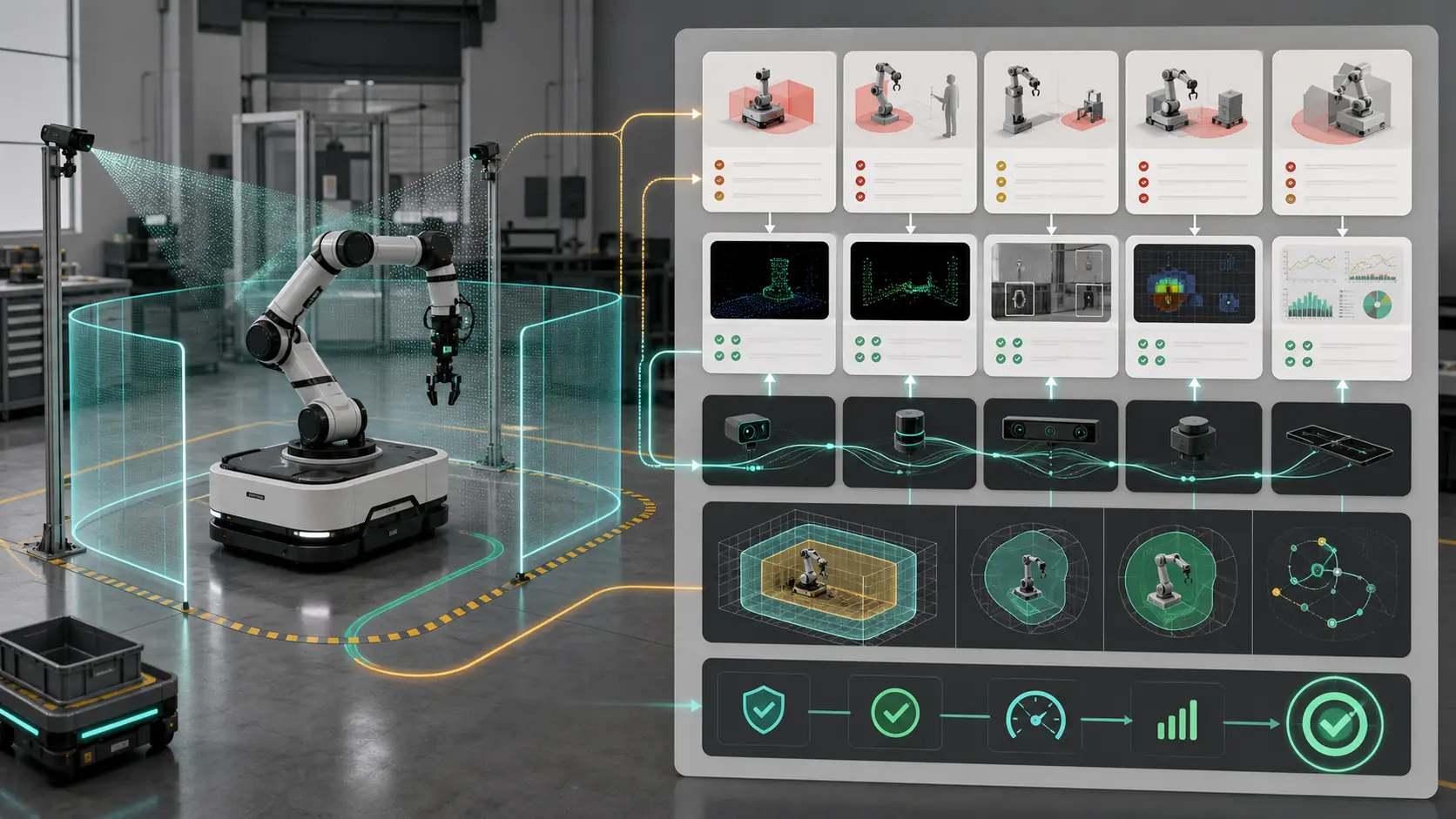
The practical answer is an assumption ledger: a deployment artifact that maps operating assumptions to hazards, evidence, monitors, invalidation triggers, owners, and fallback behavior. It sits between the risk assessment, the runtime assurance layer, and the release gate.
The ledger connects the practices covered in robot safety architecture, runtime assurance, command validation, VLA safety limits, sensor-to-actuator timing budgets, and ROS 2 logs and rosbags.
What the ledger must make explicit
- An assumption ledger is a structured register of the environmental, physical, software, AI, operator, and operational assumptions that must remain true for a robot deployment to stay inside its safety case.
- The ledger should not be a static document. It should feed runtime assurance, diagnostics, test planning, release gates, incident review, and decommissioning.
- Physical AI needs this artifact because learned perception, VLA policies, LLM-based copilots, and AI planners often depend on context that is not visible in a normal software requirements file.
- Each assumption should have an owner, hazard link, evidence source, validation method, invalidation trigger, runtime monitor, fallback behavior, and review cadence.
- Assumptions about lighting, payload, friction, calibration, timing, human access, network quality, sensor confidence, and command authority should be treated as operational constraints, not background notes.
- The working artifact is an assumption ledger table plus an evidence gate: no assumption without evidence, no evidence without freshness, no stale assumption without reduced robot authority.
What an assumption ledger is
An assumption ledger for Physical AI robots is a safety and deployment artifact that records the conditions a robot depends on to operate safely: environment, payload, sensors, calibration, timing, operator authority, AI model limits, workspace boundaries, and fallback behavior. Each assumption is linked to hazards, evidence, runtime monitors, invalidation triggers, owners, and release gates. The goal is to prevent a robot from acting on stale deployment assumptions when real-world conditions move outside the tested operating envelope.
Why assumptions become safety risks
Every robot has assumptions.
Some are obvious:
- maximum payload,
- workspace boundary,
- expected floor surface,
- safe stopping distance,
- battery voltage range,
- E-stop availability.
Some are less obvious:
- camera exposure stays within a useful range,
- localization covariance remains bounded,
- object geometry matches the trained examples,
- Wi-Fi latency is not part of the control loop,
- the operator can see the robot before approving motion,
- the AI agent only proposes skills and cannot bypass validation,
- the test dataset covers the lighting and occlusion patterns in production.
Physical AI makes the second class more dangerous because the AI layer often consumes context indirectly. It may appear to work until one hidden assumption breaks.
The NIST AI Risk Management Framework is useful here because it frames AI risk work around mapping, measuring, managing, and governing risk over the lifecycle. In robotics terms, “map” means more than listing hazards. It means identifying the assumptions that make the hazard analysis true.
For machinery, ISO 12100 is a useful anchor because it focuses on risk assessment and risk reduction across the machine lifecycle. For industrial robots, ISO 10218-1:2025 gives the robot safety context, including hazards, design, risk reduction, and information for use. I am not treating these as compliance checklists here. I am using them as engineering pressure: if a risk reduction argument depends on an assumption, that assumption needs evidence.
The core architecture
The assumption ledger belongs between design-time safety work and runtime operation.
1 | hazard analysis |
It should feed three systems:
1 | 1. Release gate |
If the ledger does not affect release, runtime authority, or incident learning, it is not a control. It is documentation.
The ledger schema
Start with a table that engineers can actually maintain.
| Field | Purpose | Example |
|---|---|---|
assumption_id | Stable reference | A-PERCEPTION-014 |
claim | What must remain true | front camera detects pallets at 0.5-4 m in aisle lighting |
scope | Where it applies | warehouse aisle inspection, day shift, Zone B |
hazard_link | What can go wrong if false | collision with partially visible pallet |
evidence | What supports the claim | scenario test set, rosbag replay, calibration report |
freshness | How current evidence must be | retest after camera mount change or lighting change |
runtime_monitor | What checks it during operation | exposure range, detection confidence, topic age, diagnostics |
invalidation_trigger | What makes the assumption untrusted | confidence below threshold for 2 seconds |
fallback | What the robot does when invalid | slow mode, stop, operator confirmation, lidar-only route |
owner | Who maintains it | perception owner plus safety owner |
release_gate | What blocks deployment | no production-lighting test means no autonomous motion |
The ledger is not trying to replace hazard analysis, test reports, logs, or runtime monitors. It connects them.
Without that connection, teams end up with disconnected artifacts:
- a risk assessment nobody maps to tests,
- tests nobody maps to runtime limits,
- runtime logs nobody maps to deployment assumptions,
- incidents nobody maps back to safety claims.
Assumption classes for Physical AI
Use classes so the ledger does not become a random list.
| Class | Typical assumption | Why it matters |
|---|---|---|
| Environment | lighting, floor, weather, dust, clutter, electromagnetic noise | perception and traction fail outside tested conditions |
| Workspace | zones, human access, barriers, fixtures, forbidden areas | command validation depends on geometry being true |
| Payload and tooling | mass, center of gravity, grip surface, tool condition | motion limits and stopping behavior change |
| Sensors | field of view, calibration, sync, confidence, topic rate | the robot acts on what it believes, not what is physically true |
| Timing | callback latency, command age, network jitter, controller period | stale state can make safe plans unsafe |
| AI model | training domain, prompt boundary, VLA action limits, uncertainty | learned policies can generalize beyond evidence |
| Authority | who may command, approve, override, or teleoperate | unsafe delegation can become a physical hazard |
| Recovery | fallback controller, safe stop, degraded mode, restart rule | failure handling is part of the deployment claim |
| Operations | maintenance, cleaning, shift handoff, map updates, change control | humans can invalidate assumptions without touching code |
This is where the assumption ledger becomes more useful than a generic “risk register.” It captures the specific context a robot needs to remain safe enough to operate.
Operating envelope vs assumption ledger
The operating envelope says where the robot is allowed to operate.
The assumption ledger says what must remain true for that envelope to mean anything.
| Operating envelope item | Hidden assumptions to make explicit |
|---|---|
| Robot may move at 0.5 m/s in aisle mode | floor friction, obstacle detection range, stopping distance, localization confidence |
| Robot may inspect shelf bins | camera calibration, lighting, bin geometry, object class coverage |
| Robot may accept voice or chat commands | operator identity, command freshness, ambiguous intent handling |
| Robot may enter collaborative area | human detection coverage, protective stop behavior, zone map freshness |
| Robot may use VLA-assisted manipulation | object set, grasp force limits, tool geometry, fallback after failed grasp |
| Robot may resume after safe stop | restart position, stored energy, operator visibility, mode state |
Do not let the envelope become a drawing in a slide deck. If the robot cannot observe or validate the assumptions that define the envelope, then the runtime authority should be smaller.
The same idea appears in road-vehicle safety work as operational context. ISO 21448 is road-vehicle specific, but the SOTIF idea is relevant to robotics teams because it focuses on hazards caused by functional insufficiencies, situational awareness limits, foreseeable misuse, verification, validation, and operation-phase activities. The translation for Physical AI is direct: a system can be implemented as intended and still be unsafe if the intended function was specified too broadly for the real world.
Evidence is not the same as confidence
A confidence score is not a safety argument.
It is one signal.
A detector can be confident on the wrong object. A VLA can be confident in a scene outside its training distribution. A localization stack can publish a pose while the transform tree is wrong. A planner can produce a valid trajectory based on stale obstacle data. A human can approve an action without seeing the blocked side of the cell.
Evidence should be plural:
| Assumption | Weak evidence | Stronger evidence |
|---|---|---|
| camera detects pallet edges | model confidence from one lab run | scenario tests across production lighting and occlusion |
| robot stops before boundary | software command says stop | measured stop distance with payload, floor, speed, and controller delay |
| localization is reliable | pose topic exists | covariance, TF audit, bag replay, map-change test |
| VLA can propose bin-pick skills | successful demo video | negative tests, forbidden-object tests, failed-grasp recovery tests |
| operator can approve safely | approval button exists | evidence pack with robot state, camera view, risk tier, timeout |
| fallback is safe | fallback state in code | measured transition time and physical stop outcome |
The assumption ledger should point to evidence, not merely state belief.
Runtime invalidation
The most important column in the ledger is invalidation_trigger.
An assumption that cannot be invalidated at runtime is either:
- a design-time assumption that must be controlled by procedure, or
- a weak assumption that should not support high authority.
Examples:
| Assumption | Runtime invalidation trigger | Authority change |
|---|---|---|
| obstacle map is fresh enough for motion | map age above 150 ms | reject new motion goals |
| camera calibration is trustworthy | diagnostics report calibration mismatch or reprojection drift | disable vision-guided manipulation |
| human-free zone is confirmed | safety scanner zone breach | protective stop or low-speed mode |
| AI proposal is still current | proposal age exceeds command TTL | drop proposal and request fresh intent |
| payload is within expected mass | motor current or scale estimate outside bound | shrink acceleration or stop |
| network is not motion-critical | cloud inference needed for immediate control | force local fallback |
| operator approval is meaningful | approver lacks visibility or approval expired | block execution |
| VLA domain assumptions hold | scene classified out-of-distribution | proposal-only mode |
Runtime invalidation is where the ledger becomes operational. It gives the robot permission to stop trusting its own deployment assumptions.
How this maps to ROS 2
ROS 2 will not create an assumption ledger for you, but it gives useful places to connect one.
| ROS 2 boundary | Ledger connection |
|---|---|
| Lifecycle nodes | assumptions about component readiness map to active/inactive transitions |
| Diagnostics | sensor and hardware assumptions become machine-readable status |
| Actions | AI or operator proposals become accepted, rejected, canceled, or timed out goals |
| Parameters | deployment assumptions become versioned configuration, not tribal knowledge |
| rosbag2 | evidence bundles preserve sensor, TF, command, and safety state |
| TF tree | frame assumptions become auditable geometry contracts |
| launch files | operating mode assumptions become explicit startup composition |
The ROS 2 managed node lifecycle design is useful because lifecycle state gives software components a formal way to be unavailable, inactive, active, or finalized. That matters when a safety assumption depends on a node being healthy before motion is enabled.
The ROS diagnostic_updater documentation is practical because diagnostics can report device state, topic frequency, bounds, and hardware conditions. Those diagnostics should feed the assumption ledger and runtime assurance layer, not only a dashboard.
A release gate for assumptions
Before a Physical AI robot gets deployment authority, ask this:
| Gate question | Pass condition |
|---|---|
| Are operating assumptions listed? | Every high-risk behavior has explicit assumptions |
| Are hazards linked? | Each assumption maps to at least one hazard or safety claim |
| Is evidence attached? | Test, inspection, analysis, or operational evidence exists |
| Is evidence fresh enough? | Change triggers and review dates are defined |
| Is there a runtime monitor? | The assumption is observed or intentionally procedural |
| Is invalidation defined? | The robot knows what changes authority when false |
| Is fallback defined? | Stop, degrade, clamp, ask, or hand over is explicit |
| Is ownership named? | Engineering and safety owners are listed |
| Is incident learning connected? | Incident findings update assumptions and tests |
If a deployment depends on an assumption that is untested, unowned, unmonitored, and has no fallback, that is not a residual risk. It is an unmanaged risk.
Relationship to safety cases
An assumption ledger is not the full safety case.
It is the part of the safety case that prevents hidden context from disappearing.
UL 4600 is an autonomous-product standard, not a general robotics recipe, but it is useful because it centers a safety argument supported by risk analysis, testing, validation, data integrity, design process, and human-machine interaction. UL Standards & Engagement describes UL 4600 as addressing safety evaluation for autonomous products and requiring a safety argument. That is the right mental model: claims need evidence, and evidence needs scope.
NASA’s assurance-case work is also a useful pointer. The ASSURE workshop description frames assurance cases around structured arguments and evidence for software-intensive, safety-critical systems, including adaptive and autonomous systems. For Physical AI robots, the assumption ledger is one way to keep the argument grounded in real operating conditions.
The ledger should support a safety case argument like this:
1 | Claim: robot may perform supervised shelf inspection in Zone B. |
That is more useful than saying “we tested the robot.”
Failure modes the ledger catches
| Failure mode | What happens without a ledger | What the ledger should force |
|---|---|---|
| Lab-only lighting | model works in demo, fails in production glare | lighting range assumption and production scenario tests |
| Stale maps | planner trusts old aisle geometry | map freshness trigger and reduced authority |
| Payload drift | manipulator exceeds tested stopping or grip behavior | payload assumption, measurement, and acceleration clamp |
| Calibration change | camera mount moves after maintenance | calibration invalidation trigger and retest gate |
| Operator blind approval | human approves motion without seeing hazard | approval evidence pack and visibility rule |
| VLA overgeneralization | model applies skill to unseen object or tool | domain assumption and proposal-only mode |
| Network dependency creep | remote service becomes part of motion timing | timing assumption and local fallback requirement |
| Restart hazard | robot resumes after stop in unsafe pose | restart assumption, stored-energy check, and operator acknowledgement |
| Unowned test gap | nobody maintains edge-case evidence | assumption owner and review cadence |
| Incident repeats | logs capture symptoms but not broken context | incident review updates assumptions and tests |
This is why I prefer an assumption ledger over another broad safety checklist. It asks a sharper question: what did we assume, and how do we know it is still true?
Implementation sequence
Start small.
- Pick one physically meaningful robot behavior, such as low-speed aisle inspection, bin picking, supervised mobile manipulation, or AI-assisted maintenance recovery.
- List the assumptions that make the behavior safe enough to attempt.
- Link each assumption to hazards and affected safety claims.
- Attach the evidence that supports each assumption.
- Define what invalidates the assumption.
- Decide whether invalidation is observed by runtime diagnostics, test gates, operator procedure, or maintenance process.
- Connect invalidation to authority: allow, clamp, degrade, stop, ask for confirmation, or disable the skill.
- Record ownership and review cadence.
- Add incident review: every incident asks which assumption was missing, false, stale, or unmonitored.
- Refuse to expand AI authority until the ledger covers the new operating context.
The goal is not to slow down robotics teams. The goal is to stop teams from scaling a demo beyond the assumptions that made the demo work.
Questions that come up in deployment
Is an assumption ledger the same as a risk register?
No. A risk register lists risks and mitigations. An assumption ledger lists the conditions that make a safety claim or mitigation valid. It is closer to the context layer of the safety case and should connect directly to runtime monitors, evidence, and deployment gates.
Should every assumption be monitored at runtime?
Not every assumption can be monitored directly. Some are controlled by design, procedure, inspection, maintenance, or deployment policy. But high-risk assumptions that can change during operation should have runtime invalidation paths. If they cannot be monitored, the robot’s authority should reflect that uncertainty.
How is this different from an operational design domain?
An operational design domain defines where and under what conditions a system is intended to operate. The assumption ledger decomposes that domain into testable, owned, monitored, and invalidatable claims. It turns “warehouse aisle” into concrete assumptions about lighting, floor friction, map freshness, human access, sensor confidence, payload, and fallback behavior.
Does this apply to small prototypes?
Yes, but scale it. A lab prototype can use a short ledger with the handful of assumptions that would make the demo unsafe if false: workspace boundary, operator location, command source, E-stop access, payload, speed, and sensor freshness. The point is not bureaucracy. The point is remembering what the demo depends on.
Can an AI model help maintain the ledger?
Yes, for organization and review. An AI assistant can summarize logs, suggest missing assumptions, cluster incident evidence, and draft test cases. It should not be the authority that accepts residual risk or decides that an assumption is valid for deployment.
When should an assumption be retired?
Retire it when the robot no longer depends on it, when the behavior is removed, or when the assumption has been replaced by a stronger design control. Do not leave old assumptions attached to active deployment authority. Stale assumptions are a source of false confidence.
Make assumptions part of operating authority
A Physical AI robot is only as deployable as the assumptions behind its safety case.
The assumption ledger makes those assumptions explicit. It connects them to hazards, evidence, runtime monitors, invalidation triggers, owners, and fallback behavior. It gives engineers a practical way to say: this robot may act here, under these conditions, with this evidence, and it must reduce authority when those conditions stop being true.
That is the discipline Physical AI needs before learned models, local agents, and robot copilots are allowed near real machines.