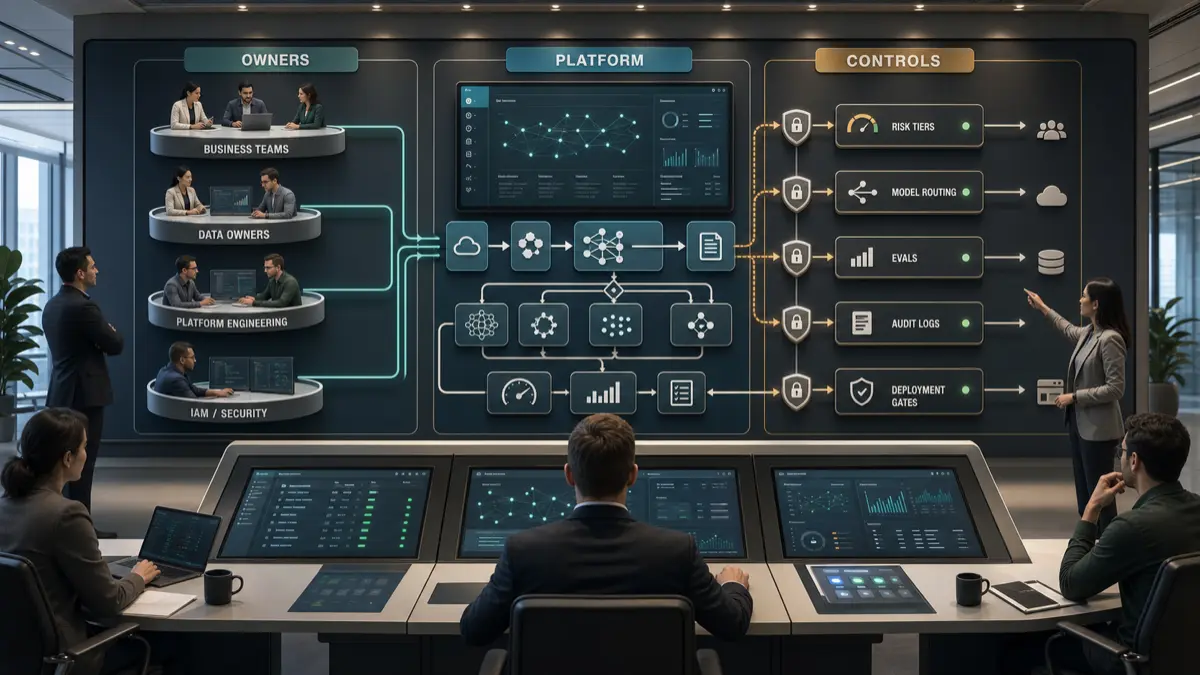
Enterprise AI transformation fails when the CIO treats AI as a portfolio of prototypes instead of a production operating model.
The problem is not only model quality. It is ownership. It is intake. It is platform reuse. It is access control. It is evals. It is cost control. It is incident response. It is the difference between a team that can demo AI and an organization that can safely run AI across business processes.
The practical question for a CIO, enterprise architect, CISO, or AI platform leader is:
What operating model lets the enterprise ship AI workflows repeatedly without turning every use case into a custom governance negotiation?
The CIO should build a center of enablement around a shared AI platform control plane, not a central approval office that tries to own every prompt and every workflow. The target operating model needs productized platform services, explicit control owners, risk-tiered delivery paths, embedded business ownership, and evidence that survives audit, rollback, and incident response.
The operating model turns the controls covered in AI governance architecture, AI ownership models, RAG governance, safe tool registries, data classification, and AI incident response into a repeatable delivery path.
The operating model in one paragraph
A CIO target operating model for enterprise AI is the organizational and technical system that assigns ownership for AI workflows, platform services, risk controls, delivery gates, and production operations. It should combine a central AI platform or center of enablement with embedded business owners, security owners, data owners, IAM owners, and LLMOps owners. The CIO should not approve every AI output manually; the CIO function should provide reusable control-plane services that make governed AI workflows faster to build than unmanaged ones.
Why the CIO cannot scale AI with projects alone
Most enterprise AI programs start as projects:
- a support assistant,
- a contract summarizer,
- a knowledge-base chatbot,
- a coding assistant,
- a finance variance explainer,
- a field-service copilot,
- an HR policy assistant,
- a sales proposal generator.
That is a reasonable starting point. It becomes a trap when each project builds its own identity model, prompt registry, retrieval pipeline, model route, approval logic, monitoring, cost budget, and rollback path.
At that point, the CIO is no longer scaling AI. The organization is scaling exceptions.
The NIST AI Risk Management Framework is useful because it frames AI risk around govern, map, measure, and manage functions across the lifecycle. The translation for CIOs is concrete: if every AI project has to govern, map, measure, and manage similar risks, the enterprise should provide shared services for those controls.
ISO/IEC 42001 describes an AI management system as the organizational elements needed to establish policies, objectives, and processes for responsible AI use. My engineering interpretation is that the management system must land in delivery mechanics: registries, gates, evidence, owners, and operational metrics.
The operating model in one picture
The operating model should separate five layers:
1 | business process owners |
The CIO does not need one giant AI team that owns all of this. The organization needs a clear operating model that decides which parts are centralized, which are embedded, and which are owned by existing control functions.
The center should enable repeatability. The business should keep accountability.
Center of excellence vs center of enablement
The wrong model is a central AI committee that reviews everything and builds nothing reusable.
The better model is a center of enablement that ships shared capability.
| Capability | Center of excellence pattern | Center of enablement pattern |
|---|---|---|
| Governance | policy reviews and slide decks | control plane, registries, gates, evidence |
| Delivery | expert team builds custom prototypes | platform services plus embedded product teams |
| Security | late review before launch | IAM, DLP, tool-risk, and audit controls built into runtime |
| Data | manual source approval per project | source authority register and reusable RAG ingestion path |
| Evals | ad hoc prompt testing | versioned eval suites with release gates |
| Cost | reviewed after spend increases | quotas, model routing, token budgets, chargeback/showback |
| Incident response | undefined AI escalation path | containment levers, audit traces, rollback, severity matrix |
| Success metric | number of prototypes | governed workflows in production with reused controls |
The center of enablement should be judged by how much friction it removes from responsible delivery. A good platform makes the safe path shorter.
The CIO service catalog
The CIO function should turn repeated AI needs into a service catalog. This is where the operating model becomes practical.
| Service | Primary owner | Consumers | Required evidence |
|---|---|---|---|
| Model access gateway | AI platform team | product teams, agents, applications | approved models, risk tier, latency/cost logs |
| Prompt and system-policy registry | LLMOps owner | AI product teams | prompt ID, owner, eval suite, change history |
| RAG ingestion and retrieval service | data platform plus AI platform | workflow teams | source authority, ACL sync, freshness, deletion propagation |
| Data classification policy for AI | data governance plus security | all AI systems | data class, allowed use, retention, DLP rule |
| Tool registry and broker | platform plus system owners | AI agents, workflow automation | tool schema, scopes, approval rule, rollback path |
| Risk-tier intake | AI governance owner | business sponsors | use-case scope, impact, authority, controls required |
| Evaluation harness | AI quality or LLMOps owner | AI product teams | test set, pass/fail thresholds, regression history |
| Human approval workflow | workflow platform owner | high-risk workflows | approval state, reviewer identity, expiration, override rule |
| AI observability and audit | SRE plus security | platform, SOC, compliance | trace ID, tool calls, model route, policy decision |
| Incident containment | security operations plus platform | production AI systems | kill switches, route rollback, tool revocation, evidence pack |
| Vendor/model review | procurement, legal, security | platform and product teams | terms, data boundary, security review, exit plan |
| Cost and quota management | platform plus finance | product teams | budget, usage by workflow, fallback policy |
If a use case needs one of these capabilities and the answer is “the project team will figure it out,” the operating model is not mature enough yet.
Risk-tiered delivery paths
Not every AI workflow deserves the same process.
A summarization assistant over public documentation should move quickly. An agent that can update customer records, issue refunds, modify IAM groups, generate legal commitments, or change production configuration needs stronger controls.
Use risk tiers based on authority, data class, reversibility, external impact, and autonomy.
| Tier | Example | Delivery path | Minimum controls |
|---|---|---|---|
| Tier 0: personal productivity | private drafting, brainstorming, internal note cleanup | employee guidance and approved tools | data-use rules, no restricted data, no system integration |
| Tier 1: read-only assistant | policy search, public/internal knowledge Q&A | lightweight intake | identity, source authority, RAG ACLs, logging, owner |
| Tier 2: decision support | support triage, finance analysis, sales recommendations | product delivery with eval gate | data classification, eval suite, domain owner review, audit trace |
| Tier 3: workflow action | ticket creation, CRM update, draft customer response | approval-gated deployment | tool registry, RBAC/ABAC, human approval, rollback, monitoring |
| Tier 4: high-impact agent | IAM, payment, HR, legal, production operations | formal risk acceptance and security review | separation of duties, policy-as-code, red-team tests, incident runbook |
This is where AI transformation becomes architecture. The intake form is not the control. The tier determines which runtime controls the system must use before launch.
NIST SP 800-207 on Zero Trust Architecture is relevant because AI agents make the old perimeter problem worse. An agent should not become trusted because it runs inside the network or because a user invoked it. Identity and authorization have to be evaluated around each resource, tool, and workflow.
The AI workflow lifecycle
The CIO operating model should define a lifecycle that every production AI workflow follows.
| Lifecycle stage | Decision | Evidence produced |
|---|---|---|
| 1. Intake | Is this a real workflow problem or only a model demo? | sponsor, workflow owner, target process, success metric |
| 2. Risk tiering | What authority, data, and external impact are involved? | tier, data classes, tool classes, approval requirements |
| 3. Architecture | Which platform services and controls are required? | architecture sketch, identities, sources, tools, model route |
| 4. Build | Are prompts, RAG, tools, and policies versioned? | registry entries, schemas, policy versions, test fixtures |
| 5. Evaluate | Does it pass task, safety, security, and regression tests? | eval report, failure review, accepted residual risks |
| 6. Approve | Who accepts workflow risk and production authority? | accountable owner, control owners, approval record |
| 7. Operate | Can the system be observed, contained, and improved? | audit traces, alerts, cost reports, incident hooks |
| 8. Review | Is it still useful, safe, fresh, and economically justified? | adoption metrics, drift review, source freshness, retirement decision |
The NCSC Guidelines for secure AI system development use a lifecycle view across secure design, development, deployment, and operation. That matters for CIOs because AI governance cannot end at launch. The operating model has to own the system after the first release.
RACI matrix for the target operating model
Keep the RACI small enough to use, but specific enough to prevent ambiguity.
| Activity | Accountable | Responsible | Consulted | Informed |
|---|---|---|---|---|
| Prioritize AI portfolio | CIO plus business leadership | AI enablement lead | security, data, finance, enterprise architecture | impacted teams |
| Approve use-case risk tier | AI governance owner | AI product owner | CISO, data owner, process owner | platform team |
| Own business outcome | business process owner | AI product owner | CIO, operations, legal if needed | users |
| Provide model gateway | AI platform owner | LLMOps/platform engineering | security, procurement, finance | product teams |
| Onboard data source | business data owner | data platform owner | privacy, security, knowledge owner | AI product team |
| Approve tool authority | system owner plus security owner | tool broker owner | IAM, business owner, platform | AI product team |
| Release eval gate | AI quality owner | LLMOps owner | business reviewer, security | platform owner |
| Monitor production workflow | operations owner | SRE/platform team | security operations, AI product owner | business owner |
| Contain AI incident | CISO or incident owner | AI incident commander | platform, data owner, process owner | CIO |
| Retire AI workflow | business process owner | platform owner | data owner, security, compliance | users |
The operating model fails when the AI platform team becomes the default owner for every row. Platform owns shared capability. Business owns consequences. Security owns security controls. Data owners own source authority. The CIO owns the system that makes those responsibilities work together.
What belongs in the AI platform team
The platform team should not build every AI application.
It should build the boring, reusable pieces that every serious AI application needs:
- model access gateway,
- prompt and policy registry,
- model routing and fallback,
- approved provider integrations,
- RAG ingestion patterns,
- vector index isolation and metadata contracts,
- tool registry and tool broker,
- identity and session propagation,
- policy-as-code integration,
- evaluation harness,
- red-team and abuse-case test fixtures,
- observability, audit, and replay traces,
- cost, quota, and latency controls,
- deployment gates and rollback,
- incident containment levers.
The OWASP AI Agent Security Cheat Sheet is especially useful for this operating model because agent risk is not theoretical. Tool security, least privilege, human-in-the-loop controls, monitoring, data protection, and adversarial validation all need owners and release gates.
What belongs in embedded teams
Embedded business or product teams should own the workflow.
They should know:
- the decision being changed,
- the exception path,
- the human role,
- the source of truth,
- the process metric,
- the customer or employee impact,
- the acceptable failure mode,
- the adoption plan,
- the decommissioning trigger.
This is why pure centralization fails. The platform team can make model access reliable, but it cannot decide whether an HR assistant should answer a sensitive policy question, whether a support copilot may propose a refund, or whether a field-service agent may create a work order automatically.
AI transformation is process redesign with software controls. The CIO function can provide the machine, but the business must own the changed work.
Operating metrics that matter
CIOs should stop reporting AI progress mainly as prototype count.
Use metrics that prove the operating model is becoming more capable:
| Metric | Why it matters |
|---|---|
| Production AI workflows by risk tier | separates safe experimentation from operational transformation |
| Reuse rate of platform services | shows whether the center of enablement is actually enabling |
| Time from intake to safe production | measures delivery friction without ignoring controls |
| Percentage of workflows with named owners | exposes accountability gaps |
| Percentage of workflows with eval gates | prevents launch-by-demo |
| High-risk tool calls with valid approvals | proves authority controls are enforced |
| RAG sources with owner, classification, and freshness | measures knowledge governance |
| AI incidents and near misses by class | creates feedback for architecture improvement |
| Cost per workflow and cost per useful transaction | avoids token spend masquerading as adoption |
| Human override and correction rate | detects workflow mismatch and model drift |
| Decommissioned or redesigned workflows | rewards lifecycle management, not accumulation |
The best metric is not “how many people used the chatbot.” The better metric is “which business process now runs with a better control surface than before?”
Common failure modes
| Failure mode | Symptom | Operating-model fix |
|---|---|---|
| Prototype theater | many demos, few production workflows | risk-tiered intake and production readiness gates |
| Central bottleneck | every team waits for AI experts | reusable platform services and embedded product ownership |
| Shadow AI backlash | uncontrolled tools trigger blanket bans | approved tools, data-use rules, monitoring, enablement |
| Permission laundering | assistant exposes data through inherited access | identity propagation, ABAC, RAG ACL checks, audit |
| Tool authority sprawl | agents gain broad API scopes | tool registry, least privilege, approval gates |
| Evals as decoration | tests measure tone but not workflow risk | task, security, data, and regression eval suites |
| Unowned knowledge | stale documents become authoritative | source owner, freshness rule, deletion propagation |
| Cost surprise | token spend grows without workflow value | quotas, model routing, showback, cost per transaction |
| Incident confusion | nobody can contain or replay behavior | trace schema, incident roles, rollback levers |
Most of these failures are not model failures. They are operating-model failures.
A practical first 90 days
Do not start by creating a 40-page AI governance manual.
Start with a narrow operating model that can ship.
- Create an AI workflow inventory with owner, risk tier, data classes, tools, model provider, and production status.
- Define four or five risk tiers based on data sensitivity, action authority, external impact, and reversibility.
- Stand up the minimum AI platform control plane: approved model gateway, prompt registry, RAG source registry, tool registry, eval harness, audit trace.
- Pick two production workflows: one read-only knowledge workflow and one approval-gated action workflow.
- Assign control owners for IAM, data classification, tool authority, eval gates, observability, cost, and incident response.
- Build one reusable intake-to-release path instead of treating the pilot as a special case.
- Review the first two workflows for missing owners, slow gates, false approvals, logging gaps, and cost surprises.
The objective is not to freeze innovation. The objective is to make the next governed workflow cheaper than the first one.
Make governed delivery the default
The CIO target operating model for AI should make a simple promise:
If a team wants to redesign a business process with AI, there is a known path from idea to production, with reusable platform services, named owners, proportionate controls, measurable evidence, and a rollback path.
That is the difference between AI experimentation and AI transformation.
The enterprise does not need more isolated demos. It needs an operating model that makes useful AI boring enough to run.