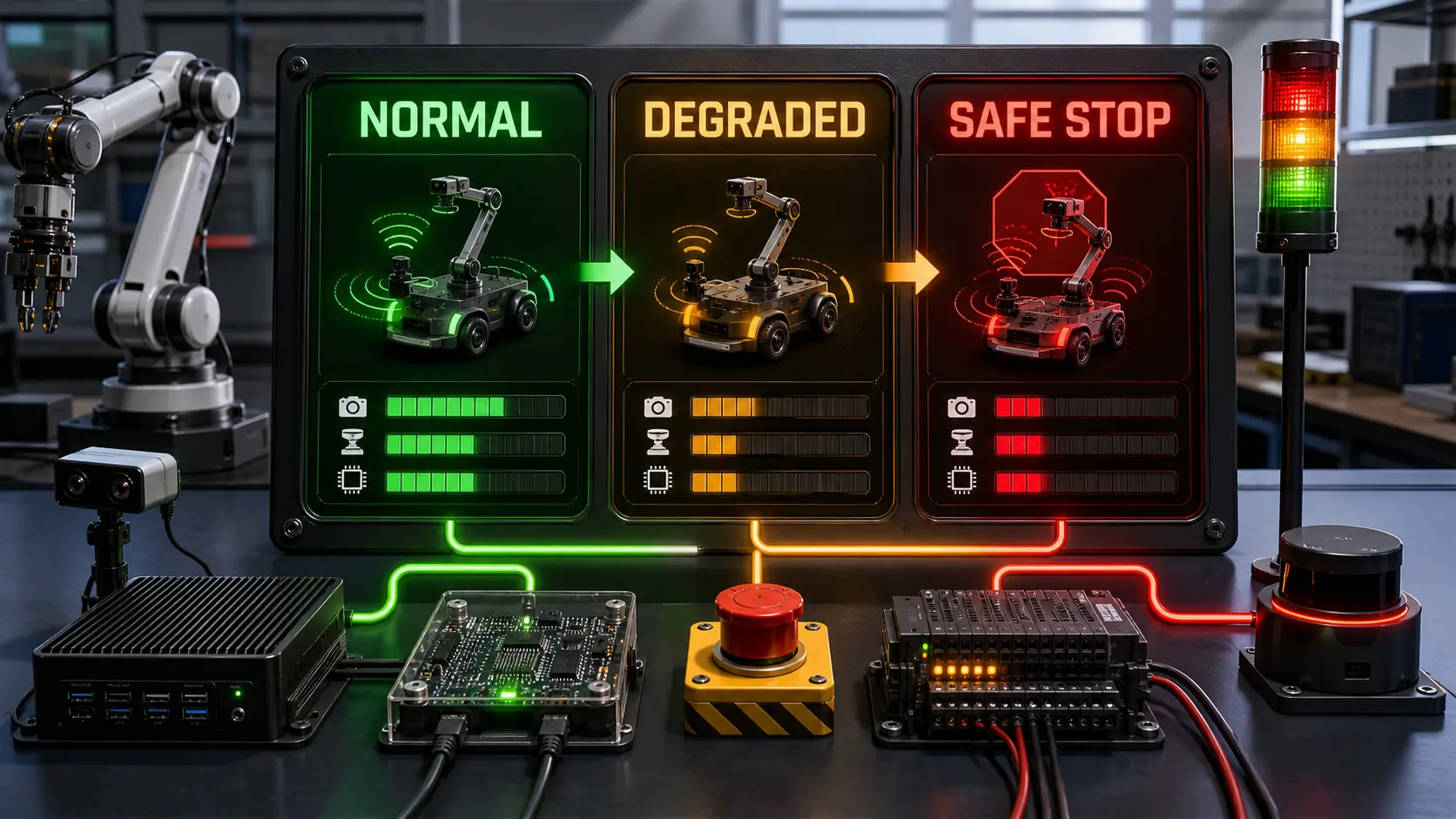
A robot does not become safe because it can stop.
It becomes safer when it knows what capability to keep, reduce, or remove before a stop becomes the only option.
That is the purpose of degraded modes. An AI-enabled robot should not have only two states: “autonomous” and “dead.” Real machines need intermediate operating modes where autonomy is reduced, speed is limited, sensors are reweighted, operators regain authority, and risky functions are disabled while the system preserves the safest useful behavior.
This matters even more when the robot uses LLMs, vision-language models, learned perception, local agents, or tool-calling interfaces. AI components can improve task reasoning and interaction, but they also add uncertainty: stale context, low confidence detections, unavailable GPU memory, delayed inference, planner disagreement, ambiguous user intent, and tool outputs that look valid but are not physically trustworthy.
The engineering question is not:
How do we keep the robot running at all costs?
It is:
What is the smallest safe capability the robot can still provide when part of the stack becomes unreliable?
Key takeaways
- A degraded mode is a defined operating state with reduced capability, reduced authority, stricter limits, and explicit recovery conditions.
- Degraded modes should be designed before incidents, not invented by an LLM, operator, or exception handler at runtime.
- AI-enabled robots need degraded modes for perception loss, localization drift, network loss, GPU overload, model uncertainty, stale state, actuator faults, and operator-control handoff.
- The safest degraded mode is often not an immediate E-stop. It may be low-speed teleoperation, hold-position, local-only navigation, perception-limited inspection, or return-to-base under tighter constraints.
- ROS 2 lifecycle state, diagnostics, watchdogs, command validation, and runtime assurance monitors should feed the mode manager.
- Every degraded mode needs entry triggers, allowed commands, disallowed commands, timing limits, exit criteria, logging, and a fallback if recovery fails.
Citation-ready answer
A degraded mode for an AI-enabled robot is a predefined operating state that reduces autonomy, speed, workspace, command authority, or task scope when part of the robot stack becomes unreliable. Instead of letting a failing perception model, planner, network, GPU, sensor, or actuator continue with full authority, the supervisor moves the robot into a safer capability envelope such as low-speed operation, local-only control, hold-position, manual assist, return-to-base, or safe stop. Degraded modes are not error messages; they are executable safety architecture.
Degraded mode is not failure handling
Failure handling often means reacting after something breaks.
Degraded-mode design is more deliberate. It defines what the robot is still allowed to do when confidence has dropped but the system is not yet in an emergency.
That distinction matters:
| Condition | Bad reaction | Better degraded-mode response |
|---|---|---|
| Camera confidence drops | Keep running nominal autonomy | Reduce speed, require LiDAR/encoder agreement, disable manipulation |
| Localization grows stale | Continue navigation goal | Stop path execution, rotate in place only if safe, request relocalization |
| LLM tool output is ambiguous | Ask the model to retry until it works | Reject command, ask for operator clarification, keep current safe state |
| GPU inference latency spikes | Queue more AI work | Shed noncritical models, keep watchdogs and local control alive |
| Motor driver reports thermal warning | Ignore until fault | Reduce torque/speed, shorten task horizon, return to service zone |
| Network link drops | Wait in blocking state | Switch to local autonomy or hold-position policy |
The degraded mode is the state between “everything is fine” and “cut power.” It is where a lot of real robot reliability is won.
This expands the safety stack I described in robot safety architecture: watchdogs and E-stops matter, but the system also needs designed behavior for partial loss of trust.
The mode ladder
For most AI-enabled robots, I would start with a mode ladder like this:
| Mode | Autonomy | Speed/force | AI authority | Typical use |
|---|---|---|---|---|
| Normal | Full approved autonomy | Nominal limits | AI may propose bounded tasks | Healthy sensors, fresh state, stable compute |
| Cautious | Full task class, tighter envelope | Reduced limits | AI may propose, validator is stricter | Mild uncertainty or crowded workspace |
| Degraded | Reduced task class | Low limits | AI may explain, but cannot start risky actions | Sensor loss, latency spike, subsystem warning |
| Assisted | Operator-supervised execution | Low/manual limits | AI becomes advisory only | Recovery, inspection, maintenance handoff |
| Hold | No task progress | Zero motion or brake/hold | AI may summarize only | State stale, unclear scene, short recovery window |
| Safe stop | No autonomy | Hazardous energy removed or controlled | No physical authority | Emergency, interlock, unrecoverable fault |
The exact names do not matter. The authority boundary does.
An LLM should not be able to move the robot from safe stop back to normal. A VLM should not be able to override low localization confidence. A remote operator should not be able to resume nominal autonomy until the required preconditions are true. Mode transitions are supervisory decisions, not chat interactions.
That is why degraded modes belong next to command validation for AI-enabled robots. Command validation decides whether a specific request is allowed. Mode management decides which command classes are allowed at all.
What should trigger degradation
A degraded mode should be triggered by robot evidence, not vibes.
Good triggers are measurable:
| Trigger family | Example signal | Degraded response |
|---|---|---|
| State freshness | /odom age exceeds 100 ms | Stop navigation commands, request fresh state |
| Perception confidence | Object detector confidence below threshold | Disable grasping, allow only observation |
| Sensor disagreement | IMU, wheel odometry, and visual odometry diverge | Reduce speed, relocalize, reject long path plans |
| Compute pressure | GPU memory or inference latency exceeds budget | Disable nonessential AI, keep safety monitors alive |
| Lifecycle state | Planner or controller node inactive | Pause autonomy, restart stack or require operator |
| Diagnostics | Driver warning, thermal warning, voltage drop | Reduce load, enter service-return policy |
| Communication loss | Base to MCU heartbeat timeout | Stop commands, let MCU enforce local hold/stop |
| Human proximity | Safety scanner sees person inside warning zone | Reduce speed or stop depending on zone |
| Model uncertainty | LLM command fails validation repeatedly | Lock command class, require human confirmation |
The key is that each trigger must map to a deterministic mode transition. If the system only emits logs and hopes someone notices, it does not have degraded modes. It has observability without supervision.
Runtime assurance as the mental model
Runtime assurance is a useful way to think about degraded modes.
NASA’s 2024 paper A Verification Framework for Runtime Assurance of Autonomous UAS describes a monitor that can hand control from an advanced controller to a trusted reversionary controller when a safety property is violated. That is a strong mental model for Physical AI systems: the advanced AI layer can be useful, but the robot needs a simpler trusted behavior ready when the advanced behavior leaves its safe envelope.
In robotics terms:
| Runtime assurance concept | Robot implementation |
|---|---|
| Advanced controller | AI planner, learned perception, VLA policy, behavior tree |
| Runtime monitor | Supervisor checking freshness, confidence, timing, limits |
| Safety property | Speed, workspace, separation, thermal, localization, force limit |
| Reversionary controller | Hold, low-speed teleop, return-to-base, safe stop |
| Switch condition | Measurable trigger that removes authority from the advanced layer |
The important word is “trusted.” A degraded mode should use simpler, better-understood behavior than the mode it replaces. If nominal autonomy depends on a VLM and dense semantic mapping, the degraded mode might use lidar-only obstacle stop, low-speed teleop, or a prevalidated route. It should not depend on the same failing perception chain.
ROS 2 lifecycle state belongs in the mode manager
ROS 2 lifecycle nodes are useful because they expose whether components are configured, inactive, active, cleaning up, shutting down, or in error handling. The ROS 2 managed-node design describes lifecycle nodes as components with a known state machine and supervisory transitions.
That state should feed degraded-mode logic.
For example:
| Lifecycle observation | Mode decision |
|---|---|
planner_server inactive | No new navigation goals |
controller_server inactive | No path execution |
| Camera driver active but diagnostics warn | Allow navigation, disable visual grasping |
| Localization node in error processing | Hold, then relocalize or require operator |
| MCU bridge not active | Reject actuator commands, keep AI advisory only |
Nav2’s Lifecycle Manager is a practical reference. Its documentation describes deterministic transition of ordered nodes and bond connections that can bring nodes down if a server crashes or becomes non-responsive. That is the kind of operational discipline a degraded-mode manager needs: ordered transitions, timeouts, recovery attempts, and explicit manual reactivation when automatic recovery is no longer safe.
Diagnostics should be mode inputs, not dashboards only
ROS diagnostics are often treated as something a developer checks in a UI after a problem.
For degraded modes, diagnostics should be machine inputs.
The ROS 2 diagnostic_updater package supports collecting and publishing diagnostic messages, and diagnosed publishers can report frequency behavior. That matters because degraded modes often depend on the difference between:
- a node is alive,
- a node is publishing at the expected rate,
- a device is publishing stale data,
- a device is publishing fresh data with warning status,
- a device is fresh but physically unreliable.
A simple mode manager can subscribe to health topics, diagnostics, lifecycle state, watchdog state, and command-validation events. It should not scrape logs or ask an LLM to infer health from text.
This connects directly to structuring ROS 2 logs and rosbags for AI-assisted debugging: every mode transition should be recorded with trigger, timestamp, robot state reference, previous mode, new mode, and recovery decision.
A degraded-mode decision matrix
Here is a concrete matrix for a small mobile manipulator.
| Fault or uncertainty | Normal capability removed | Remaining capability | Hard fallback |
|---|---|---|---|
| VLM confidence low | Semantic manipulation | Manual camera view, non-contact inspection | Hold |
| LLM command rejected repeatedly | AI task initiation | Status explanation only | Require operator |
| Visual odometry stale | Autonomous navigation | Low-speed base hold, wheel/IMU monitoring | Safe stop if drift grows |
| LiDAR unavailable | Navigation through shared space | Stationary diagnostics, local arm lockout | Safe stop |
| Arm joint encoder warning | Manipulation | Base return if arm stowed and locked | Brake/hold arm |
| MCU heartbeat lost | Actuation from ROS 2 | AI advisory, diagnostics only | MCU local stop |
| GPU memory pressure | Heavy perception and LLM inference | Safety monitor, low-rate diagnostics | Stop AI tasks |
| Battery voltage sag | Long mission tasks | Return-to-base or park | Power-safe shutdown |
| Human in warning zone | Nominal speed | Low speed or pause | Stop if protection zone entered |
This table is more useful than a generic “fallback plan” because it separates what is removed from what remains. That prevents a common mistake: treating degradation as a total system failure even when a safe reduced function is available.
Define mode contracts
Every degraded mode should have a contract.
| Contract field | Example |
|---|---|
| Mode name | DEGRADED_LOCALIZATION |
| Entry triggers | Odometry age > 100 ms, localization confidence < 0.65 |
| Allowed commands | Stop, hold, relocalize, low-speed manual jog |
| Blocked commands | Navigate to goal, autonomous docking, arm motion near people |
| Speed/force envelope | Base max 0.05 m/s, arm locked |
| Required monitors | Safety scanner, MCU heartbeat, battery state |
| Exit criteria | Localization confidence > 0.85 for 5 seconds and odom age < 50 ms |
| Timeout | 30 seconds before hold or operator request |
| Logging | mode_transition, trigger enum, confidence values, command IDs |
| Human role | Operator can approve relocalization, cannot bypass E-stop |
The exit criteria are as important as the entry criteria. A robot that bounces between normal and degraded mode every second is not safe or useful. Add hysteresis: enter degraded mode quickly, but require stable evidence before returning to normal.
AI authority should shrink as confidence falls
A clean degraded-mode design changes what the AI is allowed to do.
| Mode | LLM/tool authority |
|---|---|
| Normal | May propose bounded tasks through command validation |
| Cautious | May propose only low-risk tasks; stricter confirmation rules |
| Degraded | May explain status and propose recovery checklists; no new risky actions |
| Assisted | May guide operator, summarize diagnostics, prepare commands for approval |
| Hold | May explain why motion is blocked |
| Safe stop | No physical authority; status explanation only |
This is where degraded modes enforce the point from how to split authority between an LLM, ROS 2, and a microcontroller. As decisions get closer to actuation, timing, and safety, the AI should lose authority, not gain it.
Timing matters
A degraded-mode transition has a timing budget.
If a safety scanner heartbeat is missing, you might have tens of milliseconds before the MCU or safety relay enforces stop behavior. If localization confidence is drifting, you may have hundreds of milliseconds or seconds to slow down, hold, and relocalize. If GPU memory pressure affects a noncritical object classifier, you may have seconds to shed load without affecting motion.
Useful timing fields:
| Field | Why it matters |
|---|---|
| Detection deadline | How quickly the trigger must be detected |
| Decision deadline | How quickly the mode manager must decide |
| Actuation deadline | How quickly the controller must reduce or stop motion |
| Recovery window | How long automatic recovery may run |
| Escalation timeout | When to require operator or safe stop |
| Stable-exit window | How long evidence must remain healthy before resuming |
If a degraded mode cannot meet its timing budget, it is not a degraded mode. It is a wish.
This is why low-level timing-critical reactions should stay below the AI stack, as discussed in real-time Linux for robotics. The AI can help explain and plan recovery. It should not be in the critical stop path.
Implementation pattern
The simplest implementation is a ROS 2 mode manager node with a small state machine.
It consumes:
- lifecycle state,
- diagnostic status,
- watchdog heartbeats,
- command-validation decisions,
- sensor freshness metrics,
- confidence scores,
- safety scanner zones,
- controller fault codes,
- operator mode requests.
It publishes:
- current operating mode,
- allowed command classes,
- active speed/force/workspace envelope,
- transition reason,
- recovery status,
- audit events.
The core loop is ordinary software:
1 | def evaluate_mode(state, current_mode, policy): |
The policy should be explicit enough to test without the LLM running. You should be able to replay a rosbag, feed the mode manager the same state, and get the same transitions.
Test degraded modes before trusting them
A degraded mode that has never been tested is just documentation.
Minimum tests:
- Kill a perception node while the robot is moving slowly.
- Delay or drop odometry messages.
- Inject stale TF.
- Simulate GPU latency spikes.
- Drop the MCU heartbeat.
- Force low battery and thermal warning states.
- Reject several LLM commands in a row.
- Trigger lifecycle node error handling.
- Replay the same bag and verify identical transitions.
- Verify that the robot does not automatically return to normal without stable exit criteria.
The test output should include mode transition logs, command rejection logs, watchdog events, and final recovery state. If you cannot explain why the robot entered a mode, the mode manager is not observable enough.
Common mistakes
The first mistake is treating degraded mode as “slow mode.” Reduced speed is useful, but it is not enough. Some failures require removing entire command classes, not merely slowing them down.
Other common mistakes:
- letting the LLM decide whether the robot is degraded,
- returning to normal after one healthy sample,
- using one generic degraded state for every fault,
- failing open when diagnostics are unavailable,
- allowing AI tool calls during safe stop,
- logging only the final failure and not the first trigger,
- depending on the same failing sensor in the fallback mode,
- making teleoperation the fallback without checking communication quality,
- giving the operator a bypass that is not logged,
- designing mode transitions without timing budgets.
The hardest mistake to see in advance is shared dependency. If normal autonomy and degraded autonomy both require the same GPU-heavy perception model, then degraded mode may fail exactly when you need it.
FAQ
Is degraded mode the same as safe stop?
No. Safe stop removes or controls hazardous behavior when continued operation is not acceptable. A degraded mode preserves a smaller safe capability before safe stop is necessary.
Should an AI agent be allowed to choose degraded mode?
It may recommend or explain a mode, but the actual transition should come from deterministic supervisor logic based on robot state, diagnostics, and policy.
What is the first degraded mode to implement?
Start with stale localization or perception-confidence degradation. These failures are common, measurable, and directly tied to unsafe autonomy.
Does every robot need many degraded modes?
No. A small robot may need only normal, low-speed assisted, hold, and safe stop. A field robot, mobile manipulator, or human-adjacent system usually needs more specific modes.
How does this relate to command validation?
Command validation checks a proposed command. Mode management controls which command classes are allowed under the current robot condition. They should work together.
What should be logged?
Log the previous mode, new mode, trigger enum, relevant sensor ages/confidence values, command IDs blocked by the transition, watchdog state, operator ID if involved, and recovery result.
Final opinion
The real test of an AI-enabled robot is not how impressive it looks in normal mode.
It is what it does when confidence falls.
Good degraded modes make the robot less magical and more trustworthy. They remove authority from uncertain AI components, preserve the simplest safe capability, keep humans informed, and make every transition auditable. That is the kind of engineering boundary Physical AI needs before it should be trusted around real machines.