
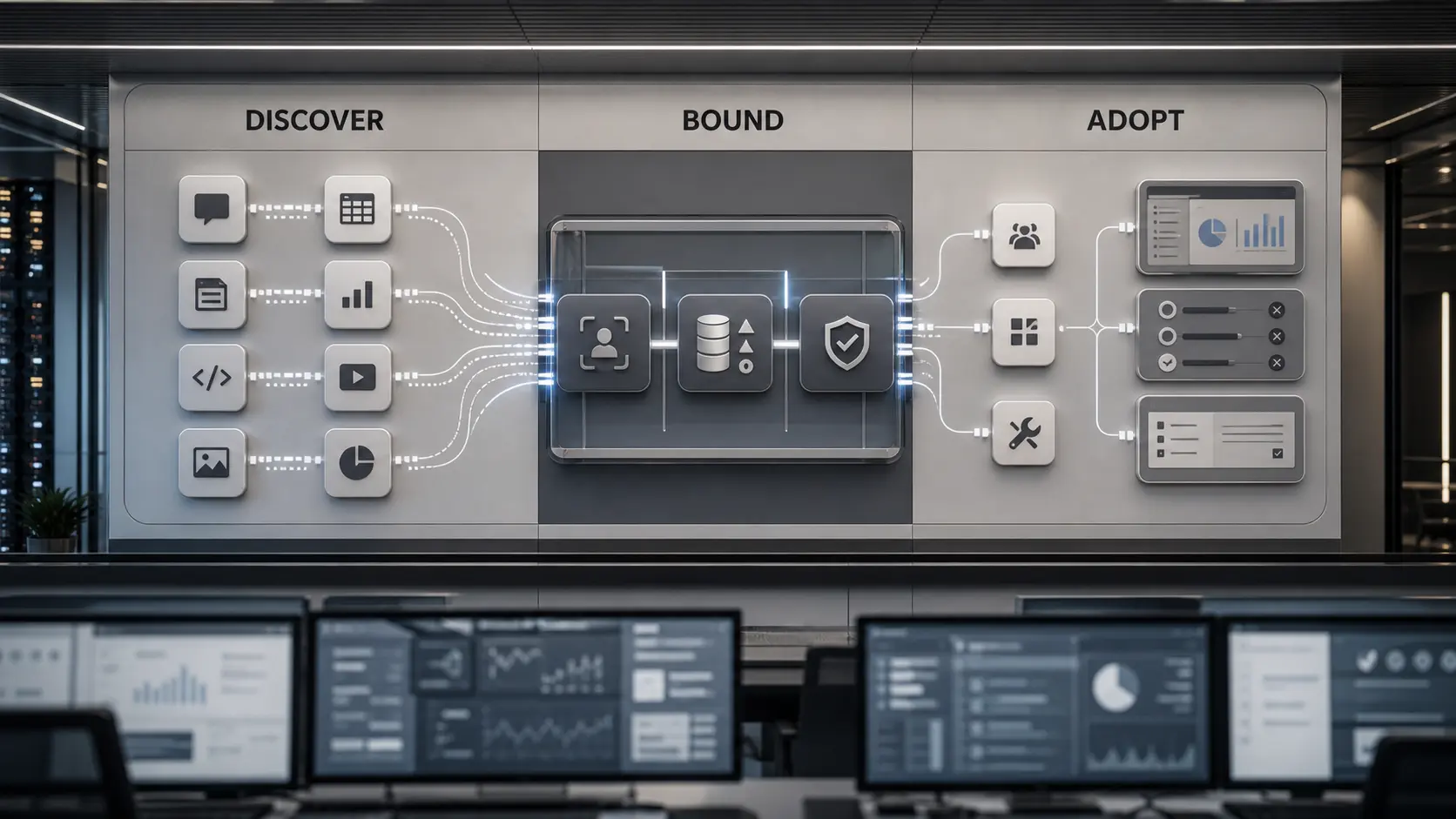
Shadow AI is not mainly a policy failure. It is an architecture feedback signal.
When employees paste sensitive context into unmanaged AI tools, install browser extensions, connect unreviewed copilots to SaaS systems, or build small agents with personal API keys, the organization has learned something important: the official path is slower, less useful, or less available than the work people are trying to do.
The governance response should not be blanket prohibition. It should be a control architecture that discovers real usage, separates low-risk experimentation from dangerous execution, gives teams approved paths, and preserves enough evidence for security, compliance, and business ownership to act.
The practical question for CIOs, CISOs, enterprise architects, and AI platform teams is this:
How do we turn unsanctioned AI use into managed adoption without giving every team a permanent exception?
The answer is not a longer acceptable-use PDF. The answer is an operating loop: discover usage, classify the data and authority involved, decide the disposition, route the team to an approved pattern, and measure whether the sanctioned path is actually absorbing demand.
This post builds on the control-plane ideas in AI governance architecture, Zero Trust for enterprise AI agents, data classification for enterprise AI assistants, safe tool registries, threat modeling enterprise AI agents, and agent audit logs. Shadow AI is where those controls meet real adoption pressure.
Define The Control Objective
Shadow AI governance has one primary objective:
1 | Keep useful AI adoption inside observable, owned, least-privilege patterns. |
That sentence matters because it avoids two common mistakes.
The first mistake is treating all unsanctioned AI use as equally dangerous. A marketing analyst using a public chatbot to rewrite non-sensitive copy is not the same risk as an operations analyst uploading customer exports to an unmanaged model, or an engineer giving an agent access to production repositories and shell commands.
The second mistake is treating discovery as the end state. A dashboard that lists AI apps is useful only if it feeds decisions: allow, warn, migrate, contain, block, approve, or retire.
NIST AI RMF is helpful here because it frames AI risk management as an ongoing govern, map, measure, and manage loop. For shadow AI, those verbs translate into a concrete enterprise workflow:
1 | discover usage |
NIST’s Generative AI Profile adds the GenAI-specific layer: risk management has to follow the lifecycle of systems that create content, synthesize data, and mediate decisions. That is why shadow AI governance must track purpose, exposed sources, output use, and downstream authority rather than only the vendor name.
If that loop does not exist, the organization will oscillate between permissive chaos and unrealistic bans.
Inventory Signals Before You Design Controls
Do not start by asking every team to fill in a spreadsheet. Start with signals the environment already produces, then use human intake to explain the unknowns.
A useful shadow AI inventory combines at least six sources:
| Signal source | What it can reveal | What it cannot prove |
|---|---|---|
| CASB or secure web gateway logs | visits to generative AI apps, browser upload patterns, unsanctioned domains | business purpose, exact data sensitivity |
| Endpoint DLP | sensitive text copied or uploaded into AI sites, local file movement | whether the AI output was used operationally |
| SaaS audit logs | installed AI extensions, connected apps, OAuth grants, anomalous API usage | whether the model influenced a decision |
| Identity provider logs | new app registrations, consent grants, service accounts, risky sign-ins | whether the app is AI-enabled unless enriched |
| Code and package scanning | AI SDKs, agent frameworks, vector database clients, MCP servers, prompt files | production usage without deployment context |
| Expense and procurement data | paid AI subscriptions and department-level demand | free tools, personal accounts, technical scope |
Microsoft’s current Purview Data Security Posture Management documentation is a useful example of the direction enterprise tooling is taking: AI observability, sensitive interactions, app and agent inventories, and activity exploration are becoming security operations inputs. The exact product is less important than the pattern. AI usage needs to become an observable enterprise activity, not a rumor collected during quarterly reviews.
Inventory should produce a normalized record, not a screenshot:
1 | { |
The record is intentionally operational. It gives security, platform engineering, and the business owner enough information to decide what happens next.
Use A Disposition Matrix, Not A Binary Ban
The core artifact is a disposition matrix. It turns discovered usage into a repeatable decision.
| Shadow AI pattern | Main risk | Default disposition | Required migration path |
|---|---|---|---|
| Public prompt with non-sensitive text | inaccurate output, policy misunderstanding | allow with guidance | approved prompt guidance and training |
| Public prompt with confidential text | data leakage, retention exposure | warn or block depending on data class | enterprise assistant with DLP and retention controls |
| AI meeting note taker without review | consent, recording, data retention | review before broader use | approved meeting AI with retention and access rules |
| Browser extension connected to SaaS | OAuth sprawl, data exfiltration, supply-chain risk | contain until reviewed | sanctioned extension or approved API integration |
| Team-built RAG over shared drives | oversharing, stale sources, broken ownership | migrate | governed RAG pattern with source authority and access inheritance |
| Agent with write access to business systems | excessive agency, identity abuse, incident impact | block or isolate until redesigned | tool broker, policy gate, approval flow, audit trace |
| Developer agent with shell, repo, and package access | supply-chain compromise, secret exposure, unauthorized changes | restrict by environment | sandboxed coding environment, secrets boundary, CI gates |
| AI workflow affecting customers or finance | business harm, accountability gap | formal approval required | workflow risk tier, human approval, rollback, incident runbook |
This matrix should be versioned and reviewed. It should also be visible to teams. People behave better when they can see the path to approval.
The point is not to normalize unsafe behavior. The point is to give the organization a way to say “yes, but through this path” more often than it says “no” without explanation.
Separate Data Exposure From Action Authority
Shadow AI risk has two axes:
1 | What can the AI see? |
Many governance programs collapse those axes into a single risk label. That creates bad decisions.
A tool that sees highly confidential source code but cannot write anything has a different risk profile from a low-context agent that can send external emails, modify a CRM record, or run a deployment command. The first is primarily a data protection and retention problem. The second is an authority and accountability problem. A system can be low-risk on one axis and high-risk on the other.
Use a two-axis map:
| Data exposure | Action authority | Example | Control posture |
|---|---|---|---|
| Public | No action | rewriting public documentation | guidance and output review |
| Internal | No action | summarizing internal policies | approved assistant, access inheritance, logging |
| Confidential | No action | summarizing contracts or support records | DLP, retention, source ownership, restricted model route |
| Internal | Low-risk action | creating draft tickets | tool registry, scoped identity, standard audit |
| Confidential | Customer-visible action | drafting and sending a customer response | approval gate, redaction, enhanced audit, rollback path |
| Privileged | Administrative action | changing IAM, finance, production, or security settings | deny by default, formal workflow, separation of duties |
This split is where the earlier articles on data classification and safe tool registries connect. Data controls decide what context can enter the model. Tool controls decide which operations can leave the model boundary and touch enterprise systems.
Build Approved Paths That Are Easier Than Workarounds
If every AI request goes through a six-week review board, shadow AI will continue. The sanctioned path has to be easier than the workaround for common use cases.
Create a small service catalog:
| Approved path | Good for | Built-in controls |
|---|---|---|
| Approved general assistant | low-risk drafting, summarization, brainstorming | SSO, retention policy, acceptable data classes, audit metadata |
| Governed RAG assistant | internal knowledge search and synthesis | source authority, access inheritance, freshness checks, citation metadata |
| Business workflow copilot | task preparation and case work | workflow state, owner, approval rules, tool registry |
| Agent sandbox | experiments with tools, code, or workflows | isolated environment, fake data, synthetic credentials, cost limits |
| Production agent path | repeatable business process automation | risk tier, identity delegation, policy-as-code, audit logs, rollback |
The service catalog should include two things teams rarely get from policy documents: a default answer and an upgrade path.
For example:
- “Use the approved assistant for public and internal drafting.”
- “Use the governed RAG template for internal knowledge bases.”
- “Use the sandbox when a model needs tools.”
- “Use the production agent path when an AI workflow can write, send, approve, change, deploy, refund, or escalate.”
That phrasing gives practitioners something to do Monday morning.
Make Exception Handling Explicit
Some shadow AI exists because a team has a legitimate need that the platform does not yet support. Those cases need temporary exceptions, not permanent loopholes.
A good exception record includes:
| Field | Why it matters |
|---|---|
| Business owner | accountability for the use case |
| Technical owner | person responsible for integration behavior |
| Data owner | approval for exposed sources and classes |
| Security reviewer | threat model and control gap decision |
| Expiry date | prevents forgotten exceptions |
| Allowed users | prevents uncontrolled expansion |
| Allowed data classes | keeps usage inside known boundaries |
| Model or service route | records where data is processed |
| Tool authority | distinguishes read-only from action-capable use |
| Compensating controls | DLP, masking, manual approval, sandboxing, logs |
| Migration target | approved path that will replace the exception |
No exception should be approved without an expiry date and migration target. Otherwise the exception becomes the architecture.
Put Enforcement At The Right Boundaries
Shadow AI governance fails when enforcement lives only in one place.
Blocking every AI domain at the firewall misses approved APIs, browser extensions, personal devices, SaaS plugins, and code-level SDK usage. Reviewing every app manually misses runtime drift. Writing a policy without telemetry misses reality.
Use layered enforcement:
1 | identity provider |
The NCSC secure AI system development guidelines organize secure AI work across design, development, deployment, and operation. That lifecycle view is important for shadow AI because the risk is rarely confined to a single launch decision. Usage expands, plugins change, prompts become templates, data sources grow, and a harmless assistant can become a workflow engine.
For agents specifically, the OWASP AI Agent Security Cheat Sheet is a good practical reference because it treats tool security, least privilege, prompt injection defense, memory security, human oversight, output validation, monitoring, and adversarial testing as architecture concerns. Those are exactly the control categories that shadow AI bypasses when teams self-provision agents.
Govern The Lifecycle, Not Just The Tool
A common failure mode is to approve an AI product name rather than an AI use case.
That is too coarse. The same tool can be safe for one workflow and unsafe for another. A model used to summarize public documentation is not the same system when it receives confidential HR records, can query a vector index, stores memory, or calls ticketing and email APIs.
Use lifecycle states:
| State | What is allowed | Promotion gate |
|---|---|---|
| Discovered | observed use, no approval implied | owner identified |
| Triaged | business purpose and risk axes documented | data and authority classified |
| Allowed low-risk | bounded use may continue | guidance accepted and monitored |
| Migrating | team is moving to approved pattern | migration owner and deadline |
| Sandbox | experimentation allowed with fake or approved data | threat model for production |
| Production candidate | repeatable workflow under review | controls, evals, audit, rollback tested |
| Approved production | governed use under operating controls | periodic recertification |
| Retired or blocked | usage no longer permitted | access revoked and evidence retained |
The promotion gates are where architecture beats policy. They ask whether the system has the right controls for its current power.
Assign Ownership By Control Surface
Shadow AI governance breaks when “the AI committee” owns everything. The work needs named owners by control surface.
| Control surface | Accountable owner | Supporting teams |
|---|---|---|
| AI use-case register | CIO or AI platform leader | enterprise architecture, business owners |
| Data classification and source approval | data owner | security, privacy, records management |
| Identity and app registration | IAM owner | platform engineering, security architecture |
| DLP and endpoint policy | security operations | compliance, legal, IT operations |
| Model gateway and retention | AI platform team | security, legal, procurement |
| RAG source authority | business data owner | platform engineering, knowledge management |
| Tool registry and broker | platform engineering | application owners, security |
| Approval workflows | business process owner | risk, compliance, IT |
| Audit evidence and incident response | CISO organization | platform, legal, business owner |
| Adoption metrics | CIO organization | finance, product, business operations |
This ownership model prevents a familiar deadlock: security says the business owns the risk, the business says IT owns the platform, and IT says legal owns the policy. Each control needs an accountable owner and an operating mechanism.
Measure Absorption, Not Just Violations
The best shadow AI metric is not the number of blocked prompts. It is the rate at which real demand moves into governed paths.
Track:
- discovered AI apps and agents by department,
- sensitive-data interactions by data class,
- unmanaged OAuth grants and service accounts,
- number of use cases migrated to approved assistants, RAG patterns, or workflow copilots,
- median time from intake to approved low-risk use,
- median time from sandbox request to production decision,
- exceptions opened, expired, renewed, and retired,
- repeat violations after an approved alternative exists,
- incidents or near misses tied to unmanaged AI,
- platform gaps inferred from repeated shadow patterns.
If violations stay high while the approved platform is slow, the control program is producing evidence against itself. The architecture should change.
Implementation Checklist
Use this as the first 90-day build sequence:
- Create a shadow AI inventory schema with business purpose, data class, identity mode, tool authority, owner, evidence source, and disposition.
- Connect at least three discovery signals: secure web gateway or CASB, endpoint DLP, and identity provider app-consent logs.
- Define the two-axis risk map: data exposure and action authority.
- Publish a disposition matrix that distinguishes allow, warn, migrate, sandbox, contain, block, and approve.
- Stand up a low-friction approved assistant for low-risk drafting and summarization.
- Provide a governed RAG template with source ownership, access inheritance, freshness, and audit metadata.
- Create an agent sandbox for tool-use experiments with synthetic data and no production credentials.
- Route action-capable workflows through a tool registry, policy gate, approval flow, and audit trace.
- Require expiry dates and migration targets for exceptions.
- Report absorption metrics to the CIO and CISO monthly: demand discovered, demand migrated, risks contained, platform gaps found.
Do not wait for a perfect enterprise AI platform before starting this loop. The first version can be simple. What matters is that every discovered use case has a path, every risky path has an owner, and every owner can see what decision was made.
The Real Governance Test
The test of shadow AI governance is not whether the organization can say “no.” Most organizations can say no. The harder test is whether they can absorb useful demand fast enough that teams stop needing workarounds.
That requires architecture: identity boundaries, data classification, approved model routes, RAG source authority, tool registries, approval workflows, audit logs, and incident response hooks. It also requires an operating model that treats shadow AI as a signal for platform design, not just employee behavior.
When the governed path becomes faster than the workaround, adoption and control stop fighting each other.