
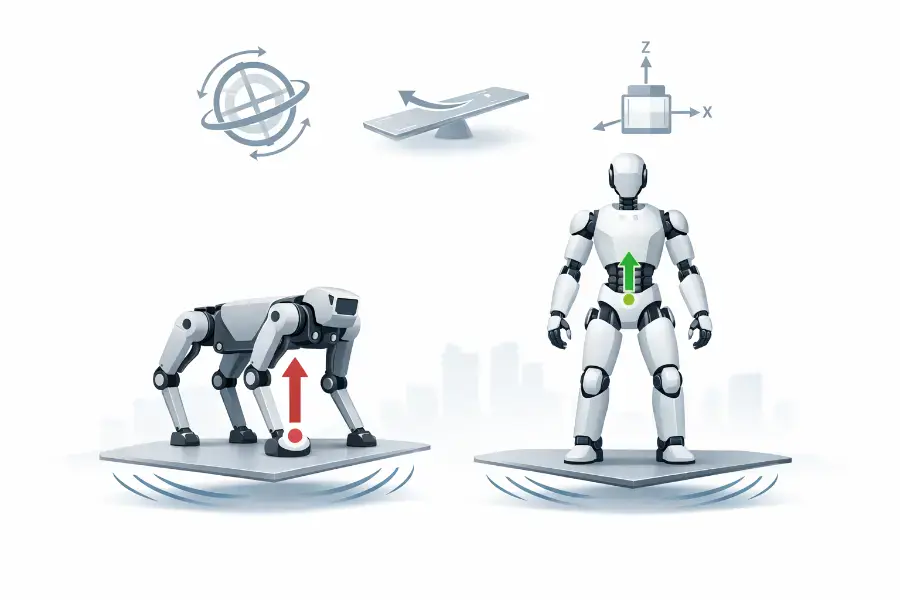
Legged robots look magical when they recover from a shove, step over debris, or keep walking on uneven ground. But their balance is not magic. It is the result of layered engineering: mechanics, sensing, estimation, dynamics, control, planning, and increasingly learning.
This matters because balance is not just a locomotion problem. It is the foundation that makes a quadruped inspect industrial sites, a humanoid carry boxes in a warehouse, or a mobile manipulator interact safely with the physical world. If balance fails, everything above it fails too.
In this article, I will go deep into how quadruped and humanoid robots stay balanced, what the main control strategies are, where the current state of the art is heading, and where the real limitations still are. I will also connect the topic to robotics platforms, cyber-physical systems, and Physical AI, because in practice balance is never a single algorithm. It is an entire closed-loop system.
If you are new to this broader stack, these articles give useful context:
- What is a Cyber-Physical System?
- Physical AI Explained: What It Really Means for Robotics and Cyber-Physical Systems
- PID vs MPC in Robotics: A Practical Guide for AI Engineers
- World Models in Robotics: How Robots Learn to Predict the Future
- What Is a Digital Twin in Robotics (And What It Is Not)
- The Real Role of LLMs and Other AI Models in a Cyber-Physical System
- What Is Sensor Fusion in Robotics? How Robots Combine IMUs, Cameras, Encoders, and GPS
- ROS 2 Architecture Patterns That Scale
- Real-Time Linux for Robotics
What robot balance actually means
For a legged robot, balance means keeping the full body in a dynamically controllable state while interacting with the ground through intermittent contacts.
That definition is important.
A robot does not stay balanced simply by keeping its torso visually upright. A robot is balanced when it can keep or recover a physically feasible motion under:
- gravity,
- inertia,
- contact constraints,
- actuator limits,
- friction limits,
- sensor uncertainty,
- computation and communication delays,
- and external disturbances.
In other words, balance is the ability to keep the system inside a region of recoverable trajectories.
For a static robot, that may reduce to a geometric condition: keep the center of mass projection inside the support polygon. For a dynamic legged robot, that is not enough. Once the robot moves fast, changes contact mode, swings limbs aggressively, or uses arms while walking, balance becomes a trajectory feasibility problem.
That is why modern legged robots are not controlled by one simple loop. They are usually controlled by a stack, and that stack sits squarely inside a cyber-physical system where sensing, compute, timing, and actuation all matter at once.
The balance stack: the real architecture behind stable legged robots
In practice, quadrupeds and humanoids stay balanced through a layered architecture:
- Mechanical design: mass distribution, joint placement, transmission stiffness, foot geometry, and actuator bandwidth.
- Low-level servo control: torque, current, impedance, or position loops running at high frequency.
- State estimation: fusing IMU, joint encoders, foot contacts, force sensing, and sometimes vision or LiDAR.
- Reduced-order dynamics control: center of mass, centroidal momentum, Zero Moment Point, Capture Point, or Divergent Component of Motion.
- Whole-body control: solving for joint accelerations, torques, and contact forces that satisfy task priorities and physical constraints.
- Footstep or contact planning: deciding where and when to place feet.
- High-level behavior generation: gait switching, task coordination, terrain adaptation, manipulation intent.
- Learning components: RL policies, learned terrain estimators, motion priors, disturbance models, or policy adaptation.
The exact split varies by platform, but the principle is the same: balance emerges from coordinated control across multiple time scales.
If you work with production robot software, this layered structure should look familiar. It maps naturally onto the kind of runtime decomposition I described in ROS 2 Architecture Patterns That Scale: device interfaces, estimation, control, planning, and supervision are different concerns for a reason.
Why quadrupeds are usually easier than humanoids
Quadrupeds and humanoids solve the same physics problem, but not with the same margins.
Quadrupeds have four main structural advantages:
- a larger support polygon,
- more contact redundancy,
- lower center of mass relative to the base footprint,
- and less severe underactuation during many gaits.
That is why quadrupeds often reach robust field deployment earlier. They can tolerate moderate modeling errors, modest terrain uncertainty, and imperfect state estimation more gracefully.
Humanoids are harder because they operate in a morphology optimized for human environments, not for control simplicity. They are tall, top-heavy, strongly coupled, and often underactuated at the floating base. During walking, they repeatedly enter phases where the support polygon is small, sometimes effectively a line or a point during transitions. Add arm motion, object carrying, narrow footholds, and compliance, and the control problem becomes much harsher.
So when people ask why quadrupeds seem more robust today, the answer is partly software but also fundamentally morphology.
The core physics: center of mass, momentum, and contacts
At the heart of robot balance are three quantities:
1. Center of mass (CoM)
The CoM is the weighted average position of the robot’s mass. If the robot were static, balance could be approximated by keeping the CoM projection inside the support area.
That idea is still useful, but dynamic locomotion needs more.
2. Centroidal momentum
Centroidal momentum captures the linear and angular momentum of the whole robot around its center of mass. This is one of the most useful abstractions in modern legged robotics because it connects full-body motion to contact forces in a compact form.
When a robot swings a leg, twists the torso, or moves its arms, it changes its momentum. Balance control must manage those momentum changes, not just body pose.
3. Contact wrench feasibility
The robot can only influence its motion through contact forces and torques that are physically feasible:
- the foot must actually be in contact,
- friction cones must not be violated,
- normal forces cannot pull the ground,
- joint torque limits must be respected,
- and the resulting motion must remain dynamically realizable.
This is why balance is deeply tied to contact modeling.
The classic concepts: support polygon, ZMP, Capture Point, DCM
Before going into modern controllers, it helps to understand the conceptual tools that shaped the field.
Support polygon
The support polygon is the convex region spanned by the active ground contacts. In quasi-static motion, keeping the CoM projection inside this region is a simple stability heuristic.
Useful, but limited.
It breaks down for running, jumping, fast push recovery, and highly dynamic gait transitions.
Zero Moment Point (ZMP)
ZMP is one of the most influential concepts in humanoid balance. Informally, it is the point on the support surface where the net tipping moment is zero.
If the ZMP stays inside the support polygon, then the contact forces are consistent with non-tipping motion under the assumptions of the model.
ZMP worked extremely well for the generation of stable walking patterns in many classic biped systems, especially with linear inverted pendulum approximations. It remains an important conceptual and engineering tool.
But ZMP has limits:
- it assumes contact conditions that may be too simple,
- it is less expressive for highly dynamic whole-body behaviors,
- it does not fully capture swing-limb effects and upper-body coupling,
- and it is not sufficient for complex multi-contact interactions.
Capture Point and Divergent Component of Motion (DCM)
A more dynamic view is the Capture Point: the point where the robot needs to step to come to a stop, under simplified dynamics.
This is powerful for push recovery. If a disturbance pushes the robot beyond what ankle torques can handle, stepping becomes the recovery strategy. Capture Point and DCM formulations make that explicit.
For humanoids, these ideas are especially important because recovery often depends on timely foot placement, not just posture correction.
Model choices: from inverted pendulums to full rigid-body dynamics
One of the most important engineering decisions is the model used by the controller.
Reduced-order models
These include:
- Linear Inverted Pendulum Model (LIPM)
- Spring-loaded inverted pendulum variants
- Single rigid body models for quadrupeds
- Centroidal models
Why use them?
Because they are fast enough for real-time optimization. They reduce the dimensionality of the problem and allow MPC or preview control to run online.
For quadrupeds, the single rigid body model is particularly common. It ignores detailed leg dynamics and focuses on the trunk plus contact forces. This is often enough for planning and force distribution.
Full-body rigid dynamics
For precision, the robot also needs full kinematics and dynamics:
- joint limits,
- self-collision,
- torque limits,
- limb inertia,
- contact Jacobians,
- internal force distribution,
- and task couplings.
That is where whole-body control enters.
The best practical systems combine both worlds:
- a reduced model for fast predictive planning,
- and a full-body controller for execution.
This hybrid split is one of the most important recurring themes in modern robotics. It is also why world models in robotics are so interesting: they extend the predictive layer, but they do not eliminate the need for hard real-time physical control.
State estimation: the hidden hero of robot balance
People often focus on locomotion policies, but many failures are estimation failures.
A legged robot must estimate, in real time:
- base orientation,
- base position and velocity,
- joint states,
- foot contact states,
- sometimes terrain height and surface normal,
- and sometimes external disturbances.
This is harder than it sounds because a floating-base robot cannot directly measure its base pose in the same way a fixed industrial arm can.
Typical inputs include:
- IMU data,
- joint encoders,
- foot force sensors or contact switches,
- motor current estimates,
- cameras,
- depth sensors,
- LiDAR,
- and occasionally GPS or UWB outdoors.
A very common pattern is contact-aided inertial estimation. When a foot is believed to be stationary on the ground, it becomes a temporary anchor for state estimation. But this is fragile on slippery, soft, or moving terrain.
That is why contact estimation is itself a hard problem. Misclassify contact, and your state estimate drifts. Drift the state estimate, and your controller commands the wrong reaction forces. Once that happens, “balance” may collapse even if the control law is theoretically sound.
In cyber-physical systems terms, balance depends on observability as much as on control. If you want a broader view of this stack, my article on sensor fusion in robotics goes much deeper into how robots combine IMUs, cameras, encoders, and other signals into usable state estimates.
Whole-body control: balance is a constrained optimization problem
Whole-Body Control (WBC) is where modern humanoids and advanced quadrupeds become truly interesting.
Instead of controlling each joint independently, WBC solves for a coordinated full-body action that satisfies multiple tasks and constraints at once.
A typical WBC formulation may include:
- torso orientation tracking,
- center of mass regulation,
- swing foot tracking,
- hand pose control,
- contact force consistency,
- friction cone constraints,
- torque limits,
- joint acceleration limits,
- posture regularization,
- and task priorities.
Mathematically, this is often expressed as a hierarchical quadratic program or a stack of optimization problems.
That matters because legged robots rarely do only one thing. A humanoid may need to:
- keep balance,
- walk,
- move an arm,
- avoid joint singularities,
- and maintain contact consistency,
all at the same time.
WBC is the framework that lets these objectives coexist.
For humanoids, this is essential. Arm motion can destabilize the rest of the body. Carrying a load changes the CoM. Leaning to reach an object modifies feasible foot forces. A controller that ignores full-body coupling will fail quickly.
MPC: why prediction matters so much
Model Predictive Control (MPC) has become one of the central tools for balancing legged robots.
The key idea is simple: at each cycle, predict future robot motion over a short horizon, optimize control actions under constraints, apply the first action, then solve again.
Why is this so good for legged locomotion?
Because balance is inherently predictive.
A legged robot must anticipate:
- where the body momentum is going,
- whether the current contacts can sustain it,
- where the next foot should land,
- and whether torque and friction limits will be violated.
MPC handles that naturally.
For quadrupeds, MPC is commonly used to optimize:
- contact forces,
- footstep timing,
- gait schedules,
- body motion,
- and sometimes energy use.
For humanoids, MPC often works on reduced-order dynamics, previewing CoM evolution, DCM behavior, or centroidal momentum while a lower-level controller executes the motion.
This is one of the reasons I wrote a full article on PID vs MPC in robotics. Once constraints, delays, contacts, and future feasibility matter, predictive control becomes far more natural than classic local servo reasoning alone.
Impedance control and compliance: balance is not only about rigid tracking
Real robots operate in the real world, not in a clean simulator.
That means they need compliance.
Impedance control shapes the dynamic relationship between motion error and applied force. Instead of aggressively forcing the body to exact trajectories, the robot behaves like a controlled spring-damper in selected directions.
This helps because:
- terrain is uncertain,
- contact impacts are imperfectly modeled,
- force sensing is noisy,
- and rigid control can amplify shocks.
Well-designed impedance behavior makes the robot more tolerant to contact uncertainty and more physically safe.
The tradeoff is precision. Too soft, and the robot becomes sloppy or unstable. Too stiff, and it becomes brittle.
This tuning problem is still more art than many people admit.
Learning-based balance: what RL and foundation models are changing
The field is clearly moving toward hybrid systems that mix model-based control and learning.
Reinforcement learning for locomotion
RL has shown impressive results for:
- rough terrain traversal,
- recovery policies,
- agile gait transitions,
- adaptation to disturbances,
- and robust motor policies trained across domain randomization.
In simulation, RL can discover surprisingly effective strategies for quadrupeds and humanoids. Large-scale GPU simulation platforms are accelerating this trend.
Where learning helps most today
The strongest near-term use of learning is usually not “replace all control theory.” It is:
- learn residual corrections on top of model-based control,
- adapt gains or gait parameters,
- estimate terrain properties,
- infer contact events,
- generate reusable motion priors,
- and compress complex whole-body strategies into deployable policies.
Foundation models and general whole-body control
Recent work is pushing beyond single-task locomotion toward more general whole-body behavior models, especially for humanoids.
That is exciting because the real challenge is not merely “walk on flat ground.” It is to transition between locomotion, balance recovery, manipulation, crouching, turning, stepping over clutter, and interacting with human-scale environments.
That broader trend also connects naturally to vision-language-action models in robotics, but we should be realistic: these systems are not replacing hard constraints, safety envelopes, real-time servo loops, or contact mechanics. At least not in serious deployments.
If you are interested in that broader perspective, see my article on the real role of LLMs and other AI models in a cyber-physical system and also why LLMs should not control motors and robots. Intelligence in robotics is layered. It does not erase the physics layer.
The real limits of current robot balance systems
This is where the discussion needs honesty.
Robots today are much better at staying balanced than five years ago. But they are still far from “solved.”
1. Contact uncertainty remains brutal
Most controllers still rely on assumptions that become fragile on:
- mud,
- wet floors,
- gravel,
- deformable surfaces,
- ladders,
- cables,
- and partially compliant industrial structures.
Ground truth contact conditions are rarely known perfectly.
2. State estimation drift is still a major bottleneck
Especially in visual degradation, dust, vibration, repetitive textures, or dynamic lighting, estimation quality drops.
When people see a robot “mysteriously” fall, it is often not one bad control equation. It is a degraded estimate propagating through the loop.
Again, this is why sensor fusion is not a side topic. It is a core enabler of stable locomotion.
3. Sim-to-real is improving, but the gap is real
A policy that works beautifully in simulation may fail because of:
- actuator dynamics mismatch,
- latency mismatch,
- joint backlash,
- cable flex,
- thermal effects,
- unmodeled compliance,
- or imperfect friction.
That is why simulation matters so much, but also why digital twins must be treated as engineering tools, not magical replicas.
4. Humanoid balance under manipulation is still hard
Walking alone is one problem. Walking while carrying, reaching, twisting, or colliding lightly with the environment is a much harder multi-contact problem.
This is one of the main reasons why useful industrial humanoids are still an active frontier.
5. Formal guarantees are limited
For many learning-based systems, robustness is empirical rather than certified.
That is acceptable in research and perhaps some bounded industrial contexts, but it becomes much harder in high-assurance domains.
6. Compute, timing, and middleware matter
Balance is a real-time problem.
If the sensing pipeline, estimator, controller, and actuator commands are not synchronized with predictable latency, performance degrades quickly. In distributed cyber-physical systems, middleware jitter, time sync drift, and unreliable communications can become control problems.
This is why robotics is not just AI. It is systems engineering. If this part resonates, Real-Time Linux for Robotics and ROS 2 Architecture Patterns That Scale are directly relevant follow-ups.
Use cases: where balance quality directly changes product value
Now let’s go from theory to applications.
Quadruped robot use cases
Industrial inspection
Quadrupeds are already useful in plants, energy facilities, tunnels, and construction-like environments because they can traverse stairs, gratings, uneven paths, and narrow walkways better than many wheeled systems.
Good balance here means:
- fewer teleoperation interventions,
- safer autonomy around obstacles,
- better sensor placement stability,
- and more reliable mission completion.
This is also exactly the kind of deployment where Physical AI becomes concrete: the robot must sense, reason, act, and recover under physical constraints, not just classify images.
Defense, security, and hazardous environment access
In uncertain terrain, balance is mission-critical. A robot that can recover from slips, partial footholds, and disturbances is fundamentally more useful than one that only performs well on flat lab floors.
Mapping and data collection in hard terrain
Stable locomotion improves perception quality. Less body oscillation and fewer recovery events mean cleaner sensor trajectories and better mapping.
That loops back to sensor fusion and to the broader architecture of perception-centric robotics systems.
Humanoid robot use cases
Warehouse and logistics manipulation
Humanoids are interesting when the environment is already built for people. Shelves, stairs, handles, pallets, totes, and workstations all favor human-like reach and mobility.
But the balancing problem becomes harder because the robot must move arms and body while maintaining stable contact.
General-purpose industrial tasks
A humanoid that can walk to a workstation, bend, grasp, carry, turn, and place objects without falling is effectively solving a whole-body balance-plus-manipulation problem.
That is why whole-body control and prediction are central to industrial humanoid development.
Human-centered service environments
Hospitals, hotels, eldercare, and domestic environments all contain clutter, narrow clearances, and dynamic human motion. Balance quality determines not only task success but also perceived safety.
This is also where vision-language-action models become strategically interesting: not as replacements for control, but as higher-level interfaces layered above stable embodied execution.
Robotics and cyber-physical systems use cases
This is the part many articles miss.
Balance is not only about the robot body. In cyber-physical systems, balance quality affects the entire system architecture.
Closed-loop digital twins
A high-fidelity digital twin can be used to:
- validate controllers,
- test disturbance recovery,
- stress estimation pipelines,
- and rehearse contact-rich tasks before deployment.
For legged systems, this is especially valuable because physical failure is costly. That is also why I keep insisting that a digital twin in robotics is useful precisely when it improves real engineering decisions.
Runtime monitoring and anomaly detection
Balance controllers generate rich telemetry:
- estimated base states,
- contact probabilities,
- friction margin usage,
- torque reserve,
- MPC residuals,
- optimizer convergence quality.
These are powerful signals for runtime health monitoring.
Fleet operations and remote supervision
For robot fleets, balance quality influences mission scheduling, risk scoring, and operational autonomy. A robot with poor estimated traction or unstable estimator confidence should not be sent into the same tasks as one operating within strong margins.
Safety envelopes for Physical AI
As robots become more autonomous, balance constraints become part of the safety layer. A high-level AI agent may request a task, but the motion stack must still reject commands that violate contact or stability limits.
That is a core cyber-physical design pattern, and it sits directly in the intersection of Physical AI, CPS architecture, and the correct role of LLMs in robotics.
State of the art in 2026: what is actually changing
The broad trend is not one silver bullet. It is convergence.
The strongest systems now combine:
- reduced-order predictive control,
- whole-body constrained optimization,
- improved state estimation,
- high-throughput simulation,
- learned adaptation,
- and broader behavior models.
For quadrupeds, the field is pushing toward better disturbance rejection, rough-terrain robustness, adaptive MPC, and tighter fusion of learned and model-based methods.
For humanoids, the frontier is general whole-body control rather than isolated walking demos. The hard problem is coordinated locomotion, balance recovery, and manipulation across many tasks and environments.
That direction aligns with the broader Physical AI shift: robots are moving from scripted behaviors to reusable embodied priors trained in simulation and refined in the real world.
Still, the execution stack remains deeply control-centric.
My practical view: how to think about robot balance without hype
If I had to summarize it simply:
- Classical control gives structure.
- State estimation gives observability.
- MPC gives foresight.
- Whole-body control gives coordination.
- Learning gives adaptation and scale.
- Systems engineering makes it real.
The mistake is to think one of these replaces the others.
A humanoid or quadruped stays balanced because the entire stack is aligned: sensors, clocks, estimators, models, controllers, planners, actuators, and runtime software.
That is exactly why this topic sits at the intersection of robotics, AI, and cyber-physical systems. It is also why posts like PID vs MPC in Robotics, Real-Time Linux for Robotics, ROS 2 Architecture Patterns That Scale, and World Models in Robotics all connect back to the same operational truth: good robots are layered systems, not isolated algorithms.
Final thoughts
How quadruped and humanoid robots stay balanced is one of the best examples of what modern robotics really is.
It is not “just AI.”
It is not “just control theory.”
It is not “just hardware.”
It is the disciplined integration of all three.
Quadrupeds currently benefit from friendlier morphology and have therefore reached robust deployment faster in many field scenarios. Humanoids, however, remain strategically important because the world is built for human form factors. That means the pressure to solve humanoid balance at scale will only increase.
The next few years will likely bring better hybrid controllers, broader motion priors, richer simulation pipelines, and tighter safety layers between high-level AI and low-level balance control. But the laws of mechanics are not going away.
The robots that succeed will not be the ones with the most impressive demo video. They will be the ones with the most reliable closed-loop balance stack in the messy, delayed, noisy, contact-rich real world.
If this article matches the way you think about robotics, you will probably also enjoy my deeper pieces on Physical AI, sensor fusion, world models, digital twins, ROS 2 architecture, and why LLMs should not directly control motors.
FAQ
Do humanoid robots use ZMP today?
Yes, ZMP remains an important concept and still influences planning and control design, especially in humanoid locomotion. But modern systems often combine it with centroidal models, MPC, whole-body optimization, and learned components.
Are quadrupeds easier to balance than humanoids?
Usually yes. Four-legged morphology provides larger support regions and more contact redundancy, which generally makes robust locomotion easier than in tall, top-heavy bipeds.
Is reinforcement learning enough to keep a robot balanced?
Not by itself in most serious systems. RL can be extremely useful, but real deployments still depend heavily on state estimation, control constraints, actuator limits, and safety layers.
What is the biggest hidden challenge in robot balance?
State estimation and contact uncertainty. Many apparent control failures are actually sensing, observability, or timing failures propagating through the loop. That is why articles like What Is Sensor Fusion in Robotics? and Real-Time Linux for Robotics matter much more than they first appear.
Why does balance matter for cyber-physical systems?
Because balance is a closed-loop systems problem. It depends on sensing, timing, communications, compute, control, and physical interaction all working together under real-world constraints. In other words, it is exactly the kind of problem that defines a cyber-physical system.