
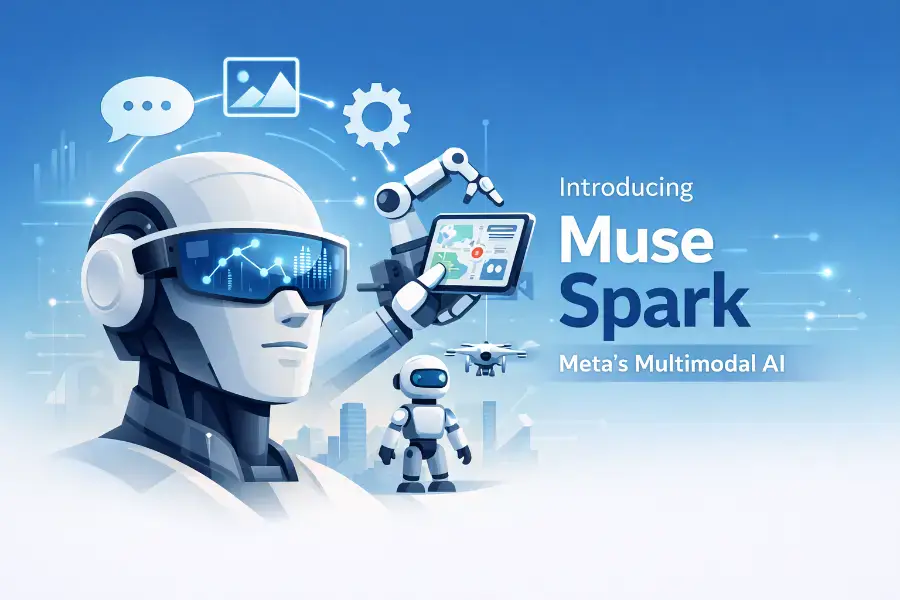
On April 8, 2026, Meta released Muse Spark, the first model in its new Muse family and the first major model launch from Meta Superintelligence Labs.
This is not just another chatbot release.
Muse Spark matters because it shows a real shift in how Meta now wants to compete: not only through base-model capability, but through a full multimodal, tool-using, product-integrated AI runtime. Meta describes Muse Spark as a natively multimodal reasoning model with tool use, visual chain of thought, and multi-agent orchestration. In plain English, that means Meta is no longer aiming only for “a model that writes text well.” It is aiming for a system that can see, reason, plan, call tools, split work into subproblems, and return a synthesized answer.
That is a much bigger architectural signal than a benchmark screenshot.
My take is simple: Muse Spark is not the final answer, but it is a very serious reset for Meta. It looks much stronger than the company’s recent AI narrative suggested. It is also a good excuse to step back and ask a bigger question:
What kind of model stack actually matters in 2026?
Because the frontier is clearly moving away from pure text generation and toward multimodal, agentic, compute-adaptive systems. And once you care about real products, real interfaces, and eventually the real world, that shift becomes even more important.
If you have been following my recent writing on the real role of LLMs and other AI models in a cyber-physical system, what Physical AI actually means, or why world models matter in robotics, Muse Spark fits directly into that broader evolution.
1. What Muse Spark actually is
Meta’s own positioning is unusually revealing.
Muse Spark is described as:
- a new multimodal reasoning model
- the first model in the Muse series
- small and fast by design
- able to reason through science, math, and health
- integrated into Meta AI
- deployed with Instant and Thinking modes
- capable of launching multiple subagents in parallel
- rolling out across Meta AI, WhatsApp, Instagram, Facebook, Messenger, and AI glasses
- available in private preview via API to selected partners
That list matters because it tells us Muse Spark is not being presented as a single monolithic “answer engine.” It is being presented as a runtime system.
That distinction is important.
A classic LLM story is mostly about pretraining scale, parameter count, and next-token quality. A runtime-system story is about something broader:
- perception
- reasoning
- tool access
- decomposition
- synthesis
- latency and cost control
- product integration
That is much closer to how real AI products are built in 2026.
Meta is also explicit that Muse Spark is the first step of a larger scaling program. The company says it rebuilt its AI stack over the last nine months, views Muse Spark as an early data point in a more deliberate scaling strategy, and already has larger models in development.
That matters because Muse Spark looks less like a one-off model drop and more like a new development line.
2. Why this launch matters technically
The biggest signal here is not “Meta has a new model.”
The biggest signal is what kind of model it chose to launch first.
Muse Spark is not positioned as the biggest possible flagship with maximum brute-force reasoning. Instead, it is positioned as a fast, efficient, multimodal reasoning model that can be deeply embedded into products.
That choice says a lot.
2.1 Multimodality is becoming the default interface
The model is designed to work with text and images, and Meta’s product examples are clearly camera-native:
- comparing products from a scan
- estimating calories from a meal photo
- understanding charts and health visuals
- grounding responses in what the user is looking at
- eventually doing this through AI glasses
This is exactly where the market is going.
The old chat interface assumed the user would translate reality into text. That is a bad interface. The better interface is increasingly:
the model looks at the world with you
That is why multimodal systems matter so much beyond “cool demos.” They collapse the gap between human context and machine input.
This is also why I found Qwen 3.5 VLM’s agent-native multimodal direction so interesting recently. The core shift is the same: the model is not only reading instructions, it is interpreting a mixed input stream of text, images, UI state, and tool context.
2.2 Inference-time compute is becoming a first-class design axis
Meta’s Instant vs. Thinking split is not just a product detail.
It reflects one of the most important frontier trends right now: model quality increasingly depends on how intelligently the system spends compute at inference time, not only on pretraining.
The frontier used to be dominated by a relatively simple assumption:
bigger pretrained model = better output
That is no longer enough.
Now the real game includes:
- dynamic reasoning budgets
- adaptive search depth
- iterative self-improvement
- parallel subagents
- tool-augmented planning
- cost-aware response shaping
In other words, quality is becoming a property of the whole inference policy, not just the frozen base model.
That is one reason Muse Spark’s reported token efficiency is interesting. Independent testing suggests it is relatively efficient for its intelligence level, which is strategically important because real adoption is constrained by latency, cost, and serving efficiency, not just benchmark glory.
2.3 Multi-agent orchestration is finally moving from demo gimmick to product primitive
Meta’s subagent story is easy to dismiss as marketing unless you think about the task structure.
Many real tasks are naturally decomposable:
- compare multiple destinations
- evaluate multiple product options
- draft alternatives
- gather evidence from multiple sources
- separate planning from validation
- reconcile conflicting criteria
A single forward pass is often not the best computational pattern for these problems.
A multi-agent pattern does not magically create intelligence. But it can improve performance when:
- the task is structurally decomposable
- intermediate outputs can be checked
- different subtasks benefit from different retrieval or reasoning behavior
- synthesis is easier than solving the whole problem in one pass
This is also why I still like modular orchestrations in practice. In my own multi-agent architecture write-up, the interesting part was never “many agents are cooler than one.” The interesting part was that decomposition created better controllability, validation, and reliability.
Muse Spark seems to move in that same direction, but inside a much larger consumer product surface.
3. What Meta has not told us
This part matters.
Meta has not publicly disclosed Muse Spark’s parameter count or detailed architecture. It is also not open weights, which is a major break from the Llama playbook.
That means any technical reading beyond the official feature set is partly inferential.
So here is the honest framing:
We can say a lot about the system-level direction.
We cannot yet say much with confidence about the low-level architecture.
Still, the product surface gives away some likely design priorities.
3.1 The architecture appears optimized for systems behavior, not just leaderboard theater
Given what Meta disclosed, Muse Spark was likely optimized around a combination of:
- strong multimodal fusion
- efficient reasoning under limited latency
- tool-friendly planning
- agentic decomposition
- product deployment constraints
- controllable response modes
That is very different from optimizing only for “maximum coding score at any cost.”
In fact, Muse Spark’s profile makes much more sense if you view it as a consumer-and-platform model rather than a pure research model. Meta needs a model that can power large-scale assistant experiences inside apps people already use. That means practical constraints dominate:
- response time
- serving cost
- robustness to messy inputs
- grounded visual understanding
- good enough reasoning
- good enough planning
- acceptable safety behavior
- product-grade integration
That is a very different optimization objective from “win the hardest abstract coding benchmark.”
3.2 “Visual chain of thought” is important, but it should be interpreted carefully
Meta says Muse Spark supports visual chain of thought.
That is an interesting phrase, but it should not be read too naively.
What it most likely means at a systems level is that the model can perform more explicit intermediate reasoning over visual inputs than a shallow image-captioning pipeline. It suggests structured internal reasoning over spatial and visual evidence.
What it does not automatically mean is that users get perfect, transparent, externally inspectable reasoning traces.
In practical AI engineering, there is a big difference between:
- richer internal reasoning structure
- trustworthy externally exposed reasoning
So the capability is interesting. The reliability question remains open.
4. Where Muse Spark sits in the state of the art
Independent benchmarking paints a pretty clear picture.
According to Artificial Analysis, Muse Spark scores 52 on its Intelligence Index, placing it in the top five models they have benchmarked. They also report that Muse Spark is the second-most capable vision model they have tested, with 80.5% on MMMU-Pro, and that it performs strongly on reasoning and instruction-following benchmarks such as HLE and CritPT.
That is the good news.
The more nuanced news is that Muse Spark does not appear equally strong everywhere. Artificial Analysis reports that its agentic performance does not stand out, and Reuters similarly reports that the model catches up to leading competitors in areas such as language and visual understanding while still lagging in coding and abstract reasoning.
That benchmark profile is coherent.
Muse Spark looks strongest where these matter:
- multimodal understanding
- visual grounding
- constrained reasoning
- instruction following
- efficient consumer-facing inference
It looks less dominant where these matter more:
- long-horizon coding
- terminal-heavy agent execution
- abstract puzzle-like reasoning
- deeper autonomous work-task performance
That does not make it weak.
It makes it specialized in a strategically sensible way.
If your deployment surface is Meta AI, Instagram, Facebook, WhatsApp, Messenger, and AI glasses, it is more valuable to be extremely good at vision-grounded assistance and consumer multimodal tasks than to be the absolute best at every software-engineering eval.
In other words, Muse Spark looks like a model optimized for the next product interface, not only for the next benchmark war.
If you want a useful comparison point from the open-model side, read my recent article on Gemma 4’s architecture, limits, and real-world use cases. The contrast is instructive: Gemma 4 is interesting because of deployability and openness; Muse Spark is interesting because of product integration, multimodality, and runtime orchestration.
5. The most interesting general use cases
The official Meta demos are not the whole story, but they do reveal the intended operating envelope.
5.1 Camera-native assistance
This is the most obvious one.
Muse Spark is built for situations where the user does not want to describe everything manually. The model sees the shelf, the chart, the product, the meal, the object, or the environment and reasons from there.
That matters for:
- shopping and comparison
- nutrition and health-adjacent assistance
- place discovery
- consumer decision support
- everyday visual Q&A
- wearable assistants
This is especially important for AI glasses. A multimodal model embedded in a wearable interface is a much more natural assistant than a text-only chatbot hidden behind a keyboard.
5.2 Multimodal knowledge work
A more interesting enterprise use case is mixed-input knowledge work.
Many important workflows are not text-only. They involve a combination of:
- screenshots
- dashboards
- charts
- manuals
- photos
- scanned forms
- support tickets
- status logs
- UI states
- natural-language instructions
Muse Spark’s architecture is naturally better suited to these workflows than a pure text LLM.
Potential examples include:
- field-service copilots
- frontline troubleshooting assistants
- support operations
- internal business diagnostics
- visual analytics assistants
- retail intelligence
- operations review tools
- onboarding and process guidance
5.3 Lightweight visual software generation
Meta is explicitly pushing Muse Spark for “visual coding,” including small websites, mini-games, and simple dashboards.
I do not think this means Muse Spark is suddenly the strongest model for serious software engineering. That is not the right interpretation.
The real opportunity is elsewhere:
- rapid prototypes
- internal tools
- interactive mockups
- visual UX scaffolds
- lightweight web apps
- non-expert software creation
That is a huge practical market.
A lot of valuable software is not a hyperscale distributed platform. It is a small tool someone inside a team wishes they had yesterday.
5.4 Socially grounded recommendation and discovery
This is where Meta has an advantage few competitors have.
Meta is tying Muse Spark into the content graph of Instagram, Facebook, Threads, and eventually other surfaces. That opens the door to recommendations and search experiences grounded not only in the open web, but in social context and community-generated signals.
Strategically, that is very powerful.
Technically, it is also risky.
Because “socially grounded” does not automatically mean “true,” “representative,” or “safe.” It means the model gains access to a very rich layer of human context—but one that is noisy, biased, trend-sensitive, and sometimes unreliable.
So the opportunity is real, but so is the failure mode.
6. Why Muse Spark matters for robotics and cyber-physical systems
This is the section I care about most.
Muse Spark is not a robot foundation model in the strict sense. It is not a motor controller. It is not a whole-body policy. It is not a VLA that directly outputs joint trajectories. It is not a safety-certified planner.
But that is exactly why it is interesting.
Because in real robotics and cyber-physical systems, the highest-value model is often not the one that directly closes the innermost loop.
It is the model that sits at the semantic-supervisory layer.
I have made this argument repeatedly in Why LLMs Should Not Control Motors and Robots and in The Real Role of LLMs and Other AI Models in a Cyber-Physical System:
intelligence in robotics is layered, distributed, and bounded
Muse Spark fits naturally into that layer.
6.1 The current state of the art in embodied AI is already layered
If you look across the frontier of robotics AI, a pattern is emerging:
- Gemini Robotics pushes multimodal embodied reasoning
- NVIDIA Isaac GR00T pushes open humanoid foundation models
- Figure Helix pushes unified perception-language-control stacks
- Physical Intelligence π0 / π0-FAST pushes generalist robot policies and more efficient action tokenization
- world-model systems keep pushing predictive simulation and physical foresight
The important point is not that all these systems use the same architecture. They do not.
The important point is that the field is converging toward stacked intelligence:
- semantic interpretation
- perceptual grounding
- task planning
- world prediction
- action proposal
- bounded control execution
- safety supervision
That is why articles like How Vision-Language-Action Models Are Revolutionizing Robotics and What Is a Digital Twin in Robotics? matter so much. The future is not a single magical model. It is a layered system that combines reasoning, prediction, simulation, control, and observability.
6.2 Where Muse Spark fits in that stack
Muse Spark looks very plausible as a high-level embodied reasoning and orchestration layer.
Think about what such a model can already do well:
- understand images and visual context
- read documents, dashboards, and charts
- reason over textual goals
- call tools
- decompose multi-step tasks
- synthesize explanations
- interact naturally with humans
That is extremely valuable in robotics and cyber-physical systems even if the model never sends a direct motor command.
Potential deployment roles include:
- mission planner
- operator copilot
- maintenance triage assistant
- incident summarizer
- alarm interpretation layer
- fleet-level coordination assistant
- digital twin query interface
- HMI assistant
- work-instruction grounding engine
- root-cause analysis assistant
- simulation-assisted recovery planner
That is a big deal.
Because many of the expensive human bottlenecks in real-world automation are not low-level control problems. They are:
- interpreting incomplete information
- translating goals into structured plans
- coordinating across systems
- deciding what to do after something unusual happens
- explaining what happened to humans
- finding the right procedure, constraint, or recovery path
Muse Spark is much more relevant to that layer than to torque control.
6.3 Example: a warehouse or industrial operations stack
Imagine a warehouse robot fleet or an industrial autonomous system.
A good modern stack might look like this:
- sensor fusion estimates state
- classical planning / MPC / local control handles movement
- ROS 2 orchestration coordinates components
- digital twin / simulator supports validation and planning
- semantic multimodal model interprets goals, alarms, images, and operator requests
That semantic layer is where a Muse-Spark-like model can create real leverage.
It could:
- inspect an error photo
- read the robot’s current mission state
- query maintenance logs
- pull the latest SOP
- compare recovery options
- ask a planner tool to simulate alternatives
- summarize the best recovery plan for the operator
That is not science fiction. That is a very plausible near-term deployment pattern.
And it aligns closely with why scalable robot architectures need disciplined foundations like ROS 2 architecture patterns that scale, strong sensor fusion, and careful real-time Linux design. The smarter the semantic layer becomes, the more important it is that the underlying physical layers remain deterministic and bounded.
6.4 Why this does not mean “let Muse Spark drive the robot”
This is the most important limitation.
Physical systems punish fuzzy reasoning much harder than digital systems do.
A model can hallucinate a summary and maybe waste a few minutes.
A model can hallucinate a physical action and cause damage.
That is why I remain strongly convinced that the future of robotics is hybrid, not monolithic.
The right architecture is not:
one giant model directly controlling everything
The right architecture is closer to:
- foundation model for semantics, planning, and communication
- world model or simulator for predictive evaluation
- structured planners for task decomposition
- bounded controllers for actuation
- supervisory safety layer for intervention and fallback
This is exactly why world models in robotics matter: they add predictive foresight. And it is why PID vs MPC in robotics still matters: the physical execution layer still lives or dies by control quality, not by prompt cleverness.
7. The hard limitations
Muse Spark is impressive. It is also important to stay honest about what it does not solve.
7.1 It is not the best model for every hard workflow
The evidence so far suggests Muse Spark is strong, but not universally dominant.
If your main workload is:
- deep software engineering
- terminal-centric agents
- long autonomous execution chains
- abstract reasoning puzzles
- formal technical synthesis under minimal grounding
there are still areas where other frontier models appear stronger.
That is normal. But it matters.
7.2 It is closed and still somewhat opaque
Muse Spark is proprietary. Parameter count is undisclosed. Full architecture details are undisclosed. Public API access is not broadly available yet.
That creates obvious downsides:
- less inspectability
- less reproducibility
- less bottom-up experimentation
- less open research value
- more dependency on Meta’s own roadmap
That is a major shift from Meta’s previous open-weight AI narrative.
7.3 Product integration creates privacy and trust questions
Meta’s strategic advantage is context.
But context cuts both ways.
A model deeply integrated into social platforms, community posts, and product surfaces may become more useful—but it also raises questions around:
- data provenance
- recommendation transparency
- personalization boundaries
- privacy expectations
- ranking bias
- commercial influence on answers
This is not a reason to dismiss Muse Spark. It is a reason to evaluate it like a real product infrastructure, not only like a benchmark object.
7.4 Multimodal confidence is not multimodal reliability
A model that can look at the world is not automatically a model that interprets the world correctly.
This matters especially for:
- health
- shopping
- recommendations
- operational diagnostics
- physical-system support
- trend-sensitive social context
Muse Spark may be able to read charts, meal photos, product images, or scene snapshots much better than older assistants. But in high-trust domains, the key question is still:
does it know when it is uncertain?
That is the real reliability test.
8. My take
Muse Spark does not end the frontier race.
But it absolutely puts Meta back in it.
And more importantly, it puts Meta back in it with a model that is aligned with where real AI systems are going:
- multimodal
- camera-native
- tool-using
- compute-adaptive
- agentic
- product-integrated
- increasingly relevant to real-world interfaces
That is why I think Muse Spark matters more than a simple “who won the benchmark” framing suggests.
The more interesting story is that frontier AI is becoming a systems discipline.
The model still matters.
But the runtime matters more.
The interface matters more.
The orchestration matters more.
The safety boundaries matter more.
And in robotics and cyber-physical systems, the architecture around the model matters much more.
So my current read is this:
Muse Spark is not the finished form of Meta’s AI strategy.
It is the first credible proof that Meta has switched to the right game.
And that game is not just text generation anymore.
It is multimodal reasoning in context, connected to tools, connected to products, and eventually connected to the physical world through layered system design.
Further reading on this blog
If this article matches what you are interested in, these pieces go deeper into the adjacent stack:
- The Real Role of LLMs and Other AI Models in a Cyber-Physical System
- Physical AI Explained - What It Really Means for Robotics and Cyber-Physical Systems
- World Models in Robotics - How Robots Learn to Predict the Future
- How Vision-Language-Action Models Are Revolutionizing Robotics
- What Is a Digital Twin in Robotics (And What It Is Not)
- Why LLMs Should Not Control Motors and Robots
- ROS 2 Architecture Patterns That Scale
- What Is Sensor Fusion in Robotics?
- Real-Time Linux for Robotics
- How I Built an AI Agent Architecture
- Gemma 4 Explained - Architecture, Benchmarks, Limits, and Real-World Use Cases
- Qwen 3.5 VLM Just Dropped - and It’s a Very Agent-Native Kind of Multimodal
References
Muse Spark and Meta
- Meta AI - Introducing Muse Spark: Scaling Towards Personal Superintelligence
- Meta - Introducing Muse Spark: MSL’s First Model, Purpose-Built to Prioritize People
- Meta AI - Scaling How We Build and Test Our Most Advanced AI
- Meta AI - Advanced AI Scaling Framework v2
Independent analysis
- Artificial Analysis - Muse Spark: Everything You Need to Know
- Artificial Analysis - Intelligence Index
- Reuters - Meta unveils first AI model from costly superintelligence team