If you are building robots long enough, you stop asking “which communication bus is best?” and start asking a better question:
which bus is best for this exact part of the robot?
Cyber-Physical Systems Blog
Engineering notes on local AI, ROS 2, embedded boards, sensors, robots, and the practical systems that connect code to the physical world.

If you are building robots long enough, you stop asking “which communication bus is best?” and start asking a better question:
which bus is best for this exact part of the robot?

Modern robots rarely fail because one node crashes. They fail because the architecture looked clean in simulation, then became fragile under load: too many hidden couplings, unclear frame ownership, blocking service calls in control paths, impossible startup ordering, or logs and bags that tell you everything except what actually went wrong.

If you work in robotics long enough, this question always comes back:
Should I use PID or MPC?
It sounds simple, but in practice it is one of the most important control decisions you will make. It affects compute budget, tuning effort, safety, latency, robustness, and ultimately whether your robot feels precise or fragile.

For the last few years, “AI” mostly meant software that could classify, recommend, generate text, or produce images. In 2026, that definition is no longer big enough.ction, manufacturing, and other industries.

I wanted an AI system that could generate beautiful, production-ready newsletter HTML from a single prompt, while still being reliable enough for real workflows. Agentic workflows are designed for real world applications, enabling generative AI systems to automate repetitive tasks, reduce human effort, and increase operational speed. In this project, generative AI powers the agentic workflows that drive the system.

A few days ago, Alibaba’s Qwen team released Qwen 3.5, and it’s one of those launches that quietly changes the “default mental model” of what a VLM is supposed to be. Not just a model that can see, but a model that’s clearly being positioned as a native multimodal agent: something that can look at a UI, reason over it, decide what to do next, and (crucially) do so efficiently enough that you can imagine it running in production without your GPU bill turning into performance art.

This guide explains how to install OpenClaw on a NVIDIA Jetson Orin Nano, and how to extend it into a real Physical AI agent capable of interacting with the physical world. The computational power of the Jetson Orin Nano enables advanced physical AI models to operate in real time.

The term digital twin in robotics is one of the most overused — and misunderstood — concepts in modern engineering. Digital twins are used to create dynamic digital replicas of physical products and their physical counterparts, not just in robotics but also in construction, manufacturing, and other industries.

Artificial intelligence in robotics is often associated with large language models, vision systems, or reinforcement learning. But one of the most transformative concepts emerging in modern AI — especially for robots and cyber-physical systems (CPS) — is the world model.

Containers Are Tools, Not Religion in Cyber Physical Systems
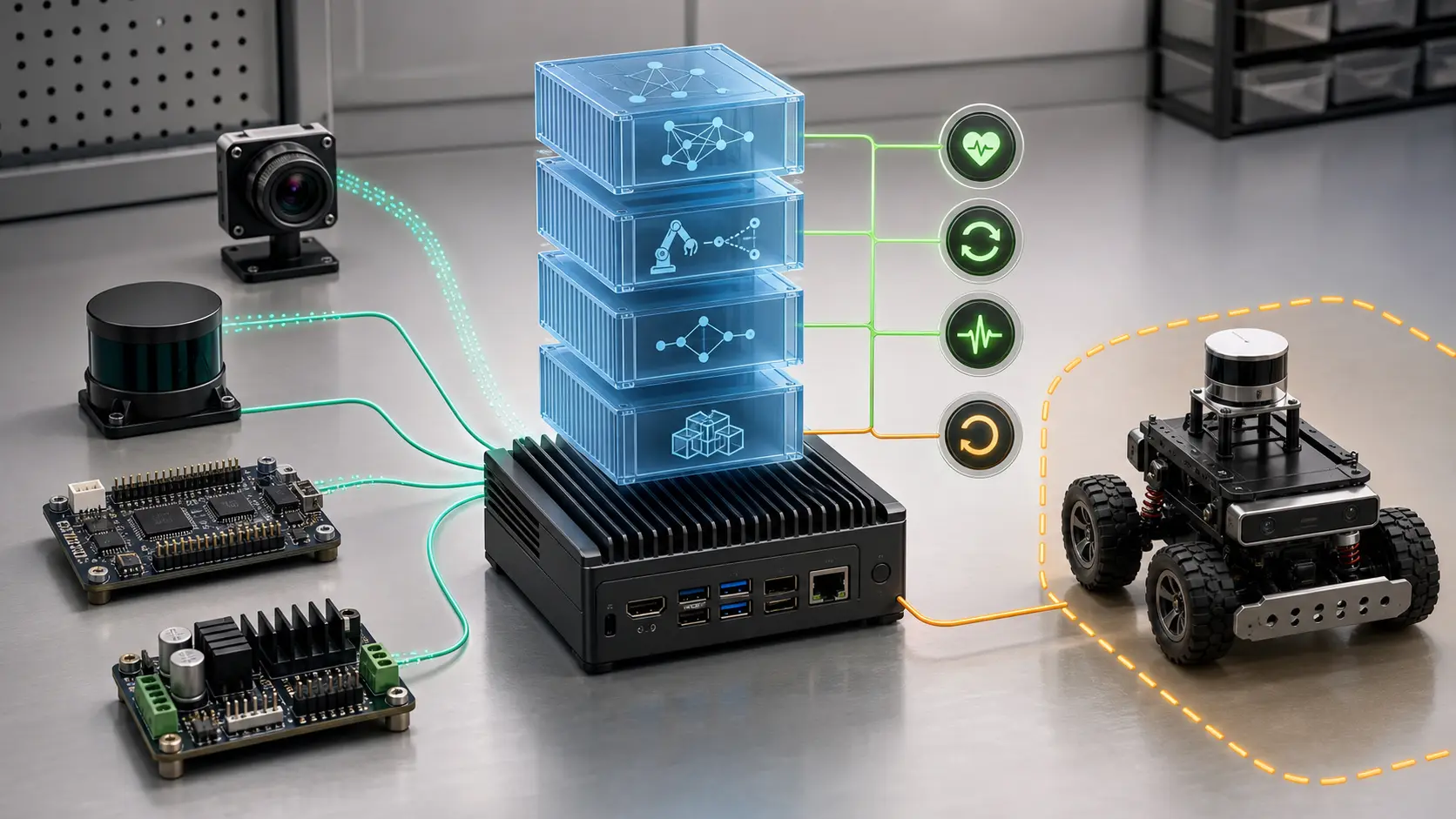
Containerization has become almost ideological in modern software engineering. In web infrastructure, “just Dockerize it” is often the correct answer. In robotics, that mindset can either save you months of pain — or create subtle, catastrophic problems that only appear under load, in the field, or during a live demo.