
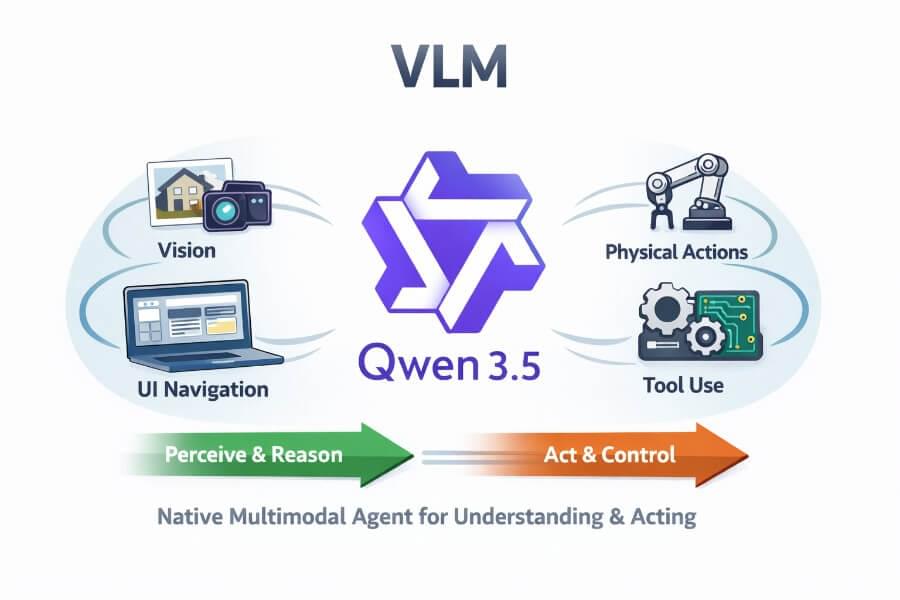
A few days ago, Alibaba’s Qwen team released Qwen 3.5, and it’s one of those launches that quietly changes the “default mental model” of what a VLM is supposed to be. Not just a model that can see, but a model that’s clearly being positioned as a native multimodal agent: something that can look at a UI, reason over it, decide what to do next, and (crucially) do so efficiently enough that you can imagine it running in production without your GPU bill turning into performance art.
NVIDIA amplified that angle immediately with a hands-on post showing how to run Qwen 3.5 through GPU-accelerated endpoints and scale it with NIM(containerized inference microservices) and NeMo (fine-tuning tooling). The headline detail: the flagship Qwen 3.5 VLM is a ~400B-class model, but it’s Mixture-of-Experts so it activates only a small slice per token — which is a big part of why it’s being marketed as “frontier capability per unit cost.” Qwen 3.5 leverages an efficient hybrid architecture to enable scalable, high-performance multimodal inference.
This article is my deep dive into what was actually released, what makes it technically interesting (without drowning beginners), and why I think it matters a lot for Physical AI and cyber-physical systems (CPS) — the kind of systems where “understanding” is not the end goal, but merely the first step before you act in the real world. Qwen 3.5 is designed to operate effectively in complex environments, where diverse and unpredictable factors challenge traditional AI models.
What exactly is Qwen 3.5 (and what does “VLM” mean for vision language models here)?
Let’s reset vocabulary quickly.
A VLM (Vision-Language Model) is a model that can take images (and sometimes video) plus text as input, and output text (and sometimes structured actions). Historically, many “VLM stacks” were bolted together: a vision encoder feeding tokens into a text-only LLM. That works, but it often feels like two worlds stitched together.
Qwen 3.5 is being presented as a unified vision-language foundation model: trained with early fusion on massive multimodal data so that vision + language aren’t just “supported,” they’re part of the model’s native reasoning loop. Qwen 3.5 belongs to a new generation of multimodal models that integrate vision, language, and reasoning for advanced agentic workflows. Both NVIDIA’s write-up and the official model materials emphasize this “unified foundation” aspect as a key design goal.
Also, the “VLM” in Qwen 3.5 isn’t a small side-branch of the family: the flagship release is explicitly a native vision-language model with tool use / agentic workflows in mind. NVIDIA even calls out UI navigation as a core capability improvement over previous generations. Qwen 3.5 can interpret images to understand and interact with visual interfaces.
The flagship model: big numbers, but the right big numbers
The flagship is Qwen3.5-397B-A17B.
That name is already a lesson:
397B total parameters
17B active parameters per token (because of sparse expert routing)
MoE activation rate around a few percent (NVIDIA summarizes it as ~4.28%)
The model utilizes a sparse mixture-of-experts approach to maximize inference efficiency.
From NVIDIA’s spec table, plus the model card details NVIDIA hosts, you get a surprisingly complete picture of the architecture and scale:
512 experts
10 routed + 1 shared expert per token
60 layers
248,320 vocabulary size
Very long context: ~262k tokens natively, extensible to ~1M with RoPE scaling
The model’s extended context length enables it to handle ultra-long sequences and complex reasoning tasks.
If you’ve been following open-weight models recently, you already know the meta-trend: frontier-ish capability is moving toward efficiency tricks (MoE, hybrid attention, quantization formats like FP8/NVFP4) rather than only brute-force dense scaling. Qwen 3.5 is very much in that lane — but with a strong “multimodal agents” flavor rather than “just chat.”
What’s new vs the previous Qwen world?
Here’s the important mental shift: Qwen previously had clearer separation between “text” and “vision” product lines (Qwen3 vs Qwen3-VL style families). Qwen 3.5’s flagship is positioned as unifying these into a single foundation model that can do reasoning + multimodal + agents.
On the release timeline, the Qwen team’s GitHub repo is pretty explicit:
2026-02-16: first Qwen 3.5 release includes the 397B-A17B MoE model
2026-02-24: additional sizes dropped (Qwen3.5-122B-A10B, Qwen3.5-35B-A3B, Qwen3.5-27B)
For builders, this matters more than it sounds: “a single enormous flagship” is great for demos, but the moment you have 27B / 35B / 122B options, the model family becomes deployable across a wider range of budgets and hardware footprints. Users can choose from different models to suit their specific deployment needs, leveraging the strengths of the base models as foundational building blocks for further customization and fine-tuning.
The architecture story (explained like you’re not living on arXiv)
You’ll see two recurring terms in the Qwen 3.5 materials:
1) Mixture-of-Experts (MoE)
MoE is a scaling trick: instead of having one dense brain that runs fully for every token, you have many “expert sub-networks,” and a router picks only a subset to activate per token.
So you can have “397B worth of knowledge capacity,” but only pay (roughly) “17B worth of compute” at inference time — obviously with a bunch of engineering nuance, but that’s the intuitive idea. NVIDIA’s post and the model card both highlight this exact “total vs active” framing.
2) Gated Delta Networks (plus some full attention)
This one is the more exotic part. The NVIDIA-hosted model card describes a hybrid layout combining Gated DeltaNet layers (a form of linear-attention-ish mechanism) with some Gated Attention (more classic full attention) layers, arranged in a repeating pattern.
For beginners: attention is often the expensive part when context windows explode. Hybrid/linear mechanisms are one way the industry is trying to keep long-context models practical. The key takeaway isn’t “memorize DeltaNet,” it’s: Qwen 3.5 is engineered for long context + agent workflows without collapsing under compute cost.
Why NVIDIA is pushing it: “native multimodal agents” + production path
The NVIDIA blog post is short, but it’s very telling: it’s not framed as “here is a cool model,” it’s framed as “here is how to build and deploy an agent with it.”
Three concrete paths are emphasized:
Try it instantly on build.nvidia.com using GPU-accelerated endpoints (they mention Blackwell GPUs powering the endpoints).
Use an OpenAI-compatible chat completions API at NVIDIA’s integration endpoint, including tool calling with a tools array.
Production deployment using NVIDIA NIM, i.e., containerized inference microservices, plus NeMo for fine-tuning (including LoRA). This approach enables seamless integration of Qwen 3.5 into existing workflows, supporting efficient interoperability and collaboration.
This is exactly the story enterprise teams want: “experiment → integrate → deploy → customize,” without inventing a bespoke inference stack from scratch.
To access Qwen 3.5 endpoints, users will need to configure their api key to authenticate and enable communication with the model.
Quickstart: call Qwen 3.5 via NVIDIA’s hosted endpoint (minimal code)
NVIDIA provides a simple Python example using a chat-completions style payload and a model name like qwen/qwen3.5-397b-a17b, with an option to enable “thinking.”
A practical mental model if you’re new:
You send messages like you would for any modern chat model.
You can stream tokens (“stream”: true).
You can include tool definitions (function calling) in the same schema you already know from OpenAI-compatible APIs.
Users can also evaluate the model’s performance using a fixed prompt to ensure consistency across different test scenarios.
That means you can prototype agent behaviors fast: “look at a screenshot → decide next action → call tool → continue.”
Deploy it yourself: vLLM is already publishing a Qwen 3.5 recipe
If you’re the kind of person (like me) who wants a path to running models in your own infrastructure, vLLM published a Qwen3.5 usage guide with concrete serving commands and tuning flags.
A few details that matter in real life:
They recommend an FP8 checkpoint for serving efficiency (and mention NVFP4 for GB200-class systems).
They differentiate between throughput-focused vs latency-focused serving, including speculative decoding config (MTP). Enabling multi token prediction can further improve throughput and memory efficiency during inference, especially for long context and multimodal applications.
They explicitly mention “language-model-only” mode to skip loading the vision encoder when you only need text, freeing memory for KV cache.
Optimizing for minimal latency is crucial for real-time applications, especially when deploying Qwen 3.5 in production environments.
For beginners: don’t obsess over every flag. The big point is: the ecosystem is moving fast enough that serving guidance exists days after release, which is usually a strong signal that a model is going to see real adoption.
“Visual agentic capabilities”: UI understanding is a big deal (even if you don’t care about UI)
Both NVIDIA and Reuters highlight a capability that I think is larger than it looks on paper: Qwen 3.5 is marketed as being able to understand and navigate user interfaces — i.e., treat a screenshot like an interactive environment.
If you’ve never built an “agent,” here’s why this matters:
Traditional chatbots are text-only reasoning engines.
Agents are decision-making loops that observe → decide → act → observe again.
A lot of enterprise “action space” is… boring UI: internal tools, CRMs, admin panels, web apps.
Qwen 3.5 can recognize objects within user interfaces and leverage image search tools to enhance its reasoning capabilities.
So a model that can reliably interpret a UI (buttons, fields, dialog boxes, state changes) becomes a general automation engine. And once you accept that, it’s only one conceptual step to Physical AI.
Video input: Qwen 3.5’s leap into temporal multimodality
One of the most exciting frontiers unlocked by Qwen 3.5 is its ability to handle video input—not just static images. This marks a major step forward for vision language models, pushing them from “snapshot” understanding into the realm of temporal multimodality. In plain terms: Qwen 3.5 can now interpret sequences of visual data over time, not just isolated frames.
Why does this matter? In the context of physical AI—where autonomous machines interact with the physical world—the ability to process video is a game-changer. Real-world environments are dynamic: objects move, people interact, and situations evolve second by second. For an AI system to truly understand and act within these environments, it needs to make sense of visual data as it unfolds, not just as a series of disconnected images.
Why this matters for Physical AI and cyber-physical systems
Let’s connect the dots to robotics and CPS — because that’s where I personally get excited.
A cyber-physical system is basically: software + sensors + actuators + safety constraints + real-world consequences. In robotics, you can think of it as:
Perception: cameras, lidar, microphones, proprioception
World model / state estimation: what’s happening right now?
Planning: what should I do next?
Control: send commands to motors/relays/arms/doors
Feedback loop: did it work? what changed?
Qwen 3.5 can process sensor data and understand spatial relationships, enabling advanced perception and planning for physical AI systems.
A “native multimodal agent” VLM fits naturally into the top of that stack:
It can ingest images/video from the robot’s cameras.
It can read UI-like telemetry (dashboards, graphs, error dialogs, even physical device screens).
It can reason over long context (maintenance logs, environment maps, task history).
It can choose tools/actions (ROS services, GPIO scripts, home automation APIs).
It can explain decisions to humans (which becomes a safety feature in itself).
The model also supports autonomous robots operating in assembly line settings and other industrial environments.
The huge context window (262k native, up to ~1M with scaling) is especially relevant here, because CPS problems are rarely “single prompt.” They are long-running: system logs, sequences of observations, multi-step procedures, recovery plans. Qwen 3.5 is well-suited for handling complex tasks and physical AI work that require extended reasoning and general understanding.
And the MoE efficiency story matters because Physical AI is often deployed in environments where compute is constrained or costly (edge servers, on-prem GPU nodes, robotics labs where latency matters). Having “400B-class capacity” with “~17B active compute” is exactly the kind of tradeoff you want if you’re trying to do real-time-ish reasoning with a model that can also see. Training physical AI in simulated environments and virtual spaces, leveraging synthetic data and reinforcement learning, is crucial to prepare models for real-world deployment.
What I would actually build with it (concrete scenarios)
Here are a few “this feels very 2026” examples where Qwen 3.5’s positioning makes sense:
10.1. A robot operator that can handle smart home dashboards, web interfaces, and even control physical devices. Qwen 3.5 can also process and summarize information from web pages, making it easier to manage and interact with complex digital environments.
10.2. An agent that can perform image search, extract relevant information, and reason step-by-step to solve visual puzzles.
10.3. Digital twin workflows, where the agent can simulate, monitor, and optimize real-world processes. The agent can guide users to a final answer after reasoning through complex visual and data-driven scenarios.
1) A robot operator that understands screens and scenes
A mobile robot in a house doesn’t just need to see the hallway — it also needs to handle the ecosystem of human tools: router admin pages, smart home dashboards, security camera UIs, or even a heat pump’s web interface. A VLM that can “navigate UI” gives you a shortcut: instead of building brittle UI automation, you can drive actions through an agent loop.
2) Maintenance + troubleshooting copilots for industrial CPS
Give the agent a live camera feed, equipment manuals, wiring diagrams, and the last 90 days of logs. Long context + multimodal reasoning lets it do something closer to a senior technician: correlate symptoms, propose checks, and walk a human through safe steps.
3) Digital twins + multimodal reasoning
A lot of digital twin workflows involve: dashboards, plots, maps, anomaly visuals, plus structured time-series. A VLM agent can become the “glue” that reads the visuals, queries the underlying data tools, and proposes corrective actions.
Practical caveats (because reality always wins)
A few grounded notes before you sprint into production:
A 397B MoE model is still huge. MoE reduces active compute, but the overall system still has heavy memory + bandwidth requirements. Plan your deployment footprint accordingly.
Tool calling is where the magic happens (and where safety must be engineered). If your agent can call “real actions” (GPIO, ROS nodes, home automation), you need guardrails, permissions, and auditability.
Thinking mode is powerful but not free. The NVIDIA model card notes it generates < think>…< /think> content by default, with an option to disable it. That can affect latency and token usage.
If you’re deploying via vLLM/SGLang, expect to spend time on serving configs: throughput vs latency tradeoffs, caching, speculative decoding, multimodal encoder parallelism, etc. Effective context management strategies, such as applying a preset threshold to cumulative tool response length, are essential for maintaining performance. Discarding earlier tool responses using a simple context folding strategy helps keep the context window within manageable limits during long-running interactions.
Closing thoughts: Qwen 3.5 feels like a “model shaped by agents,” not a model with agents bolted on
What I like about this release is the coherence of the story:
The model architecture is explicitly engineered for efficiency at long context.
The marketing focus is explicitly “multimodal agents” and UI navigation. The Qwen 3.5 family demonstrates how leading organizations model adopt advanced strategies to optimize agentic workflows.
NVIDIA’s integration story immediately provides a production-shaped path (endpoints → API → NIM → NeMo fine-tuning).
The Qwen repo shows the family expanding quickly into smaller sizes, which is usually what unlocks broader real-world adoption.
And for anyone building Physical AI (robots, smart environments, cyber-physical automation), this is exactly the direction you want: models that don’t just “answer,” but can observe, reason, and act across modalities — while still being deployable with sane engineering. Qwen 3.5 leverages generative AI techniques to enable flexible, human-like reasoning and action across modalities.