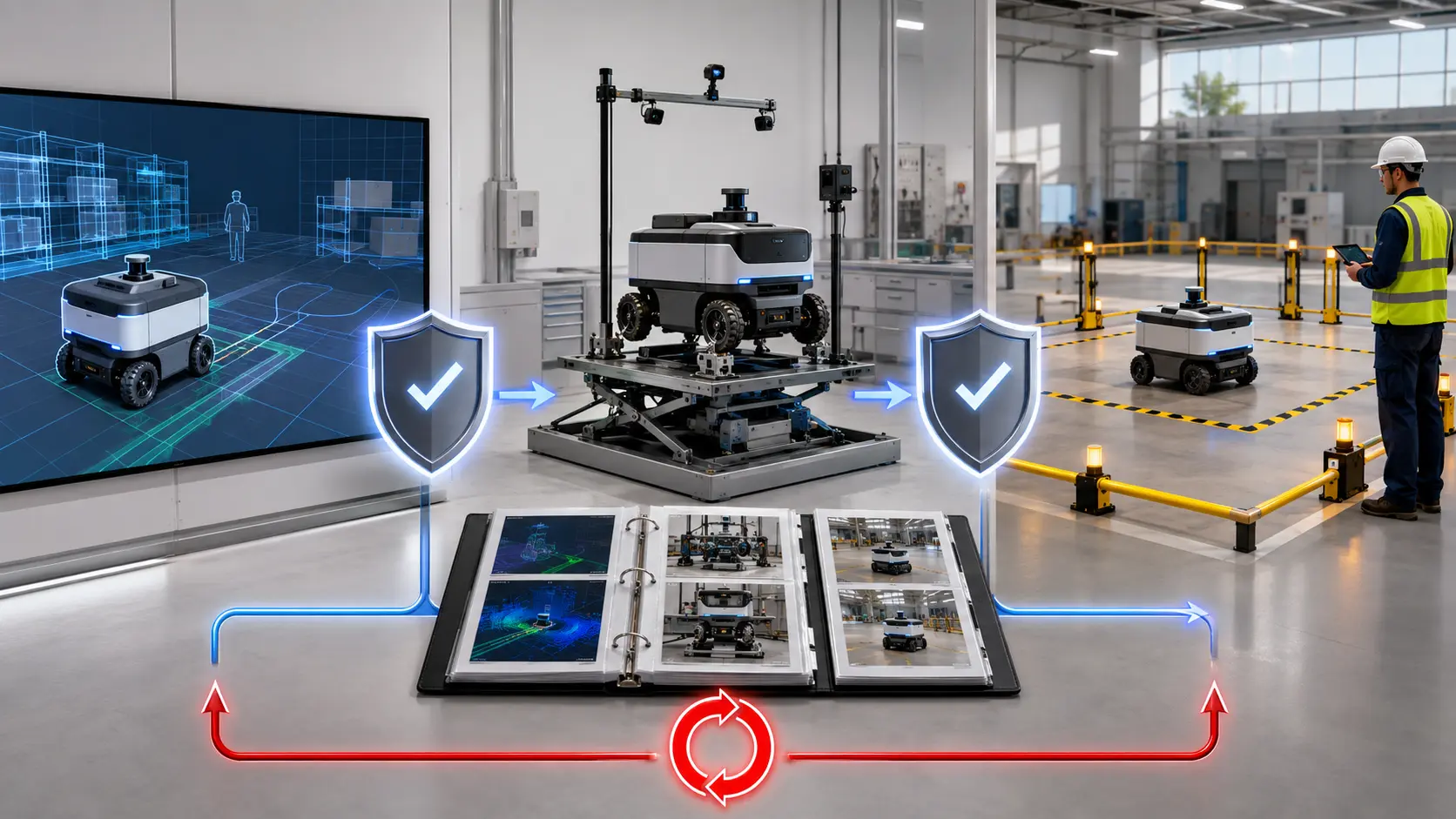
Robot autonomy should not move from simulation to the real world because the demo looked good.
It should move because the system has earned a specific level of physical authority.
That distinction changes how a robotics team ships. The release question is not “does the model work?” or “did the robot complete the task in the lab?” The release question is more concrete: what evidence proves that this robot may accept this class of goals, inside this operating envelope, with these fallbacks, under this supervision model?
For AI-enabled robots, Physical AI systems, mobile manipulators, inspection robots, and local robot agents, I would treat release as an authority ladder. Simulation is one rung. Bench testing is one rung. Tethered motion is one rung. Supervised field operation is one rung. Bounded production is one rung. Each rung must define what the autonomy is allowed to do, what it is forbidden to do, what evidence is required, and what immediately reduces authority again.
This article builds on the safety and evidence stack from runtime assurance for Physical AI robots, the assumption ledger for Physical AI robots, command validation for AI robot agents in ROS 2, sensor-to-actuator timing budgets, ROS 2 logs and rosbags for robot debugging, and degraded modes for AI-enabled robots.
A Release Gate Is A Change In Authority
Most software release gates ask whether code can move from one environment to another.
Robotics release gates must ask whether software can influence more physical energy, more space, more speed, more autonomy, or less human supervision.
That is a different kind of decision. A robot can pass a perception benchmark and still be unsafe to move near people. A local planner can work in simulation and still produce bad behavior on a polished floor. A VLA policy can complete a manipulation task and still be unfit to own recovery when grasp confidence collapses. A ROS 2 graph can launch successfully and still be missing the cancellation path that matters when the robot enters a forbidden zone.
So the gate should be stated as an authority claim:
1 | This release may execute <task class> |
If the release note cannot be written that way, the robot is probably being advanced by confidence instead of evidence.
The Autonomy Release Ladder
The ladder below is a starting point. The exact levels should be tuned to the machine, domain, hazards, and business process, but the principle is stable: each gate grants only the next useful unit of authority.
| Gate | Authority granted | Evidence required | Immediate rollback trigger |
|---|---|---|---|
| G0: Design review | No robot authority | Hazard analysis, operating envelope, command contract, assumption ledger, owner map | Missing owner, undefined fallback, unknown hazard |
| G1: Simulation only | Autonomy can run against a simulated robot | Scenario suite, randomized environments, sensor model limits, collision and timeout results | Scenario gap, unbounded unsafe command, unexplained success |
| G2: Bench test | Hardware may energize in a constrained rig | Power limits, actuator checks, sensor calibration, emergency stop, watchdog timing | Unexpected motion, stale sensor path, failed stop path |
| G3: Tethered robot | Low-speed supervised motion in a controlled zone | Command validation, runtime assurance, action cancellation, operator recovery drill | Missed cancellation, mode confusion, unsafe recovery |
| G4: Supervised field trial | Bounded task execution with human oversight | Field run logs, ODD match, degraded modes, incident-free exposure hours, edge-case replay | Near miss, repeated intervention, assumption invalidation |
| G5: Bounded production | Approved autonomy in a defined operating envelope | Release evidence packet, rollback plan, monitoring thresholds, maintenance procedure | Threshold breach, unexplained anomaly, evidence drift |
| G6: Expanded deployment | More sites, tasks, speed, payload, or autonomy | Site comparison, fleet telemetry, regression evidence, updated safety argument | New site hazard, distribution shift, fleet incident pattern |
The important part is not the labels. The important part is that a robot cannot quietly jump from G1 to G5 because the lab team is tired of testing.
Build Evidence By Failure Mode
A weak release gate asks, “How often did the robot succeed?”
A stronger release gate asks:
- What failures were deliberately created?
- Which failures were detected before motion became unsafe?
- Which failures reduced authority instead of triggering improvisation?
- Which failures were only visible after reviewing logs?
- Which failures were not covered by the current gate?
For a warehouse inspection robot, the test matrix might include stale localization, reflective floor sections, blocked aisles, delayed perception inference, low battery, degraded Wi-Fi, false obstacle detections, moving workers, ambiguous operator commands, unreadable labels, and a failed docking attempt. For a mobile manipulator, it might include payload variance, grasp slip, poor lighting, fixture misalignment, joint limit proximity, force threshold breach, camera occlusion, and tool-change ambiguity.
The gate should not pretend all failures are equal. It should separate:
| Failure class | Release meaning |
|---|---|
| Detected and safely handled | Evidence for the current authority level |
| Detected but poorly handled | Release blocker for higher authority |
| Undetected but harmless in test | Regression case before expansion |
| Undetected and hazardous | Stop the release and redesign the boundary |
| Detected only in logs | Improve runtime monitors before increasing autonomy |
The NIST Performance Assessment Framework for Robotic Systems is useful here because it frames robot performance as composed measurements across perception, mobility, dexterity, and safety, rather than a single demo outcome. That mindset is exactly what Physical AI release gates need.
Simulation Is Evidence, Not Permission
Simulation is valuable because it lets the team vary conditions faster than the real world does. It is the right place to run scenario sweeps, regression suites, perception perturbations, path-planning edge cases, sensor dropout, timing stress, and synthetic data experiments.
Tools such as NVIDIA Isaac Sim are built for robotics simulation workflows that include scene import, physics, sensors, synthetic data, software-in-the-loop testing, and ROS 2 integration. That is useful release evidence.
It is not release permission by itself.
Simulation should answer three questions before the robot touches hardware:
- What scenarios are now known to be safe enough to try at lower physical authority?
- What scenarios are known failures and must be blocked by command validation or runtime assurance?
- What assumptions are still unverified because the simulator does not capture the real sensor, surface, lighting, contact, network, or human behavior?
The third question matters most. A simulator can give the team confidence that a failure mode exists. It cannot prove that the real robot’s camera timestamping, wheel slip, emergency stop chain, payload dynamics, wireless jitter, or operator recovery behavior is correct.
What Must Be Measured On Hardware
Hardware testing should not repeat the simulation plan at slower speed. It should measure the parts simulation is least qualified to prove.
For an AI-enabled mobile robot, the hardware evidence set should include:
| Evidence area | What to capture |
|---|---|
| Stop path | Emergency stop latency, controller stop behavior, brake behavior, power removal or safe torque behavior |
| Timing | Sensor age, callback latency, TF freshness, command age, actuator response, jitter under load |
| Command admission | Accepted, rejected, delayed, canceled, and human-approved goals |
| Runtime assurance | Monitor inputs, intervention horizon, fallback activation, recovery criteria |
| Degraded modes | Entry trigger, allowed commands, disallowed commands, exit criteria, escalation path |
| Sensor validity | Calibration drift, confidence, occlusion, lighting sensitivity, dropped frames, outlier handling |
| Operator intervention | Time to notice, time to pause, time to recover, ambiguity in UI or procedure |
| Evidence quality | rosbag coverage, diagnostic events, clock sync, trace correlation, log retention |
The point is to make the release decision reconstructable. If the robot hits a bad state in the field, the team should be able to replay what the release gate believed, what evidence it had, and which assumption was wrong.
ROS 2 Boundaries Should Be Gateable
ROS 2 gives a team useful primitives for release gating, but only if the architecture treats them as control boundaries.
ROS 2 actions are a natural boundary for long-running robot behavior because they include goals, feedback, terminal results, and cancellation. If an AI agent or operator copilot can request navigation, inspection, docking, grasping, or tool use, the release gate should verify that the action server can reject invalid goals, expose useful feedback, report terminal failure, and cancel before the intervention horizon is lost.
Managed lifecycle nodes are useful because activation becomes a gate. A perception node, planner, controller, bridge, or safety monitor should not enter the active state until configuration, calibration, dependencies, clocks, parameters, and diagnostics are ready.
ROS 2 QoS settings also belong in the evidence set. Deadline, lifespan, and liveliness are not cosmetic middleware settings for robots. They help define when data is late, stale, or no longer safe to use.
A practical release gate should therefore inspect:
- which actions exist and who can call them,
- which goals can be canceled,
- which lifecycle nodes must be active before motion is allowed,
- which topics have freshness requirements,
- which diagnostics are release blockers,
- which logs prove the state of the robot at the gate,
- and which supervisor can reduce authority when one of those facts changes.
The Field Evidence Packet
Every serious robot autonomy release should leave behind an evidence packet. It can be implemented as a folder, dashboard, database record, or signed release artifact, but it should be structured enough that a different engineer can audit the decision later.
I would start with this schema:
1 | release_id: robot-autonomy-2026-09-field-g4 |
The packet does not need to be heavy. It needs to be explicit. The worst release artifact is a chat thread, a demo video, and a vague agreement that the robot “seems stable now.”
Gate The Operating Envelope, Not The Robot
One robot can have several valid authority levels at the same time.
It might be approved for autonomous inspection in an empty aisle at 0.5 m/s, approved only for supervised motion near people at 0.2 m/s, approved for docking when the station fiducial is visible, and forbidden from autonomous manipulation until the gripper slip evidence improves.
That is why release gates should attach to operating envelopes and task classes, not to the robot as a whole.
Use this structure:
| Dimension | Example release boundary |
|---|---|
| Task class | Inspect aisle, dock, carry payload, manipulate fixture |
| Workspace | Test cell, marked zone, warehouse aisle, customer site |
| Human proximity | Empty zone, trained operator nearby, shared workspace |
| Speed and force | Low-speed trial, production speed, reduced torque |
| Autonomy level | Advisory, proposal-only, supervised execution, autonomous execution |
| Sensor condition | Full perception, camera degraded, LiDAR-only, localization uncertain |
| Recovery authority | Hold, return-to-base, operator handoff, safe stop |
This avoids a common failure: treating one successful narrow deployment as permission to expand everywhere. Expansion is a new release decision. A new site, payload, surface, speed, lighting condition, human workflow, or sensor configuration can invalidate the old evidence.
Rollback Must Reduce Physical Authority
Software rollback usually means deploying the previous version.
Robot autonomy rollback must also reduce physical authority.
If a field trial crosses a threshold, the system should not simply restart the same stack and hope the anomaly disappears. It should downgrade to a lower gate:
1 | G5 bounded production |
Rollback triggers should be objective enough that the on-call engineer does not have to negotiate with optimism at 2 a.m.
Useful triggers include:
- accepted command outside the approved contract,
- action cancellation that missed the intervention horizon,
- stale state used for motion,
- runtime assurance monitor unavailable,
- emergency stop chain failure or unexplained delay,
- repeated operator intervention for the same cause,
- near miss or contact event,
- new site assumption not represented in the ledger,
- telemetry pattern that differs from the release evidence,
- or missing logs during a safety-relevant interval.
This is where UL 4600’s autonomous-product safety framing is a useful reference point: the safety argument has to explain why the autonomous system is acceptable in its intended use, not merely show that a component performed well in isolation.
Ownership Of The Gate
Release gates fail when nobody owns the decision.
The AI engineer owns model behavior evidence. The robotics engineer owns ROS 2 integration, action behavior, timing, and hardware interfaces. The safety engineer owns hazard links, safety functions, and unacceptable risk. The field operations lead owns site readiness, operator procedures, and intervention evidence. The product or technical lead owns the authority tradeoff: what the robot is allowed to do for users now, and what must wait.
I would make the gate decision a small RACI, not a meeting without artifacts:
| Artifact | Accountable owner | Required reviewers |
|---|---|---|
| Operating envelope | Robotics lead | Safety, field operations |
| Command contract | Robotics lead | AI engineer, safety |
| Simulation suite | Robotics or autonomy lead | AI engineer, QA |
| Hardware timing evidence | Robotics lead | Safety, platform |
| Runtime assurance evidence | Safety lead | Robotics, AI engineer |
| Field trial report | Field operations lead | Robotics, product |
| Release decision | Product or technical owner | Safety, robotics, operations |
| Rollback procedure | Operations lead | Robotics, safety |
The accountable owner should sign for the specific authority being granted. Nobody should sign for “the robot is safe” in the abstract.
What Good Looks Like
A strong robot autonomy release gate has a few recognizable properties:
- The autonomy level is explicit.
- The operating envelope is narrow enough to test.
- The command surface is typed and validated.
- Simulation covers known scenario classes but does not pretend to prove reality.
- Hardware tests measure timing, stop behavior, sensor validity, and recovery.
- Runtime assurance has authority, not just visibility.
- Degraded modes are executable states, not comments in a runbook.
- Field trials produce replayable evidence.
- Rollback reduces physical authority, not only software version.
- Owners sign the gate, not the vibe.
For Physical AI, the engineering discipline is simple to state and hard to maintain: increase robot authority only when the evidence has increased first.
That is the difference between a convincing demo and a system that deserves to operate outside the lab.