
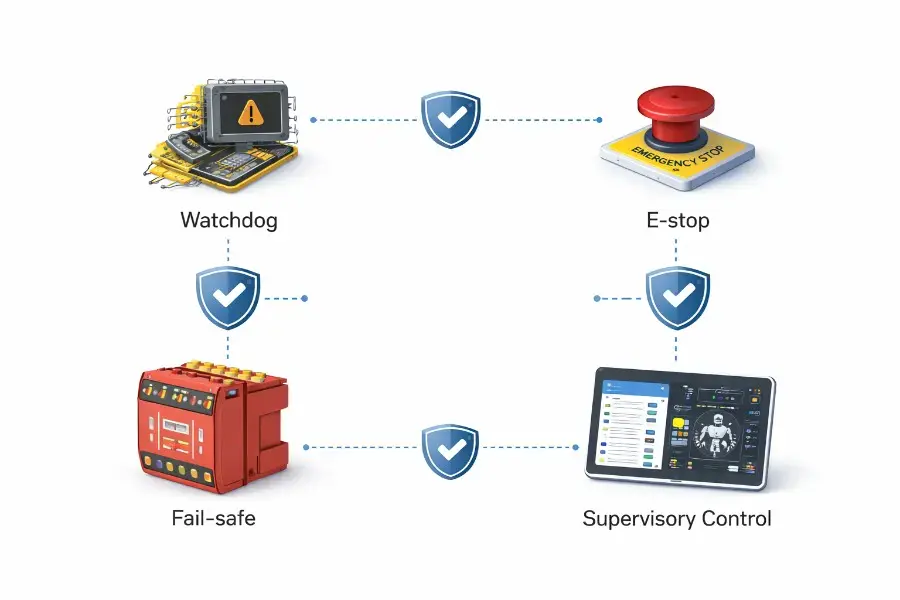
The fastest way to misunderstand robot safety is to treat it as a button.
It is not.
A red mushroom emergency stop matters. A watchdog matters. A failsafe matters. But none of them, alone, is robot safety architecture. Safety in robotics is not a feature. It is not a checkbox. It is not a clever prompt, a neat ROS node, or a good-looking demo video. It is an architectural property of the whole cyber-physical system.
That distinction matters even more now that robotics is colliding with foundation models, embodied AI, and agentic software. The industry is producing increasingly capable models for planning, perception, language grounding, and action generation. But the more capable the high-level intelligence becomes, the more important it is to separate intelligence from authority.
I have already argued that LLMs should not control motors and robots directly. This article is the natural follow-up: if not that, then what should the safety architecture actually look like?
The answer is layered control, independent safety channels, explicit supervisory authority, verified fallbacks, and well-defined degraded modes. In other words: a robot should be allowed to be smart only inside an envelope that remains safe when the smart part is wrong.
If you want more context before going deeper, these earlier pieces connect directly to this one:
- The real role of LLMs and other AI models in a cyber-physical system
- What Physical AI really means for robotics and cyber-physical systems
- PID vs MPC in robotics
- A story-driven introduction to PID controllers
- ROS 2 architecture patterns that scale
- Real-Time Linux for robotics
- What is sensor fusion in robotics
- World models in robotics
- How vision-language-action models are revolutionizing robotics
- Understanding the cyber-physical systems feedback loop
- What is a digital twin in robotics
TL;DR
Robot safety architecture is the layered design that ensures a robot remains within acceptable risk even when software fails, sensors go stale, communications drop, models hallucinate, operators make mistakes, or the environment changes in ways the planner did not expect.
In practice, that means:
- hardware safety functions that can independently remove hazardous actuation or enforce a safe stop,
- safety-rated control paths that do not depend on the same software stack as the nominal autonomy,
- watchdogs and health monitors for liveness, timing, data freshness, and state consistency,
- supervisory control that decides which modes, skills, and envelopes are permitted,
- degraded modes that preserve safety while sacrificing performance,
- human-aware risk reduction for shared workspaces,
- and continuous risk management across the whole CPS lifecycle.
That is the architecture. Everything else is implementation detail.
What robot safety architecture actually is
A robot is not just a manipulator, or a mobile base, or a humanoid body. It is a tightly coupled cyber-physical system:
- sensing,
- estimation,
- communication,
- planning,
- control,
- actuation,
- power,
- human interaction,
- and operational procedures.
So when I say robot safety architecture, I mean the structure that constrains all of those layers such that hazardous behavior is either prevented, detected quickly enough, or forced back into a safe state.
A useful mental model is this:
- Nominal intelligence tries to achieve the mission.
- Supervisory logic constrains what nominal intelligence is allowed to do.
- Safety mechanisms intervene when constraints are violated or confidence is lost.
- Hardware safety functions remain effective even if higher software layers are broken.
That is why safety is not the same thing as “good control,” and not the same thing as “good AI.”
A robot can have excellent manipulation performance and terrible safety architecture.
A robot can also be extremely safe and perform terribly.
Real engineering is in the trade-off.
Safety is a stack, not a single mechanism
When teams say “we have safety,” they often mean one of four very different things:
- Functional safety: the system performs a safety function correctly when needed.
- Operational safety: procedures, training, maintenance, lockout/tagout, change control.
- Behavioral safety: the autonomy behaves within constraints in realistic environments.
- Human safety: the robot can coexist with people under foreseeable interactions and misuse.
These overlap, but they are not identical.
A watchdog is mostly about functional liveness.
An E-stop is an emergency risk reduction measure.
A collision checker is a behavioral safeguard.
A light curtain or safety scanner is a human-protection layer.
A maintenance procedure is operational safety.
Confusing these categories is how people build systems that look safe in architecture diagrams and fail in production.
A practical reference architecture for robot safety
Here is the architecture I recommend as a default mental model for modern robots, especially AI-enabled ones.
1 | +--------------------------------------------------------------+ |
Now add a second, partially independent path:
1 | Safety sensors -> safety logic -> safety-rated stop / safe torque off |
That path must not disappear just because your Linux userland is busy, your ROS graph is fragmented, your planner is hung, or your VLA found a “creative” interpretation of the task.
That independence is the entire point.
Hardware cutoff vs software stop
This distinction is one of the most important in robotics, and one of the most misunderstood.
Software stop
A software stop is a stop requested and executed through the nominal control stack.
Examples:
- the planner decides to halt,
- ROS sends zero velocity,
- the navigation stack cancels a goal,
- a behavior tree enters a “stop” node,
- a local collision checker commands deceleration.
This is useful, and often desirable, because it can be smooth and controlled.
But it is only as trustworthy as the stack executing it.
If the process is deadlocked, if the scheduler is overloaded, if the bus is partitioned, if the wrong task still has write access, or if the command path is compromised, a software stop may arrive late or not at all.
Safety-rated stop
A safety-rated stop is implemented through a safety-related channel that has been designed, integrated, and validated specifically for safety functions.
This usually means some combination of:
- safety controller or safety PLC,
- certified safety relay or drive safety function,
- safe digital inputs,
- safe fieldbus,
- monitored standstill,
- safe speed monitoring,
- safe brake control.
This is categorically different from “the app says stop.”
Hardware cutoff
A hardware cutoff removes or blocks hazardous actuation at the energy or drive level.
Examples:
- dropping drive enable,
- opening a contactor,
- activating Safe Torque Off (STO) on a servo drive,
- venting pneumatic energy through a safety valve,
- de-energizing a gripper,
- releasing or applying a holding brake, depending on the mechanism.
This is the last line between a software failure and physical motion.
But even here, nuance matters.
For some systems, power-off is the safe state.
For others, it is not.
If you remove torque from a vertical axis holding a load without a brake, gravity becomes your new controller.
If you kill a drone’s motors in the name of safety, you have not made the system safe. You have converted a controlled vehicle into a falling object.
If you cut power to a medical assist device supporting a patient, you may create more harm than the failure you were trying to avoid.
So “hardware cutoff” is essential, but the right safe function depends on the plant physics.
Stop categories and why they matter
In practice, engineers need to separate at least three kinds of stop behavior:
- Immediate uncontrolled removal of torque or energy
- Controlled deceleration followed by energy removal
- Controlled stop with monitored standstill maintained
In drive safety language, this often maps to concepts such as:
- STO (Safe Torque Off),
- SS1 (Safe Stop 1),
- SS2 (Safe Stop 2),
- sometimes combined with SOS (Safe Operating Stop), SLS (Safely-Limited Speed), or related motion safety functions.
The key design question is not “which acronym sounds most advanced?”
It is this:
What stop behavior reduces risk fastest for this mechanism, under this hazard, in this mode?
For a fast industrial arm near a pinch point, immediate torque removal may be correct.
For a mobile robot with payload inertia, a controlled stop may be safer than a skid.
For a legged robot, a graceful stabilization transition may be safer than a hard collapse.
For a collaborative cell, speed reduction and monitored standstill may be the right intermediate behavior before a harder trip.
That is why safety design starts from hazard analysis, not from a catalog checkbox.
Protective stop vs emergency stop
Teams also mix up protective stop and emergency stop, but they solve different problems.
A protective stop is typically triggered automatically by a safety function because the system detected a hazardous condition or lost a required protective condition. Typical triggers include a safety scanner zone breach, a guard door opening, a speed-and-separation threshold violation, or a safety-rated monitored stop condition. The goal is to bring the machine into a defined safe condition in an architecture-controlled way.
An emergency stop is a human-triggered emergency risk reduction action for abnormal situations. It exists for the moment when a person decides that the fastest route to risk reduction is to hit the mushroom button.
A practical rule of thumb:
- protective stop = the system detected danger and intervened,
- emergency stop = a human judged the situation abnormal enough to force emergency intervention.
Both matter. They should not share the same recovery semantics.
A protective stop may allow a structured recovery after the cause is cleared and the restart conditions are revalidated.
An emergency stop should require deliberate manual reset and should never auto-resume.
Emergency stop is necessary, but it is not the architecture
The emergency stop is one of the most visible parts of machine safety, which is precisely why people overestimate what it does.
An E-stop is an emergency risk reduction function. It is there for abnormal situations requiring immediate human intervention. It is not supposed to be your normal operating pause button. It is not a substitute for safeguarding design. It is not the same as lockout/tagout. It is not evidence that the rest of the architecture is safe.
A few practical truths:
- If operators use E-stop daily as a workflow control, the architecture is wrong.
- If recovery from E-stop is unclear, restart risk becomes its own hazard.
- If the E-stop removes torque but not stored energy, residual hazards remain.
- If your robot needs an E-stop every time the planner gets confused, the problem is not “operator awareness.” It is bad systems engineering.
A strong architecture treats the E-stop as the last human-triggered safety layer, not as the primary safety strategy.
Watchdogs: what they are, what they are good for, and what they cannot do
A watchdog is a mechanism that assumes a component is unhealthy unless it proves otherwise within a specified timing contract.
That contract might be:
- “the MCU must kick the watchdog every 10 ms,”
- “the navigation stack must publish a heartbeat every 100 ms,”
- “joint feedback must not be older than 20 ms,”
- “the planner must renew permission tokens before command execution continues,”
- “the safety supervisor must observe fresh state from both localization and obstacle sensing.”
This sounds simple. It is. But it is incredibly powerful when used correctly.
Common watchdog types in robotics
1. Hardware watchdog timers
Usually implemented in MCU or supervisory silicon.
They are independent of the main control software and reset or trip the controller if the timing contract is violated.
Best practice: prefer windowed watchdogs over simple “kick whenever” watchdogs. A windowed watchdog also faults if software kicks too early, which helps catch runaway loops and accidental infinite fast toggling.
2. Task or process watchdogs
Used at OS or middleware level.
They detect that a thread, node, process, or executor is no longer making progress.
Useful in ROS 2, edge AI runtimes, and Linux-based robot computers.
3. Communication watchdogs
Detect stale commands, stale telemetry, stale fieldbus data, stale joystick inputs, stale teleop authority, or stale safety scanner state.
These are critical for remote robots and distributed systems.
4. Data freshness watchdogs
These monitor timestamps, sequence counters, and sampling age.
This matters because a control loop using old state is not “slightly degraded.” It can be catastrophically wrong.
5. Semantic watchdogs or invariant monitors
These are more advanced.
Instead of only checking liveness, they check whether some property remains true:
- joint limit not exceeded,
- commanded velocity within safe envelope,
- localization covariance below threshold,
- geofence invariant maintained,
- perception confidence above minimum,
- predicted stopping distance smaller than remaining free path.
This is where safety starts becoming architectural rather than just embedded hygiene.
How to choose watchdog deadlines from physics instead of vibes
A watchdog timeout should never be “whatever felt reasonable during integration.”
For any hazardous motion, think in terms of an end-to-end safety budget:
1 | T_total = T_detect + T_decide + T_comm + T_actuate + T_mech + T_margin |
Where:
- T_detect is how long it takes to notice the fault,
- T_decide is how long it takes the supervisor or safety logic to decide the response,
- T_comm is transport delay to the enforcing element,
- T_actuate is electrical or pneumatic actuation delay,
- T_mech is how long the plant needs to decelerate or reach the safe state,
- T_margin covers uncertainty, jitter, and modeling error.
Your watchdog threshold has to be short enough that a missed heartbeat is detected while the remaining stopping envelope is still positive.
In distance form, the same logic looks like this:
1 | d_free > v_rel * (T_detect + T_decide + T_comm) + d_brake + d_uncertainty |
That same reasoning applies to stale transforms, teleoperation command freshness, planner output validity, camera frame age, safety scanner timestamps, and fieldbus health. The timeout is not a software preference. It is part of the plant-level safety argument.
This is exactly why real-time latency and jitter matter and why state estimation quality matters. A robot that reasons on stale state is not “being cautious.” It is simply acting late.
What watchdogs are actually good at
Watchdogs are excellent at detecting:
- hangs,
- deadlocks,
- missed deadlines,
- stale data,
- broken communication,
- missing progress,
- timing contract violations.
They are the first line against silent software failure.
What watchdogs are not good at
Watchdogs do not prove that behavior is correct.
A process can happily send “I am alive” while commanding unsafe motion.
A planner can keep publishing on time while its world model is wrong.
A VLA can respond with perfect latency and still hallucinate a nonexistent free path.
That is why watchdogs are necessary but insufficient.
They answer the question:
“Is this component alive and behaving within timing expectations?”
They do not answer:
“Is this behavior safe in context?”
That second question belongs to supervisory control, safety envelopes, and runtime assurance.
Failsafe, fail-soft, fail-operational, degraded mode
These terms get mixed together constantly. They should not.
Failsafe
A failure causes the system to transition to a state that does not create unacceptable risk.
Important nuance: the safe state is application-specific.
- For a conveyor: stop.
- For a servo axis: STO plus brake.
- For a pressure system: open relief path.
- For a drone: controlled landing or geofenced return, not “motors off.”
- For a legged robot carrying a payload near humans: stabilize, reduce energy, kneel or sit if possible, then power down.
Fail-soft
The system loses performance, but continues functioning in a restricted way.
Examples:
- reduced speed,
- reduced workspace,
- one-arm-only mode,
- autonomous navigation downgraded to local obstacle avoidance plus teleop,
- manipulation disabled while mobility remains active.
Fail-operational
The system continues operating through faults while still meeting safety goals.
This usually requires redundancy, fault isolation, and more complex certification arguments.
Common in aerospace and some industrial contexts. Less common in cost-constrained robotics.
Degraded mode
This is the most useful practical concept for robotics.
A degraded mode is a predefined, validated, lower-capability operating state entered when confidence drops but full emergency shutdown is not yet necessary.
This is where mature robot architecture differs from hobby robotics.
A production robot should not only know how to be “on” and “off.”
It should know how to be:
- normal,
- restricted,
- supervised,
- manual recovery,
- protective stop,
- emergency stop,
- maintenance/lockout.
That mode structure is part of the safety architecture.
What degraded mode should look like in real robots
Industrial manipulator
Symptoms:
- perception fault,
- task planner inconsistency,
- tool calibration uncertainty,
- loss of non-safety camera.
Degraded mode:
- retract to safe waypoint,
- reduce speed,
- shrink workspace,
- disable high-force behaviors,
- require operator acknowledgement,
- allow only prevalidated recovery motions.
AMR or warehouse robot
Symptoms:
- localization uncertainty rising,
- lidar occlusion,
- map mismatch,
- wireless loss,
- low battery.
Degraded mode:
- transition from full navigation to low-speed local safety behavior,
- stop fork actuation,
- flash/beep,
- hold position or move to safe shoulder if path confidence permits,
- request human intervention.
Mobile manipulator
Symptoms:
- arm state valid, base state uncertain,
- base valid, arm perception invalid,
- stale transform tree,
- collision map degraded.
Degraded mode:
- freeze arm,
- keep base below restricted speed,
- disallow coordinated motions,
- require re-localization before resuming manipulation.
Drone or outdoor autonomous robot
Symptoms:
- GNSS degraded,
- obstacle sensing reduced,
- wind estimation unreliable,
- link loss.
Degraded mode:
- geofence hardening,
- altitude clamp,
- speed reduction,
- return-to-home or loiter,
- controlled landing if confidence continues to drop.
Legged robot or humanoid
Symptoms:
- foot contact estimation unstable,
- upper-body policy divergence,
- thermal or power margin collapse,
- planner latency spike.
Degraded mode:
- reduce gait aggressiveness,
- lower center of mass,
- freeze nonessential limb motion,
- transition to quasi-static posture,
- sit or kneel when safe,
- then enter safe hold or shutdown.
This is the difference between a demo robot and an engineered robot.
Supervisory control: the missing layer in many AI robot stacks
When people talk about robot control, they often jump from “planner” directly to “actuator.”
That is a mistake.
Between the two, there should usually be a supervisory control layer.
Its job is not to control every joint directly. Its job is to decide what the rest of the system is allowed to do.
Think of supervisory control as the layer that owns:
- mode transitions,
- authority arbitration,
- command validation,
- safety envelope enforcement,
- fallback selection,
- degraded mode entry and exit,
- reset and recovery conditions,
- human override policy.
In classical automation, this role may be implemented by safety PLCs, interlocks, state machines, and mode logic.
In modern autonomous systems, it increasingly includes runtime assurance, policy gateways, and online safety monitors.
The core principle
The advanced controller can propose.
The supervisor disposes.
Supervisory control is basically a contract machine
At a technical level, I like to model supervisory control as an explicit finite-state machine with guarded transitions and state invariants.
- States encode allowed authority, energy level, and operating envelope.
- Guards encode the conditions required for transitions.
- Invariants encode what must remain true while the system stays in a state.
- Recovery edges encode the only legal routes back to higher-autonomy operation.
For example, NORMAL may permit autonomous navigation plus manipulation, but only if localization covariance, human-zone occupancy, drive health, and safety I/O are all valid. DEGRADED_RESTRICTED may still permit mobility but forbid coordinated base-arm motion. EMERGENCY_STOP may only transition to RESET_PENDING after manual reset, restoration of the safety chain, and diagnostic acknowledgement.
This sounds boring compared to end-to-end AI.
It is also how real safety arguments stay understandable.
That applies equally to:
- a hand-written task planner,
- a ROS behavior tree,
- an MPC trajectory generator,
- a reinforcement learning policy,
- a VLA action model,
- an LLM generating skill calls.
If the system allows the most complex, least verifiable component to be the final authority over hazardous motion, the architecture is upside down.
Runtime assurance and Simplex-style thinking
One of the most credible state-of-the-art ideas for integrating advanced autonomy into safety-critical systems is runtime assurance (RTA).
The pattern is simple and powerful:
- an advanced controller provides high performance but is not fully trusted,
- a monitor checks whether safety properties are about to be violated,
- a reversionary or baseline safe controller takes over when needed.
This family of ideas is often discussed under Simplex architecture, and modern frameworks such as SOTER made that logic concrete for robotics software.
That matters a lot for AI-enabled robots.
Because the problem with learning-based controllers is often not that they never work.
It is that they work impressively right until they do not.
RTA acknowledges that reality instead of pretending the model is “basically safe.”
Why this matters for LLMs, VLMs, and VLAs
A large model can be excellent at:
- semantic task interpretation,
- tool selection,
- recovery suggestions,
- perception grounding,
- high-level sequencing.
But it is still an untrusted component from a safety perspective unless you can formally bound its behavior in the deployed operating domain.
So the right architecture is not:
LLM -> motor command
It is closer to:
LLM/VLM/VLA -> proposed skill / target / plan -> supervisor -> validated execution primitive -> real-time controller -> drive
That is how you preserve the value of high-level intelligence without giving it direct authority over unsafe actuation.
A concrete command-validation pattern
A modern robot should treat every nontrivial motion request as an object that passes through a contract boundary.
For example:
1 | request: |
Before execution, the supervisor checks:
- Is the requested skill allowed in the current mode?
- Is the frame valid and currently resolved?
- Is the target inside reachable, approved workspace?
- Is the zone occupied by a human?
- Are tool, payload, and stopping-distance assumptions still valid?
- Is current perception confidence above threshold?
- Is the command rate, age, and issuer authority acceptable?
- Does the command violate policy, interlocks, or geofence?
- Is the required degraded mode active?
Only then should it be converted into trajectory or control actions.
This “tool-call contract” idea is just as important in robotics as it is in software agents. In robotics, it is more important, because a malformed call can move mass.
Human-robot safety is about the application, not the marketing label
One of the most persistent mistakes in robotics is thinking that a “collaborative robot” is inherently safe.
It is not.
Safety depends on the application, the tooling, the payload, the workspace, the speed, the contact geometry, the operator behavior, and the risk assessment.
A lightweight arm with soft edges can still become dangerous with:
- a sharp gripper,
- a hot tool,
- a long rigid workpiece,
- a pinch point against a fixture,
- a fast reorientation move,
- or a bad restart sequence.
Human-robot safety lives in the whole cell, not in the brochure.
The major human-aware safety patterns
Across standards and industrial practice, the key collaborative patterns revolve around:
- monitored stop / monitored standstill when a person enters a defined condition,
- hand-guiding where the person directly commands the robot under tightly constrained conditions,
- speed and separation monitoring (SSM) where the robot adjusts behavior based on protective separation distance,
- power and force limiting (PFL) where contact is allowed only within biomechanical limits.
Each has distinct use cases.
Monitored stop / monitored standstill
Best when humans intermittently enter the workspace but robot and person should not move simultaneously in the hazardous zone.
Good for inspection, replenishment, manual adjustment.
Hand-guiding
Best for teaching, assisted handling, ergonomic co-manipulation.
Requires explicit enabling logic and careful mode handling.
Speed and separation monitoring
Best when human and robot share space dynamically but contact should be avoided.
Needs good sensing, latency accounting, uncertainty margins, and validated stopping models.
Power and force limiting
Best when occasional contact is acceptable and the robot/tool/task can be designed to stay under injury thresholds.
Not a free pass. Payload, sharpness, and clamping geometry still matter.
Why SSM is more subtle than it looks
Speed and separation monitoring sounds conceptually easy:
if human is closer, slow down; if too close, stop.
In reality, it is a dynamic calculation involving at least:
- human approach speed assumptions,
- robot speed,
- sensing latency,
- controller reaction time,
- robot stopping time,
- localization uncertainty,
- sensor uncertainty,
- and geometry.
If any of those are wrong, your “safe distance” is fiction.
This is why SSM is not just a software feature. It is a system-level safety function.
Human factors are part of safety architecture
Robots do not fail only because of code and mechanics.
They also fail because humans misunderstand system state.
Common causes:
- mode confusion,
- unclear authority transfer,
- hidden degraded modes,
- silent restarts,
- poor alarm design,
- no distinction between fault, stop, and E-stop,
- recovery paths that encourage unsafe bypass.
If a technician cannot answer these questions instantly, the design is weak:
- Is the robot in automatic, reduced, manual, or maintenance mode?
- Who currently owns authority: autonomy, teleop, pendant, or supervisor?
- What exactly caused the stop?
- What conditions are required before restart?
- Which hazards remain energized?
- Is the robot parked, held, braked, or merely paused?
Good safety architecture is legible.
CPS risk management: the architecture has to start before the first line of code
A robot is a cyber-physical system, so safety has to be managed as a lifecycle, not as a late-stage patch.
A reasonable CPS safety workflow looks like this:
1. Define the operating context
Not “general warehouse robot.”
Instead:
- aisle width,
- pedestrian density,
- floor conditions,
- maximum payload,
- charging behavior,
- wireless topology,
- temperature range,
- expected misuse,
- maintenance access,
- cleaning procedures.
Safety claims without an operating context are marketing.
2. Identify hazards and unsafe control actions
Use methods appropriate to the system, often combining several:
- task-based hazard analysis,
- FMEA/FMEDA,
- fault tree analysis,
- event trees,
- STPA / unsafe control action analysis,
- misuse and maintenance scenario analysis.
For AI-enabled systems, explicitly include:
- stale or missing perception,
- wrong world model,
- bad tool invocation,
- unit/frame mismatch,
- out-of-distribution observations,
- policy drift after updates,
- operator overtrust,
- cybersecurity-induced unsafe actuation.
3. Derive safety functions and performance targets
This is where you translate hazards into concrete functions:
- stop within X under condition Y,
- never exceed speed Z in zone A,
- never actuate tool when human present in envelope B,
- transition to degraded mode when covariance exceeds threshold,
- reject command if transform age exceeds limit.
This is also where required performance levels or SIL-oriented reasoning enters the design, depending on the applicable standards and sector.
4. Architect for fault containment
This is where many systems fail.
If the autonomy stack, the safety monitor, and the command gateway all run on the same process, same clock, same power rail, same network, same codebase, and same engineer assumptions, then the fault is not contained.
Independence is not binary, but some separation is essential:
- separate processors,
- separate watchdog roots,
- separate communications paths,
- safety-rated IO,
- different software stacks,
- controlled authority boundaries,
- deterministic fallback.
5. Verify, validate, and rehearse failure
Do not only test successful missions.
Test:
- stale sensor packets,
- dropped transforms,
- encoder mismatch,
- partial lidar blackout,
- false obstacle injection,
- delayed planner response,
- repeated restart attempts,
- emergency stop recovery,
- mode confusion,
- network partitions,
- low-voltage brownouts,
- thermal throttling,
- maintenance bypass attempts.
A robot safety architecture that only passes happy-path testing is not a safety architecture.
6. Operate with change control
Every one of the following can invalidate your safety case:
- new gripper,
- new payload,
- new site layout,
- new map,
- new model version,
- new network topology,
- new operator workflow,
- new firmware,
- new safety sensor mounting position.
The robot is the same only in marketing terms.
Cybersecurity is now a safety issue in robotics
In networked robots, unauthorized access is no longer just an IT problem.
If a malicious or accidental network action can alter:
- motion limits,
- safety zones,
- task programs,
- authority routing,
- tool behavior,
- map data,
- or firmware,
then cybersecurity has become a direct contributor to physical risk.
This is especially true for:
- remotely managed fleets,
- warehouse robots,
- service robots,
- industrial robots connected to MES/ERP and cloud systems,
- AI-enabled robots with tool APIs,
- teleoperated systems.
The deeper lesson is simple:
Any path that can change robot behavior is part of the safety architecture.
Not every robot needs the same security controls.
But every connected robot needs security thinking that is explicitly tied to hazardous behavior, not bolted on later as a compliance addendum.
State of the art in 2025–2026
The robot safety conversation is changing in two directions at once.
1. Standards and industrial safety practice are getting more explicit
The baseline is still built on machine safety and functional safety standards, not on AI hype.
The most relevant references today include:
- ISO 10218-1:2025 and ISO 10218-2:2025 for industrial robots and robot applications,
- ISO/TS 15066 for collaborative robot applications,
- ISO 13849-1:2023 for safety-related parts of control systems,
- IEC 62061 as the machinery-sector functional safety framework under IEC 61508,
- IEC 61508 as the broader functional safety foundation,
- ISO 13850 for emergency stop principles,
- IEC 60204-1 for electrical equipment of machines,
- ISO 18497-1:2024 for partially automated, semi-autonomous, and autonomous agricultural machinery,
- ISO 13482 for personal care robots.
The trend is clear: modern standards increasingly recognize that robot safety is not just about a fenced fixed arm anymore. It now spans collaborative applications, mobile systems, autonomous functions, and network-connected machinery.
2. Advanced autonomy is moving faster than certifiable intelligence
On the AI side, the state of the art is impressive:
- RT-2 demonstrated the VLA idea clearly: transfer web-scale semantic knowledge into action.
- OpenVLA showed that open-source, generalist VLA models can be competitive and fine-tunable.
- NVIDIA GR00T N1 pushed a dual-system architecture with a fast action path and a slower reasoning path.
- Gemini Robotics and Gemini Robotics-ER pushed embodied reasoning, planning, and interaction capabilities further into practical robotics workflows.
These systems matter.
They improve generalization, semantic grounding, manipulation flexibility, and task-level autonomy.
But from a safety architecture perspective, they all point to the same conclusion:
model capability is increasing faster than model assurance.
There is also a parallel push to address semantic safety in embodied AI rather than only low-level motion safety. Google DeepMind explicitly describes a layered approach that spans “from low-level motor control to high-level semantic understanding,” and it positions Gemini Robotics-ER as something that should interface with embodiment-specific low-level safety-critical controllers rather than replace them. DeepMind also introduced the ASIMOV dataset to evaluate the safety implications of robotic actions in real-world scenarios.
That is notable for one reason: even the frontier labs are converging on the same architectural lesson. Semantic alignment is useful. It is not a substitute for low-level safety architecture.
That is exactly why supervisory control, runtime assurance, and constrained execution interfaces are getting more important, not less.
3. Runtime assurance is becoming the credible bridge
The most promising architectural direction for advanced autonomy is not “certify the giant black box end to end.”
It is:
- keep the advanced controller,
- define explicit safety properties,
- monitor them online,
- and switch, clamp, or blend to trusted fallback behavior when required.
That is the logic behind Simplex-style architectures, SOTER-like frameworks, and more recent work on minimally invasive runtime safety filters using ideas such as control barrier functions.
In my view, this is the serious path forward.
Not because it solves everything.
But because it respects the reality that autonomy is valuable, imperfect, and physically consequential.
Robot safety use cases: where this architecture pays off
Industrial robot cells
Use cases:
- machine tending,
- palletizing,
- welding,
- packaging,
- inspection,
- part transfer.
Architecture priority:
- hard separation between safety functions and cell logic,
- validated stop behaviors,
- tool-aware risk analysis,
- monitored restart,
- maintenance-safe recovery.
Potential:
- high throughput with reduced fencing in selected applications,
- faster changeovers with safer mode management.
Limit:
- shared workspaces remain application-specific; “cobot” branding changes nothing about pinch points, sharp tools, or payload inertia.
AMRs and warehouse robotics
Use cases:
- picking,
- transport,
- replenishment,
- tugging,
- mixed human-robot traffic.
Architecture priority:
- multi-layer perception confidence management,
- speed zoning,
- geofencing,
- stale-localization watchdogs,
- degraded navigation modes,
- authority transfer for teleassist.
Potential:
- safe coexistence at scale with better fleet efficiency.
Limit:
- localization drift, clutter, reflective surfaces, people unpredictability, and network dependencies make safety envelopes much more operationally fragile than lab demos suggest.
Mobile manipulators
Use cases:
- piece picking,
- industrial service,
- lab automation,
- hospital logistics,
- autonomous stocking.
Architecture priority:
- coupling safety across base and arm,
- motion-coordination interlocks,
- whole-body envelope supervision,
- richer degraded modes.
Potential:
- much higher task flexibility than fixed cells.
Limit:
- dramatically larger hazard surface because mobility and manipulation failures can compound.
Agricultural robots and outdoor CPS
Use cases:
- autonomous tractors,
- sprayers,
- harvesters,
- orchard robots,
- field inspection platforms.
Architecture priority:
- perception uncertainty under weather and dust,
- geofence hard limits,
- tool actuation interlocks,
- remote supervisory control,
- fail-safe transitions for GNSS degradation,
- safe partial autonomy.
Potential:
- huge productivity gains and labor relief.
Limit:
- outdoor uncertainty, mixed terrain, animals, humans, and tool hazards make “stop the motors” an oversimplified safety answer.
Humanoids and legged robots
Use cases:
- logistics assistance,
- inspection,
- flexible material handling,
- human-environment task compatibility.
Architecture priority:
- balance-aware degraded mode,
- posture stabilization,
- dynamic envelope protection,
- power/force management,
- mode visibility for nearby humans.
Potential:
- unmatched workspace compatibility in human environments.
Limit:
- dynamic instability, high-dimensional control, and large uncertainty make assurance much harder than for fixed industrial arms. This is where runtime guardrails and supervisory control become absolutely central.
Assistive and service robots
Use cases:
- elder assistance,
- rehabilitation support,
- household service,
- hospitality,
- public-space interaction.
Architecture priority:
- close-contact human safety,
- soft failure behavior,
- human factors,
- low-speed design,
- recoverable mode transitions,
- trust-calibrated interfaces.
Potential:
- meaningful impact on quality of life.
Limit:
- humans are physically close, assumptions about behavior are weaker, and mode confusion can be dangerous even when forces are low.
AI-assisted robot supervisors
Use cases:
- semantic task dispatch,
- maintenance explanation,
- operator copilot,
- autonomous workcell orchestration,
- robot fleet support.
Architecture priority:
- AI at semantic layer only,
- typed tool calls,
- explicit policy gateways,
- zero direct actuator authority,
- full audit logging.
Potential:
- major productivity gains without compromising low-level safety architecture.
Limit:
- if you let the AI bypass validated execution interfaces, you have destroyed the entire safety boundary.
Broader cyber-physical systems beyond classic robots
These architecture patterns are not limited to arms, humanoids, or AMRs.
The same logic applies to many cyber-physical systems with hazardous actuation:
- CNC cells and gantries,
- automated forklifts and port vehicles,
- drones and inspection UAVs,
- autonomous agricultural machinery,
- mechatronic medical assist devices,
- and smart industrial machines with automatic tool or part handling.
The embodiment changes.
The architecture principle does not:
untrusted intelligence above, supervisory authority in the middle, safety-rated actuation constraints below.
That is as true for an autonomous sprayer, a warehouse vehicle, or a dual-arm mobile manipulator as it is for a six-axis industrial arm.
The limits of robot safety architecture
This is the part people often skip because it is less pleasant.
A good safety architecture reduces risk.
It does not eliminate uncertainty.
It does not make an unsafe product safe by magic.
It does not compensate for impossible economics, rushed integration, or dishonest assumptions.
Limit 1: Common-cause failures
If your “independent” monitor depends on the same processor, same clock, same sensor, same power rail, and same network assumptions as the nominal controller, independence is weak.
A beautifully redundant diagram can still collapse under a common-cause fault.
Limit 2: Sensor blindness
No watchdog can recover information that was never observed.
Occlusion, glare, dust, clutter, poor calibration, and adversarial geometry still matter.
Limit 3: Bad hazard models
If you did not identify the hazard, you likely did not design the safety function.
A huge fraction of dangerous failures are born in specification, integration, commissioning, and change management, not only in runtime code.
Limit 4: Humans bypassing architecture
If operators are forced into unsafe workarounds to stay productive, the architecture will be bypassed in practice.
Safety that fights operations usually loses.
Limit 5: AI uncertainty is open-ended
You can constrain an LLM or VLA. You can sandbox it. You can supervise it. But you still cannot assume you have exhaustively characterized all failure modes.
That is why architecture matters more than model confidence scores.
Limit 6: Some tasks are fundamentally poor candidates
High-speed sharp-tool work in open human contact conditions is not something you “solve” with a nicer policy model.
Sometimes the right answer is still fencing, process separation, or no automation.
Design principles I would recommend by default
If I had to summarize practical recommendations into a compact set, it would be this:
1. Keep intelligence above a hard execution boundary
Planning, language, and high-level reasoning can be flexible.
Actuation must pass through validated contracts.
2. Give safety an independent path to authority
A safety function that requires the main autonomy stack to cooperate is not enough.
3. Define degraded modes early
Do not discover safe fallback behavior during integration panic.
Design it deliberately.
4. Prefer invariant monitors over pure heartbeat thinking
Liveness is not enough.
Monitor the properties that actually matter to safety.
5. Design for restart safety
Stopping is only half the problem.
Unexpected or poorly conditioned restart is a major hazard.
6. Treat configuration as safety-relevant
Frames, limits, payloads, tool definitions, maps, and zones are not “just config.”
Wrong config can be physically unsafe.
7. Log every safety-relevant decision
You want traceability for:
- who commanded what,
- which monitor rejected or clamped it,
- why degraded mode triggered,
- which sensor confidence failed,
- how long stop response took,
- what cleared the restart condition.
8. Re-validate after every meaningful change
New end-effector. New model. New map. New site. New task.
Re-test.
A simple pseudo-state machine for AI-enabled robots
This is the kind of logic I trust more than “let the model handle it.”
1 | NORMAL |
That is not a complete safety design.
But it is already more realistic than most “AI robot architecture” diagrams on the internet.
So where do LLMs belong?
The same place I keep insisting on:
- intent interpretation,
- task decomposition,
- explanation,
- operator assistance,
- workflow orchestration,
- semantic retrieval,
- maintenance support,
- and maybe bounded tool selection.
Not direct motor authority.
Not direct torque authority.
Not direct final say over hazardous motion.
The more we move toward physical AI, the more tempting it becomes to compress the stack.
But compression is not the same thing as correctness.
And it is definitely not the same thing as safety.
Final thought
A serious robot is not defined by how smart it looks when everything goes right.
It is defined by how predictably it behaves when things go wrong.
That is what robot safety architecture is really about.
Not making robots timid.
Not killing capability.
Not rejecting AI.
But placing every layer—controllers, planners, policies, language models, operators, networks, and hardware—inside a structure that fails in a controlled way.
A robot should be allowed to think creatively.
It should not be allowed to fail creatively.
FAQ
What is robot safety architecture?
Robot safety architecture is the layered design of hardware, software, control logic, safety functions, and operating procedures that keeps a robot within acceptable risk under faults, misuse, and uncertainty.
What is the difference between a watchdog and an E-stop?
A watchdog detects loss of liveness or timing contract violations. An E-stop is a human-triggered emergency risk reduction function. One is mainly for fault detection; the other is for immediate emergency intervention.
Is a software stop enough for robot safety?
No. Software stops are useful, but they depend on the nominal control path. Hazardous actuation generally also needs safety-rated or hardware-level stop mechanisms.
What is the difference between failsafe and degraded mode?
Failsafe is the transition to a safe condition after failure. Degraded mode is a lower-capability but still controlled operating state used when confidence drops but a full emergency stop is not yet necessary.
Can LLMs safely control robot motors?
Not directly. They can support planning and supervision, but final authority over hazardous motion should stay behind validated execution interfaces, supervisory control, and safety-rated constraints.
What is supervisory control in robotics?
Supervisory control is the layer that governs modes, permissions, envelopes, authority transfer, and fallback behavior. It decides what other robot subsystems are allowed to do.
What is speed and separation monitoring?
Speed and separation monitoring is a human-robot safety approach in which robot behavior is adjusted based on protective separation distance, accounting for approach speeds, sensing latency, stopping time, and uncertainty.
References and further reading
Standards and official guidance
- ISO 10218-1:2025 — Robotics — Safety requirements — Part 1: Industrial robots
- ISO 10218-2:2025 — Robotics — Safety requirements — Part 2: Industrial robot applications and robot cells
- ISO/TS 15066 — Robots and robotic devices — Collaborative robots
- ISO 13849-1:2023 — Safety-related parts of control systems
- ISO 13850:2015 — Emergency stop function — Principles for design
- ISO 12100:2010 — Risk assessment and risk reduction
- IEC 62061:2021 — Functional safety of safety-related control systems for machines
- IEC 61508 overview — Functional safety
- IEC 60204-1 — Electrical equipment of machines
- ISO 18497-1:2024 — Safety of partially automated, semi-autonomous and autonomous agricultural machinery
- ISO 13482:2014 — Safety requirements for personal care robots
- NIST AI Risk Management Framework (AI RMF 1.0)
- NIST Framework for Cyber-Physical Systems — Volume 1
- CISA — Industrial Control Systems guidance
- OSHA Technical Manual — Industrial Robots and Robot System Safety
Technical papers and state of the art
- NIST — Implementing Speed and Separation Monitoring in Collaborative Robot Workcells
- NIST — Best Practices for the Integration of Collaborative Robots into Workcells
- SOTER: A Runtime Assurance Framework for Programming Safe Robotics Systems
- SOTER on ROS
- NASA — A Verification Framework for Runtime Assurance of Learning-Enabled Systems
- Runtime Verification and Field Testing for ROS-Based Robotic Systems
- Towards Safe Path Tracking Using the Simplex Architecture
- A Verification Methodology for Safety Assurance of Robotic Autonomous Systems
- Guardrails: runtime safety supervision with control barrier functions