
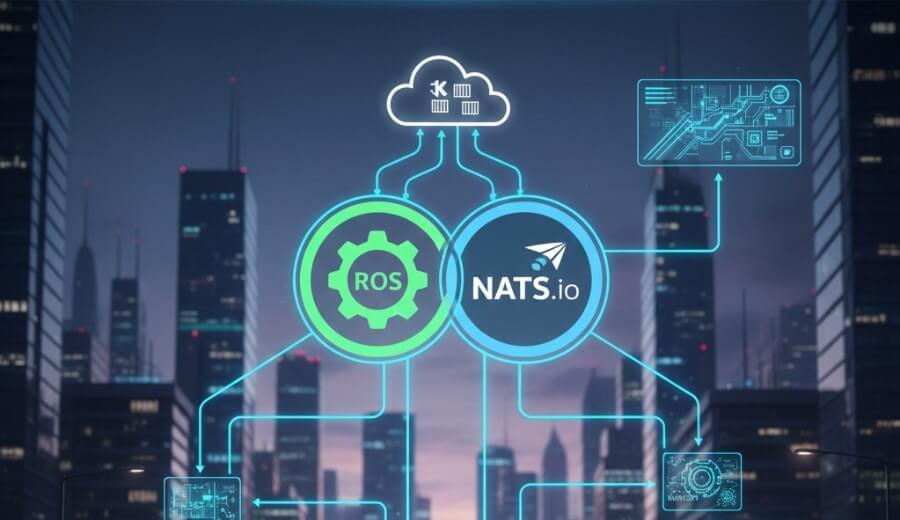
If you are a web developer or a cloud architect, the world of robotics often feels like a foreign land. We imagine humanoid machines and low-level C code that looks more like math than software. But modern robotics has moved away from monolithic codebases. Instead, it relies on Middlewares, the “glue” that allows different software parts to talk to each other.
Cyber-Physical Systems (CPS) are engineered systems that integrate computational elements with physical processes, playing a foundational role in robotics. While the Internet of Things (IoT) and Cyber-Physical Systems (CPS) share some similarities, CPS are distinguished by their deeper integration of computational and physical processes and their broader range of applications. CPS enables interaction between digital and physical components, driving advancements in robotics and other sectors.
The US National Science Foundation (NSF) has identified cyber-physical systems as a key area of research. Through its cps program, the NSF supports both foundational and community-inspired projects that advance CPS. The CPS-FR track emphasizes theoretical and foundational research that advances the core scientific and engineering principles underlying the integration of computation with physical processes and components. The CPS-CIR track aims to develop use-inspired research focused on the co-development of novel and translational innovations and systems with cyber-physical components, with proposals expected to be inspired and motivated by the needs of clearly defined communities. CPS research is inherently interdisciplinary and deeply connected to the vision of a connected community.
Before we look at the architecture, we need to understand the two main tools that make this possible: ROS 2 and NATS.
In robotics, system design involves integrating various software components and technology to enable real-time interaction between digital and physical components. The typical architecture of CPS consists of physical processes, sensors, communication networks, computational nodes, actuators, and control algorithms. CPS includes different components, like sensors, actuators, processors, and communication devices, which require sophisticated integration mechanisms. Human interaction is a crucial component in the design, operation, and resilience of CPS, ensuring these systems remain dynamic, adaptive, and community-centered.
The Contenders: ROS 2 and NATS in Cyber Physical Systems
What is ROS 2?
The Robot Operating System (ROS) is not actually an operating system like Windows or Linux. It is a flexible framework, a collection of tools, libraries, and conventions, designed to simplify the task of creating complex robotic behavior.
The “Batteries-Included” Choice: ROS 2 provides everything: drivers for cameras, algorithms for navigation, and 3D visualization tools.
Under the Hood: It uses a protocol called DDS (Data Distribution Service), which is a highly industrial, peer-to-peer standard designed for high-reliability environments. In ROS 2, system design focuses on creating scalable frameworks that integrate software components, enabling real-time feedback and robust operation for complex, cyber-physical systems.
What is NATS?
NATS is a cloud-native, open-source messaging system. While ROS was built specifically for robots, NATS was built for the distributed web and microservices.
The “Lean and Fast” Choice: It is incredibly lightweight, easy to deploy, and excels at connecting systems across different networks (like connecting a robot in a warehouse to a dashboard in the Cloud).
Under the Hood: It acts as a “central nervous system,” handling “Subject-based” messaging with extreme efficiency. NATS enables different components of a cyber-physical system to exchange data in real time, supporting coordination and autonomous decision-making across connected components.
Now, whether you use the specialized ROS 2 or the cloud-native NATS, the resulting architecture is the same: a robot is essentially just a cluster of microservices that happens to have wheels.
Physical System Components: The Hardware Behind the Microservices
While the software architecture of robotics often steals the spotlight, it’s the physical system components, the hardware, that truly bring cyber physical systems (CPS) to life. Think of these as the “hands, eyes, and nerves” of your robot, enabling the seamless integration of computational and physical elements to create deeply intertwined systems that interact with the real world.
At the heart of every CPS are physical devices like sensors, actuators, and controllers. Sensors gather data from the physical environment, temperature, motion, pressure, or even occupancy in a smart building. Actuators then use this sensor data to perform actions, such as adjusting a valve in an industrial control system or steering an autonomous vehicle through city traffic. Controllers act as the decision-makers, processing data and sending commands to other devices, ensuring the system responds intelligently to changing conditions.
The National Science Foundation has long recognized the transformative potential of CPS across various industries. CPS is integral to the Industry 4.0 movement, which is driven by hyper automation intelligence. In manufacturing, for example, CPS technologies optimize production lines, predict maintenance needs, and improve product quality by tightly integrating physical processes with digital analytics. In smart manufacturing, CPS allows robots to collaborate with humans and predict maintenance needs, preventing failures. In healthcare, medical monitoring systems use embedded sensors to collect and analyze patient data in real time, supporting better outcomes and safety. Smart grids and smart buildings leverage CPS to balance energy loads, optimize traffic flow, and enhance efficiency, all by exchanging data between digital and physical components. CPS technologies are also used in digital agriculture for measuring soil quality, moisture content, and optimizing irrigation and fertilizer usage, helping farmers make data-driven decisions and improve crop yields.
CPS applications include smart grids, autonomous vehicles, medical devices, and even aerospace systems such as automatic pilot avionics, highlighting their versatility across industries. CPS technologies are also used for measurement of soil quality and moisture content in digital agriculture.
What makes these systems truly powerful is their ability to be tightly integrated. Using standardized communication protocols and robust software libraries, like those provided by the ROS (Robot Operating System) client library, developers can ensure that physical elements and computational elements work together seamlessly. The ROS system, for instance, allows sensor data to flow effortlessly between devices, enabling rapid development and deployment of robot applications across multiple computers and platforms.
Security is also a top priority. As CPS become more prevalent in critical infrastructure, robust security measures are essential to protect against cyber threats. Machine learning and advanced embedded systems are increasingly used to detect anomalies, safeguard data collected from physical devices, and ensure the integrity of both digital and physical components.
Developing these engineered systems requires a multidisciplinary approach, blending expertise in engineering, computer science, and mathematics. Powerful developer tools, simulation environments, and the generous support of organizations like the ROS non-profit organization have accelerated innovation, making it easier than ever to build, test, and deploy CPS technologies.
In short, the physical system components of a CPS are the unsung heroes that bridge the digital and physical worlds. By enabling real-time data exchange, precise control, and adaptive responses to the environment, they form the foundation for next-generation applications in transportation, manufacturing, healthcare, and beyond. As CPS technologies continue to evolve, expect to see even more sophisticated integration of computational and physical elements, driving efficiency, safety, and productivity to new heights.
1. The Node is the Microservice
In a standard web application, we break functionality into microservices: one for authentication, one for the shopping cart.
In robotics, we call these Nodes.
One node handles the Lidar (the “Eyes”).
One node handles Localization (Calculating “Where am I?”).
One node handles Path Planning (Deciding “Where do I go?”).
Cyber-physical systems (CPS) have key features such as real-time operation, integration of cyber and physical components, adaptability, networking, and data-driven decision-making. These features enable CPS to operate autonomously, respond to changes in the physical environment with minimal delay, and optimize their performance over time.
Nodes in robotics interact directly with physical objects through sensors and actuators, enabling process control by monitoring and regulating complex physical processes. This allows the system to make decisions based on real-time data, learn from experience, and adapt its behavior for improved efficiency and safety.
Just like microservices, these nodes are decoupled. If the “Diagnostic” node crashes, the “Braking” node should still function. This isolation is what makes a system resilient.
2. Topics are the Message Brokers for Sensor Data
Microservices usually communicate via a message broker like Apache Kafka or RabbitMQ. Service A publishes an event (“Order_Created”), and Service B consumes it.
Robots work exactly the same way using a Publish-Subscribe (Pub/Sub) pattern:
The Camera Node publishes a stream of images to a topic called /camera/raw.
The Object Detection Node subscribes to that topic, processes the image, and publishes its results (“Found a human”) to /detected_objects.
The Safety Node listens and decides whether to stop the motors.
This allows you to add new features (like a recording node) without ever changing the code of the existing sensors.
3. Polyglot Development: C++ is your Go, Python is your JavaScript
In the web world, you choose the best tool for the job: Go for performance, Python for AI.
Robotics is the same:
C++ is used for the “critical path”, the parts that need to be blazingly fast, like motor control.
Python is used for the “high-level brain”, stuff like computer vision or mission logic.
Because NATS and ROS 2 use standard communication protocols, a C++ node can talk to a Python node as if they were written in the same language.
4. Orchestration: Launch Files are the Kubernetes Manifests
In the cloud, you don’t manually start 50 containers; you use Kubernetes to define how services should be deployed.
In robotics, we use Launch Files. These are scripts that tell the robot: “Start the Lidar, then start the navigation, and here are the configuration parameters for the speed limit.” It handles the lifecycle of the system, ensuring all “microservices” are up in the correct order.
5. Observability: Tracing and Monitoring
Web developers use Prometheus or Jaeger to trace requests. Robot engineers do the same, but with a spatial twist. They use:
Foxglove/Rviz: These are the “Grafana” of robotics. They visualize the topics in 3D, showing you exactly what the robot “sees.”
Rosbags/JetStream: This is the “logging” layer. Every message sent between nodes is recorded. If a robot fails, you “replay” the message stream to see exactly which microservice sent the wrong command. Analyzing historical data from these logs enables system optimization and predictive analytics, helping robotics teams improve decision-making and performance over time.
Robust Security Measures in ROS 2
As cyber physical systems become increasingly central to industries like manufacturing, healthcare, and transportation, robust security measures are more critical than ever. ROS 2 addresses these needs by embedding advanced security features directly into its framework, ensuring that data exchanged between nodes and devices remains protected from cyber threats.
ROS 2’s security framework is designed to safeguard both the digital and physical components of a system. It provides secure communication protocols that encrypt data as it moves between multiple computers and physical devices, preventing unauthorized access and tampering. Features such as authentication and authorization ensure that only trusted nodes can participate in the system, while encryption protects sensitive information during transmission.
These robust security measures are especially vital in applications like industrial control systems, medical monitoring, and autonomous vehicles, where the integrity and reliability of data can directly impact safety and performance. By supporting secure data exchange and control across distributed systems, ROS 2 helps developers build trustworthy robotics solutions that can withstand evolving cyber threats. Whether you’re managing a fleet of autonomous vehicles or deploying medical monitoring devices, ROS 2’s commitment to security ensures your cyber physical systems remain resilient and reliable.
Machine Learning Capabilities in Modern Robotics
Machine learning is revolutionizing the way robots interact with their environment, making them smarter, more adaptable, and capable of handling complex tasks. In the ROS ecosystem, machine learning algorithms can be seamlessly integrated with sensor data, allowing robots to perceive, interpret, and respond to the world around them.
For example, using the ROS client library and its extensive collection of software libraries, developers can incorporate popular machine learning frameworks like TensorFlow and PyTorch into their robotics projects. This enables robots to perform advanced tasks such as object recognition, scene understanding, and adaptive control. By analyzing sensor data in real time, robots can learn from experience, optimize their actions, and even predict future events in their environment.
Machine learning-based control algorithms empower robots to navigate autonomously, manipulate objects with precision, and interact naturally with humans. Whether it’s a robot learning to avoid obstacles in a dynamic environment or improving its performance through data-driven insights, ROS provides the tools and flexibility needed to bring intelligent, adaptive robotics to life.
Robot Operating System Applications in the Real World
The Robot Operating System (ROS) is at the heart of countless real-world applications, driving innovation across industries and transforming the way we interact with technology. In manufacturing, ROS enables the seamless control and coordination of robots and other devices, streamlining production lines and boosting efficiency. Its flexible operating system allows for the integration of sensors and software to monitor processes, ensure safety, and optimize resource use.
In healthcare, ROS powers advanced robotic systems for patient care, from robotic nurses that assist with daily tasks to surgical robots that enhance precision and safety in the operating room. The ability to integrate multiple devices and sensors makes ROS an ideal platform for developing medical monitoring systems that improve patient outcomes.
Transportation is another area where ROS shines, supporting the development of autonomous vehicles and smart traffic management systems. By connecting sensors, control systems, and other devices, ROS helps reduce congestion, enhance safety, and improve overall efficiency on the roads.
Beyond these sectors, ROS is making an impact in smart buildings, civil infrastructure, and environmental monitoring. Its ability to connect and control a wide range of devices and systems allows for optimized energy use, improved comfort, and enhanced safety in our built environment. With its open, customizable platform, ROS empowers developers to create innovative solutions that address real-world challenges and improve quality of life.
Future Prospects and Development in Robotics Middleware
The future of robotics middleware is bright, with rapid advancements shaping the next generation of cyber physical systems. As robots become more deeply intertwined with our daily lives, the demand for middleware that can handle complex, distributed, and intelligent systems is growing.
One major trend is the integration of cloud-based services and edge computing, enabling robots to process and analyze vast amounts of data in real time. This shift allows for smarter, more responsive systems that can adapt to changing environments and user needs. At the same time, the importance of robust security measures is increasing, as protecting against cyber threats becomes essential for the safe and reliable operation of robotics systems.
The National Science Foundation has identified cyber physical systems as a key area of research, supporting initiatives that drive innovation in this field. The ROS community, backed by generous support and active research, continues to develop new technologies and standards that enhance the capabilities of robotics middleware.
As robotics technology evolves, middleware like ROS will play a pivotal role in enabling more sophisticated, autonomous, and collaborative robots. These systems will not only interact with the physical world but also learn from data, ensure safety, and work alongside humans in complex environments. The ongoing development of robotics middleware promises to unlock new possibilities, making engineered systems smarter, safer, and more efficient than ever before.
Conclusion
The next time you see a complex robot, don’t be intimidated by the hardware. Look past the sensors and the motors. What you’re really seeing is a beautifully orchestrated cluster of microservices communicating in real-time.
By applying cloud-computing wisdom, like CI/CD, unit testing, and NATS-style messaging, to robotics, we aren’t just building machines; we are building distributed software that can walk, fly, and drive.