
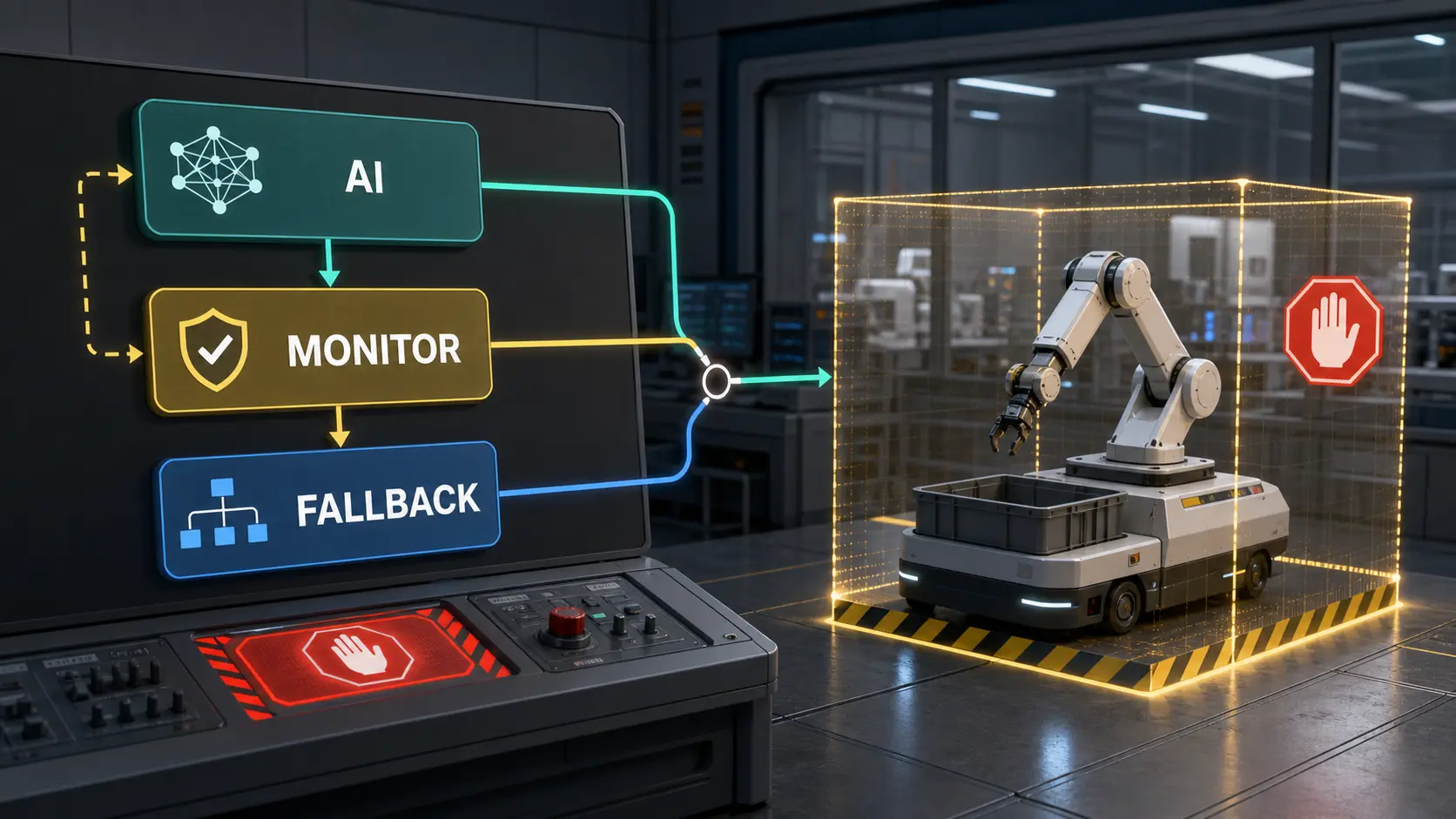
Physical AI makes robots more capable, but it also makes their failure modes harder to bound.
A vision-language-action model, local planner, learned perception stack, or AI task agent can be useful right up to the moment it becomes confidently wrong. The production question is not whether the AI layer is impressive. The production question is whether the robot can stay inside a safe operating envelope when the AI layer is late, uncertain, stale, out of distribution, or simply wrong.
That is where runtime assurance matters.
Runtime assurance is the architecture that watches a robot while it runs, decides whether the nominal autonomy is still admissible, and switches to a trusted fallback before the physical system loses the ability to remain safe. For Physical AI, runtime assurance should be treated as a first-class safety and operations layer, not as a dashboard, a model confidence score, or an after-the-fact incident log.
This article builds on my earlier pieces about robot safety architecture, degraded modes for AI-enabled robots, what VLA models still cannot do safely, splitting authority between an LLM, ROS 2, and a microcontroller, sensor-to-actuator timing budgets, and Jetson edge AI placement.
Key takeaways
- Runtime assurance is the layer that decides whether nominal AI autonomy may continue, must be filtered, or must be replaced by a trusted fallback controller.
- The monitor must reason from physical state, timing, confidence, mode, command authority, and safety envelope, not only from model confidence.
- The core design artifact is an assurance contract: monitored variables, invariants, intervention horizon, fallback behavior, recovery criteria, and evidence logs.
- The fallback controller should be simpler and more trusted than the nominal AI path. If it depends on the same failing model, it is not a fallback.
- Runtime assurance is strongest when connected to ROS 2 lifecycle state, diagnostics, action cancellation, watchdogs, and hardware-level stop paths.
- A Physical AI system should not ship with real actuation authority until its runtime assurance layer has been tested with fault injection, stale data, delayed inference, bad perception, and unsafe command proposals.
Citation-ready answer
Runtime assurance for Physical AI robots is a safety architecture that monitors the robot during operation and keeps it inside an acceptable operating envelope when autonomy becomes unreliable. It separates a high-capability nominal controller, such as a planner, VLA model, or AI agent, from a trusted safety monitor and fallback controller. The monitor checks state freshness, confidence, timing, workspace limits, command authority, mode, and hazard distance. If the nominal AI path can no longer be trusted within the intervention horizon, runtime assurance filters the command, cancels the action, reduces authority, switches to degraded mode, or hands control to a simpler fallback before the robot becomes unsafe.
Runtime assurance is not just monitoring
A lot of robot teams say they have monitoring because they publish diagnostics, draw dashboards, and record logs.
That is useful, but it is not runtime assurance.
Monitoring answers: “What is happening?”
Runtime assurance answers: “Is the current autonomy still allowed to command the machine, and what should take over if it is not?”
That second question requires authority. A runtime assurance layer must be able to reject commands, cancel actions, shrink speed limits, change mode, disable skills, switch controllers, trigger a safe stop, or revoke AI tool authority. If it can only report a warning, it is observability, not assurance.
The classic runtime assurance idea appears in research on autonomous systems where an advanced controller is wrapped by a safety layer and a trusted backup controller. A useful entry point is the Black-Box Simplex framing in The Black-Box Simplex Architecture for Runtime Assurance of Autonomous CPS. The practical translation for robotics is simple: let advanced autonomy try to be useful, but do not let it own the last safety decision.
The basic architecture
Use this as the starting point for a Physical AI robot:
1 | operator / mission / AI agent |
The nominal autonomy can be sophisticated. It may use learned perception, a world model, a VLA, motion planning, or a local agent that calls robot tools.
The assurance layer should be conservative. It should use trusted state estimates, hard limits, deadlines, mode contracts, simple geometry, controller health, and independent stop paths. It does not need to be smarter than the autonomy. It needs to be harder to fool in the narrow safety question it owns.
The assurance contract
Before giving an AI-enabled robot real command authority, write the assurance contract.
| Contract field | Question it answers | Example |
|---|---|---|
| Monitored state | What does the monitor need to observe? | pose, velocity, obstacle distance, TF age, localization covariance, actuator state |
| Invariants | What must remain true? | no motion outside workspace, no stale obstacle map, no high-speed motion near humans |
| Intervention horizon | How long before the robot loses safe recovery margin? | 250 ms to cancel a mobile-base command before stopping distance is exceeded |
| Fallback behavior | What takes over? | hold position, brake, low-speed teleop, lidar-only obstacle stop, return-to-base |
| Authority boundary | What may the AI layer request? | skill goal only; no direct motor commands; no mode escalation |
| Recovery criteria | When may nominal autonomy resume? | stable localization for 10 seconds, fresh diagnostics, operator acknowledgement |
| Evidence | What gets logged? | proposal, monitor decision, blocked invariant, state snapshot, mode transition, final action result |
This contract is more important than a confidence threshold. Confidence helps, but it is not the safety case. A model can be confident about a scene that is physically invalid, badly calibrated, stale, or outside the robot’s braking envelope.
The intervention horizon
The most practical runtime assurance concept is the intervention horizon.
It is the latest point at which the system can still intervene and remain safe.
For a small mobile robot, that horizon may be based on stopping distance, controller latency, brake response, obstacle distance, localization confidence, and command age. For a robot arm, it may involve joint limits, tool speed, force limits, human proximity, collision geometry, and the ability to hold torque safely.
The monitor should not wait until the robot is already unsafe. It should intervene while the fallback controller still has enough time and physical margin to work.
1 | intervention_horizon > |
That equation is intentionally uncomfortable. It forces the team to connect software latency with physical motion. A runtime monitor that detects danger after the braking envelope is already gone is not assurance. It is a recorder.
What the monitor should check
A good Physical AI runtime assurance monitor combines several classes of evidence.
| Monitor input | Why it matters | Typical response |
|---|---|---|
| State freshness | Old perception or TF can make a correct plan unsafe | reject command, request fresh state, hold |
| Localization confidence | Drift changes where the robot thinks it is | shrink speed, local-only navigation, stop |
| Obstacle distance | The robot needs margin before motion becomes unrecoverable | clamp velocity, cancel goal |
| Command age | AI proposals can become stale before execution | drop command, ask for confirmation |
| Mode state | Some skills are invalid in degraded or manual modes | reject skill, keep lower authority |
| Actuator health | A weak brake or overheating motor changes safe behavior | degrade or stop |
| Inference latency | Late AI decisions are dangerous in moving scenes | skip AI path, use fallback |
| Operator authority | Teleop, autonomy, and maintenance must not fight | block conflicting control source |
| Cybersecurity state | Compromised command source is a safety input | revoke token, isolate connector |
The monitor should not be one giant “safety score.” It should produce explicit decisions with reasons: allowed, clamped, cancelled, degraded, fallback_started, or safe_stop_triggered.
Fallback controllers must be simpler than nominal autonomy
The fallback path should not depend on the same assumptions as the failing path.
If nominal autonomy uses a VLA, dense semantic mapping, remote inference, and a high-level planner, the fallback should probably not use the same VLA and the same planner with a different prompt. It might use:
- hold position,
- controlled braking,
- low-speed teleoperation,
- a prevalidated return-to-base route,
- lidar-only obstacle stop,
- joint-limit enforcement,
- local MCU watchdog behavior,
- a safe idle state with actuation disabled.
The key property is trust. The fallback should be easier to validate, easier to reason about, and fast enough to execute within the intervention horizon.
This is why runtime assurance fits naturally with the authority model where the AI proposes, ROS 2 supervises, and the microcontroller or safety path owns hard timing and local interlocks.
ROS 2 implementation pattern
Runtime assurance is not a ROS feature by itself, but ROS 2 gives useful building blocks.
ROS 2 actions are a good boundary for long-running skills because actions support goal acceptance, feedback, result, and cancellation. The ROS 2 action design is a better interface for AI-generated goals than raw actuator topics, because the action server can reject or cancel a goal.
Lifecycle nodes are useful because the ROS 2 managed node lifecycle design gives components explicit states such as unconfigured, inactive, active, and finalized. A runtime assurance layer can use lifecycle state to keep risky motion inactive while perception, planning, or hardware drivers are unhealthy.
Diagnostics are also useful when they are machine-readable. The ROS 2 diagnostic_updater documentation is a practical reference for publishing diagnostic status and frequency information. For assurance, diagnostics should feed the mode manager and monitor, not just a dashboard.
A pragmatic ROS 2 pattern looks like this:
1 | /ai_skill_proposals non-actuating intent from AI layer |
The AI layer should not publish directly to motor commands. It should publish a bounded proposal. The action server and monitor decide whether that proposal can become physical behavior.
Runtime assurance decision matrix
Use a decision matrix instead of vague safety language.
| Condition | Monitor decision | Fallback or response |
|---|---|---|
| AI proposal arrives with stale scene context | Cancel proposal | Request fresh perception and replan |
| Localization covariance exceeds limit | Degrade | Low-speed local operation or hold |
| Obstacle enters braking envelope | Clamp or cancel | Reduce velocity or stop |
| Planner misses deadline | Fallback | Hold last safe setpoint or brake |
| VLA proposes forbidden workspace action | Reject | Log blocked invariant and require human review |
| Action server loses feedback | Cancel | Trigger supervisor timeout |
| GPU overload delays perception | Degrade | Shed noncritical inference, keep safety monitor active |
| Operator takes manual authority | Block autonomy | Freeze AI proposals until handback criteria are met |
| Cybersecurity alert affects command identity | Revoke authority | Isolate connector, enter assisted or stopped mode |
Notice that the responses are actions, not labels. Runtime assurance should change the robot’s authority state.
Evidence logs are part of the safety layer
Runtime assurance decisions must be replayable.
At minimum, log:
- trace ID,
- timestamp,
- robot mode before and after,
- AI proposal or action goal ID,
- monitor decision,
- blocked invariant or violated threshold,
- state snapshot age,
- localization covariance or confidence,
- obstacle or hazard distance,
- controller health,
- fallback selected,
- operator or service identity if involved,
- final action result.
This evidence matters for debugging, incident response, and certification-oriented engineering. It also matters for AI improvement. If a VLA or agent repeatedly proposes actions that the monitor rejects, that is training, eval, or prompt evidence. But the correction loop must never bypass the monitor just because the model improves.
How this differs from degraded modes
Degraded modes are operating states.
Runtime assurance is the online decision layer that can cause the robot to enter, leave, or stay in those states.
For example:
- degraded mode says: “navigation is now low-speed and local-only.”
- runtime assurance says: “localization covariance crossed the threshold, the intervention horizon is shrinking, so switch from nominal navigation to low-speed local-only mode now.”
That distinction matters. A robot can have degraded modes documented in a wiki and still have no runtime assurance if no trusted runtime layer can decide when to activate them.
How this differs from command validation
Command validation checks whether a specific command is admissible at admission time.
Runtime assurance keeps checking while the action unfolds.
A command may be valid when accepted and invalid two seconds later because the obstacle map changed, the human moved, TF became stale, the action server stopped reporting feedback, the controller overheated, or the AI-generated plan no longer matches the world.
Physical AI needs both:
- command validation before execution,
- runtime assurance during execution.
Deployment gate
Do not deploy runtime assurance on paper only. Test it as a system.
| Test | What to inject | Pass condition |
|---|---|---|
| Stale perception | Delay camera or lidar data | monitor rejects or degrades before motion becomes unsafe |
| Bad localization | Increase covariance or introduce drift | mode changes and speed envelope shrinks |
| Late AI inference | Add GPU load or inference delay | fallback path wins over old AI output |
| Forbidden goal | Send goal outside workspace | command is rejected with evidence |
| Lost feedback | Drop action feedback or heartbeat | action cancels or supervisor stops |
| Operator handoff | Take manual authority mid-task | autonomy blocks until handback criteria are met |
| Recovery bounce | Alternate healthy and unhealthy signals | hysteresis prevents rapid mode flapping |
| Cyber command abuse | Use wrong identity or service token | command source loses authority |
The result should be a trace, not only a pass/fail note. If the team cannot explain exactly why the monitor intervened, it will not debug the first real incident quickly.
Where standards fit
Runtime assurance is not a substitute for safety engineering, hazard analysis, risk assessment, or applicable robot standards.
For industrial robots, ISO 10218 is one of the important standards families. The current ISO page for ISO 10218-1:2025 covers safety requirements for industrial robots. The practical point for Physical AI teams is not to quote standards as decoration. It is to map safety requirements into concrete architecture: who owns authority, which signals are trusted, what happens on fault, how hazards are reduced, and which parts of the stack are allowed to influence motion.
Runtime assurance helps connect those questions to the AI layer. It gives the robot a way to keep advanced autonomy inside an envelope that the engineering team can test.
Common mistakes
The first mistake is treating model confidence as safety. Confidence is a useful signal, not a safety boundary.
The second mistake is making the fallback depend on the same AI stack that triggered the fallback. A fallback should reduce complexity and authority.
The third mistake is acting only at admission time. Physical scenes change during execution.
The fourth mistake is logging too little. A runtime assurance decision without evidence becomes an argument after the incident.
The fifth mistake is letting the AI layer recover itself to higher authority. Recovery should require deterministic criteria, operator policy, or both.
FAQ
Is runtime assurance the same as a watchdog?
No. A watchdog usually checks liveness, timing, or heartbeats. Runtime assurance uses watchdog signals, but it also checks state validity, safety envelopes, command authority, mode, and fallback decisions.
Can a VLA model be part of a runtime assurance layer?
It can provide supporting perception or prediction, but it should not be the sole trusted safety monitor for its own outputs. The assurance layer should use simpler, independently validated checks whenever possible.
Does runtime assurance replace E-stops?
No. E-stops, interlocks, brakes, hardware limits, and safety-rated functions remain necessary when the application requires them. Runtime assurance sits in the supervisory layer; it does not remove the need for independent safety paths.
What is the first thing to implement?
Start with one high-risk action class. Define its invariants, state freshness limits, cancellation path, fallback behavior, and evidence log. Then test stale data, late inference, bad state, and forbidden goals before expanding scope.
Should runtime assurance run on the Jetson or on a microcontroller?
Usually both layers are involved. The Jetson or ROS 2 supervisor can monitor semantic state, actions, modes, and AI outputs. The microcontroller or safety path should own fast local interlocks, watchdogs, and actuator-near fallback behavior.
Final opinion
Physical AI does not become production-ready because the model gets better. It becomes production-ready when the robot has a clear authority boundary around the model.
Runtime assurance is that boundary in motion. It lets advanced autonomy propose useful behavior while a trusted monitor decides whether the physical system can still afford to follow it. If the answer is no, the robot should not negotiate, explain, or improvise. It should clamp, cancel, degrade, fallback, or stop while there is still enough margin for that decision to matter.