
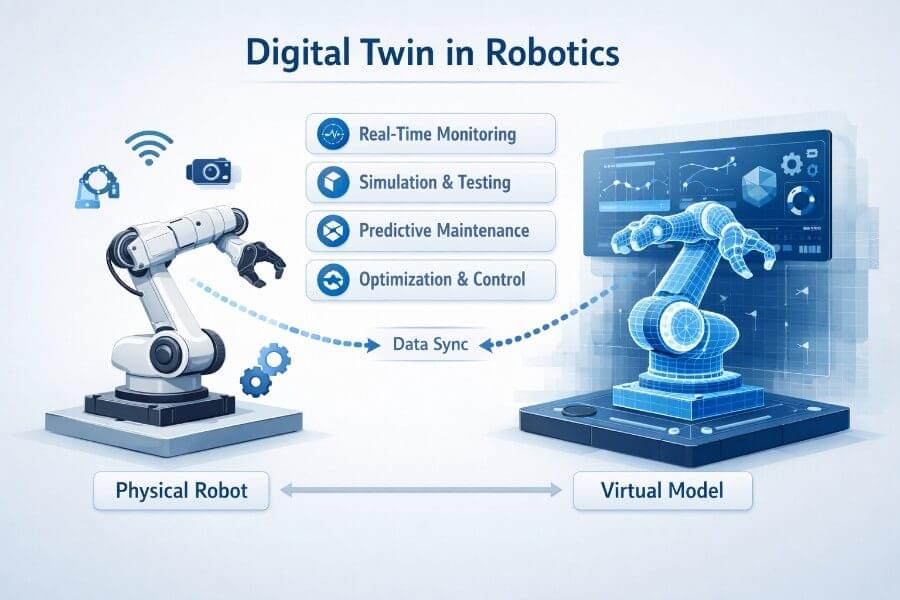
The term digital twin in robotics is one of the most overused — and misunderstood — concepts in modern engineering. Digital twins are used to create dynamic digital replicas of physical products and their physical counterparts, not just in robotics but also in construction, manufacturing, and other industries.
It appears in discussions about:
Industry 4.0
Autonomous robots
AI-driven manufacturing
Cyber-physical systems
Predictive maintenance
Smart factories
Humanoid robotics
Digital twins are also playing a growing role in smart cities and the built environment, especially for urban planning and infrastructure management.
Yet, many articles blur the line between simulation, 3D modeling, and true digital twin systems.
In this in-depth guide, we will:
Define what a digital twin in robotics really is
Explain the technical architecture behind it
Clarify what it is not
Compare simulation vs digital twin
Explore real-world industrial and autonomous robotics examples
Analyze challenges and limitations
Discuss why digital twins are foundational for physical AI systems
Digital twins are increasingly used in complex environments and real world applications, such as modeling urban environments with interactive 3D and 4D platforms. They are transforming construction and urban planning, with geographic digital twins popularized in the Smart Cities movement and the built environment.
This article is technical — but written to remain accessible for beginners entering robotics, AI, or cyber-physical systems.
1. What Is a Digital Twin? (Precise Technical Definition)
The term “digital twin” was popularized in aerospace and industrial engineering communities, notably by:
NASA
Gartner
General Electric
A rigorous definition:
A digital twin is a dynamic digital representation of a physical product or physical object that is continuously updated with real-world operational data and used for monitoring, simulation, prediction, optimization, and control. The digital twin maintains a synchronized connection with its physical counterpart, ensuring that the digital model accurately reflects the state and behavior of the real-world system.
Digital twins use IoT sensors and a digital thread to enable real-time data exchange and synchronization between the digital representation and the physical counterpart.
Let’s break this down for clarity.
Dynamic Virtual Representation of the Physical World
A digital twin is not a static 3D model. It is a dynamic virtual model—a detailed digital representation of a physical asset or system that evolves over time.
It reflects:
Kinematic state (position, velocity)
Dynamic state (forces, torque)
Environmental context
Sensor data
System health
Internal variables
Continuous Data Synchronization
The key differentiator of a real digital twin is continuous synchronization with the physical asset.
This synchronization relies on real world sensor data and ongoing data collection to ensure the digital twin accurately reflects changes in its physical counterpart.
Without live telemetry, you do not have a digital twin — you have a simulation snapshot.
Operational Usage
A digital twin must be usable for:
Real-time monitoring
Predictive maintenance
What-if analysis
Performance optimization
Operational efficiency, by optimizing operations, reducing energy consumption, and improving response times
Supporting informed decisions through real-time insights and comprehensive data analysis
AI policy testing
System validation
Digital twins can enhance operational efficiency by simulating real-world conditions and forecasting potential issues, allowing organizations to proactively address challenges and streamline processes.
In robotics, this means the twin mirrors the robot’s real-world operational state in real time or near real time.
2. Digital Twin vs Simulation in Robotics (Critical Distinction)
One of the most important SEO-relevant clarifications:
A simulation is not automatically a digital twin.
This confusion is common in robotics.
Tools like:
Gazebo
Webots
Isaac Sim
are simulation environments that provide a simulated environment or virtual world for training and testing robots. These digital environments are essential for developing and validating physical AI models, often using synthetic data to generate diverse training data. However, training a robot in simulation, even with synthetic data and reinforcement learning, is not digital twin technology. Digital environments and synthetic data are often used for training data generation in simulation, but this process is distinct from the real-time synchronization required for a digital twin.
These platforms become part of a digital twin architecture only when:
The real robot streams live telemetry
The simulator reflects the robot’s current state
There is state alignment and synchronization
The system can influence the physical robot
Key Differences for Robotics Engineers
| Simulation | Digital Twin |
|---|---|
| Offline | Connected to physical robot |
| Hypothetical | Real-world synchronized |
| Static initial conditions | Continuously updated with real world conditions |
| No operational responsibility | Used for real operational decisions and real world applications |
| In robotics development: |
Sim-to-real training is not a digital twin.
Offline reinforcement learning simulation is not a digital twin.
A 3D dashboard showing robot pose is not necessarily a digital twin.
A digital twin exists only when the digital and physical systems are tightly coupled. Digital twins enable a feedback loop by using operational data and real world conditions to inform design improvements, maintenance planning, and performance optimization. This closed feedback loop is especially critical for real world applications where continuous improvement and adaptation to dynamic environments are required.
3. Digital Twin Architecture in Robotics (Deep Technical View)
Let’s analyze the full architecture stack.
Digital twins require robust system architectures, significant computational power, and reliable network connectivity to function effectively. Seamless integration between hardware, software, and data infrastructure is essential for a functional digital twin.
3.1 Physical Layer (The Robot)
The physical system includes:
Motors and actuators
Encoders
IMUs
Cameras
LiDAR
Microcontrollers
Edge compute (e.g., NVIDIA Jetson)
Networking modules
Robots operate in diverse physical spaces and must account for varying environmental conditions, which can impact system performance and safety. Real-time data processing at the edge is critical for capturing and transmitting accurate telemetry from the physical space to the digital twin.
Robotics middleware like:
ROS 2
Isaac ROS
allows publishing structured telemetry:
1 | /joint_states |
Without high-fidelity telemetry, the twin cannot mirror reality accurately.
3.2 Communication & Data Infrastructure Layer
This is often overlooked.
Digital twins require:
Deterministic communication
Time synchronization (NTP/PTP)
Reliable message delivery (DDS, MQTT)
Data buffering
State reconstruction
Robust network connectivity for real-time data exchange between the robot and the digital twin
Continuous data collection from sensors and devices to maintain accurate synchronization
Large-scale digital twin deployments may also require dedicated data centers to support the computational and storage needs of high-performance computing, especially for scalable inference workloads.
Challenges:
Latency
Packet loss
Sensor noise
Clock drift
In robotics, millisecond-level drift can destabilize alignment between digital and physical states.
This is why time synchronization protocols and state estimation filters (e.g., EKF) are critical.
3.3 Virtual Twin Layer
The digital twin environment typically includes:
Physics engine
Kinematic model
Collision detection
Sensor simulation
Visualization
Environmental modeling
The virtual twin operates within a virtual space or digital environment, which serves as a simulated environment for testing and training autonomous systems. These digital environments or virtual worlds enable safe and efficient development by allowing AI models to interact with realistic scenarios before real-world deployment. Synthetic data can be generated within these virtual worlds to support the development and validation of AI models.
Common platforms:
Unity
Unreal Engine
Isaac Sim
The twin replicates:
Joint states
Robot localization
External environment
Sensor perception
In advanced robotics, the digital twin may reconstruct full 3D scenes from sensor fusion pipelines.
3.4 Intelligence & Analytics Layer
This is where digital twins become powerful AI systems.
Capabilities include:
Predictive maintenance modeling
Reinforcement learning validation
Failure scenario testing
Optimization algorithms
Energy consumption analysis
Throughput optimization
AI models for perception and reasoning
Machine learning for adaptive behavior
Decision making in real-time environments
Continuous improvement is achieved through ongoing analysis of training data and operational feedback, allowing the system to iteratively enhance its performance. Reinforcement learning is a key technique for enabling autonomous machines to learn from their environment, and a continuous learning loop connects the physical and digital worlds, enhancing operational capabilities over time.
In AI-enabled robotics:
The twin tests alternative policies
The twin stress-tests edge cases
The twin forecasts degradation
At scale, this becomes fleet-level intelligence.
4. What a Digital Twin Is NOT (Clarifying Misconceptions)
For SEO and conceptual clarity:
It’s important to clarify that not every virtual model, simulated environment, or use of synthetic data qualifies as a digital twin. A digital twin is specifically a virtual representation that is continuously synchronized with its real-world physical counterpart, enabling real-time monitoring, simulation, and optimization.
A virtual model or simulated environment—such as those used for training AI models or autonomous robots, or for generating synthetic data—can be valuable for design, prototyping, and testing. However, unless this virtual model or simulated environment is actively linked and updated with data from the physical system, it does not meet the definition of a digital twin.
Synthetic data generated in these environments supports robust AI development and reduces the need for extensive real-world data collection, but its use alone does not create a digital twin unless the virtual representation is synchronized with the actual asset or process.
Not Just a 3D Model
A CAD model in SolidWorks is a static virtual model or digital representation of a physical object.
No telemetry. No real-time synchronization. No operational feedback.
A virtual model or digital representation alone, without real-time synchronization with its physical counterpart, is not a digital twin.
Not Just a Robot Simulator
Running a robot in a simulated environment or virtual world without live coupling to hardware is not digital twinning.
That is virtual prototyping.
Not Just Cloud Monitoring
A dashboard showing battery level is monitoring — not a twin.
Effective digital twins require advanced data processing to collect, structure, and analyze real-time sensor data from physical environments. Additionally, seamless integration between monitoring platforms and the digital twin system is essential to enable interoperability and real-time collaboration.
Unless:
The full system state is reconstructed
Predictive models are applied
The system can simulate forward states
Not Just AI Training
Training a robot in simulation before deployment is not digital twin technology. Training physical AI typically involves the use of synthetic data, simulation, and reinforcement learning to develop models that can perform effectively in the real world. Synthetic data generated in high-fidelity simulation environments or with digital twins helps create diverse and robust training datasets for physical AI agents, such as robots or autonomous vehicles. However, this training process is distinct from deploying a digital twin, which operates during real-world deployment.
5. Types of Digital Twins in Robotics
Digital twins exist on a maturity spectrum. They are widely applied across various domains, including manufacturing processes, civil infrastructure, and the built environment. In manufacturing, digital twins are used to simulate, optimize, and validate workflows, as well as to enable predictive maintenance that reduces unplanned downtime. In construction, digital twins are often integrated with Building Information Modeling (BIM) to track project progress in real time, improving efficiency and oversight. For civil infrastructure and the built environment, digital twins support innovations in disaster response, transportation, and urban planning, enhancing the safety, efficiency, and resilience of physical assets and urban spaces.
5.1 Monitoring Twin
State mirroring
Fleet dashboards
Telemetry replication
Digital twins monitor physical assets and enhance operational efficiency by utilizing real-time sensor data during production. This allows for continuous tracking of equipment status, performance, and safety, leading to optimized operations and improved response times.
Common in industrial automation.
5.2 Diagnostic Twin
Fault detection
Thermal modeling
Wear prediction
Failure root cause analysis
Digital twins are also increasingly used in civil infrastructure to reduce the need for manual visual inspections of buildings and infrastructure after earthquakes or other extreme events.
Used heavily in aerospace and manufacturing.
5.3 Predictive Twin
Forecast system degradation
Predict motor failure
Optimize maintenance schedule
Predict energy usage
This is AI-driven robotics infrastructure.
5.4 Autonomous Decision Twin
Twin evaluates action safety
Twin simulates forward trajectory
Twin constrains physical robot behavior
Supports autonomous systems, autonomous machines, and AI agents in making real-time decisions
Physical AI enables these systems to perceive, understand, reason, and perform complex actions in the physical world by combining AI models with sensors and actuators. While these autonomous operations are powerful, human oversight remains essential to ensure safety, reliability, and trust in deployment.
Emerging in:
Autonomous vehicles
Humanoid robotics
Advanced warehouse automation
6. Digital Twins in Industrial Robotics
Industrial robotics is where digital twin technology is most mature.
On the factory floor, digital twins are used to simulate and optimize manufacturing processes and complex processes, such as advanced welding and automation tasks. This enables virtual testing and process planning for intricate procedures, improving performance and reducing costs.
Companies like:
Siemens
Bosch
ABB
use digital twins to:
Simulate full production lines to identify bottlenecks and optimize machinery layout before installation
Optimize throughput
Predict component wear
Reduce unplanned downtime through predictive maintenance
Improve safety compliance
A robotic assembly line twin may simulate:
Cycle time adjustments
Tool replacement
Line reconfiguration
Multi-robot coordination
Without stopping production.
This reduces cost dramatically.
7. Digital Twins in Autonomous and Mobile Robots
In mobile robotics:
Twin mirrors SLAM map
Twin replays navigation trajectories
Twin tests alternate path planning strategies
Twin simulates sensor occlusion scenarios
Twin simulates various weather conditions and dynamic environments to ensure robust performance
Twin enables training and testing in complex environments, which is essential for reliability and safety
For humanoid robots:
Twin models full-body kinematics
Twin simulates balance perturbations
Twin tests locomotion policy stability
Twin allows evaluation in dynamic and complex environments, including different weather conditions
For drone fleets:
Twin models airspace coordination
Twin predicts collision scenarios
Twin optimizes energy usage
Twin simulates flight in complex environments and under diverse weather conditions
This is increasingly critical for AI-enabled physical systems.
8. Digital Twin vs World Model (AI Context)
In robotics AI research:
A world model is an internal representation learned by an AI system.
A digital twin is an external synchronized representation of a real physical asset.
World models:
Exist inside neural networks
Learn environmental structure
Are probabilistic
Digital twins:
Represent specific physical systems
Are data-driven
Are operational tools
Explicitly model spatial relationships between objects in the physical space, supporting accurate simulation and analysis
They overlap — but they are not interchangeable.
9. Why Digital Twins Matter for Cyber-Physical Systems
Robots are cyber-physical systems (CPS) that integrate computation with physical processes and components to enhance community well-being. CPS technologies and engineered systems combine software, AI, mechanical hardware, sensors, and actuation, with digital twins enabling real-time monitoring and optimization of physical processes. CPS research emphasizes the interdependence between computational processes, the physical environment, and human participants.
Digital twins enable:
Safer experimentation
Continuous optimization
Faster iteration cycles
Reduced mechanical risk
AI validation before actuation
Creation of reliable and resilient systems that enhance quality of life and community well-being
CPS technologies are designed to improve safety, wellness, security, efficiency, dependability, and resilience in communities.
For advanced robotics engineers:
Digital twins are becoming core infrastructure — not optional tooling.
10. Real Technical Challenges
Digital twin marketing hides complexity.
Real-world challenges include: data integration, interoperability, data integrity, and data processing. Ensuring accurate data collection, structuring, and analysis from real-time sensor inputs is critical. Robust system architectures and tailored designs are essential to support digital twin applications.
Time synchronization errors
Model drift
Physics engine inaccuracies
Sensor noise
Bandwidth limitations
Security vulnerabilities
Data integrity issues
Building a robust digital twin system is significantly harder than building a simulator.
11. The Future of Digital Twins in Robotics
The future trends include:
AI-enhanced digital twins
Fleet-level shared twins
Continual learning twins
Edge-to-cloud hybrid twins
Self-healing robotic systems
Generative AI and physical AI models will play a key role in advancing digital twin capabilities, enabling systems to perceive, reason, and act within real-world contexts. The integration of digital twins with physical AI allows for realistic simulations that enhance the training of autonomous systems. Digital twins also enable continuous improvement by supporting ongoing data-driven updates and optimization throughout the system lifecycle.
Digital twins support a wide range of real world applications, including autonomous vehicles, robotics, renewable energy, and heritage conservation, by providing operational efficiency and tangible benefits in real-world deployments. By 2026, about 75% of businesses are expected to use digital twins to improve efficiency and reduce costs.
As physical AI advances, digital twins may become:
The operational intelligence backbone of robotics infrastructure.
Final Summary
NVIDIA offers advanced digital twin and training software that significantly enhances the development and deployment of physical AI systems. Their platform, including NVIDIA Omniverse, provides a high-fidelity simulation environment that enables the creation of detailed digital twins with realistic physics and environmental interactions. This virtual space supports synthetic data generation, training, and validation of AI models, allowing autonomous machines such as robots and self-driving cars to learn safely and efficiently before real-world deployment. NVIDIA’s software integrates reinforcement learning frameworks and supports large-scale simulations, accelerating the training process and improving the accuracy and robustness of physical AI models. By combining powerful computational resources with sophisticated simulation tools, NVIDIA’s digital twin and training software help bridge the gap between virtual training and real-world autonomous operations.
A digital twin in robotics is:
A live, synchronized virtual replica
Connected to real-world telemetry
Used for prediction, optimization, and control
Often bi-directional
It is NOT:
Just a simulator
Just a CAD model
Just a dashboard
Just AI training
When implemented correctly, digital twin technology transforms robotics from reactive systems into predictive, intelligent, cyber-physical systems.
Sources & References
Digital Twin – Wikipedia (Definition & History)
https://en.wikipedia.org/wiki/Digital_twinDigital Twin: Data Exploration, Architecture, Implementation (PMC Article)
https://pmc.ncbi.nlm.nih.gov/articles/PMC10912257/ABB – Digital Twin Applications (Industrial Perspective)
https://new.abb.com/industrial-software/features/model-predictive-control-mpc/digital-twin-applicationsThe Development of a Digital Twin Framework (MDPI Sensors Journal)
https://www.mdpi.com/1424-8220/22/19/7232Digital Twins of Robotic Systems: Increasing Capability for Industrial Applications (Research Article)
https://www.researchgate.net/publication/368922522_Digital_Twins_of_Robotic_Systems_Increasing_Capability_for_Industrial_ApplicationsDigital Twin: Benefits, Use Cases, Challenges, and Opportunities (ScienceDirect)
https://www.sciencedirect.com/science/article/pii/S277266222300005XWhat Is a Digital Twin? (Industrial Overview – Inbolt)
https://www.inbolt.com/resources/blog/what-is-a-digital-twin/