
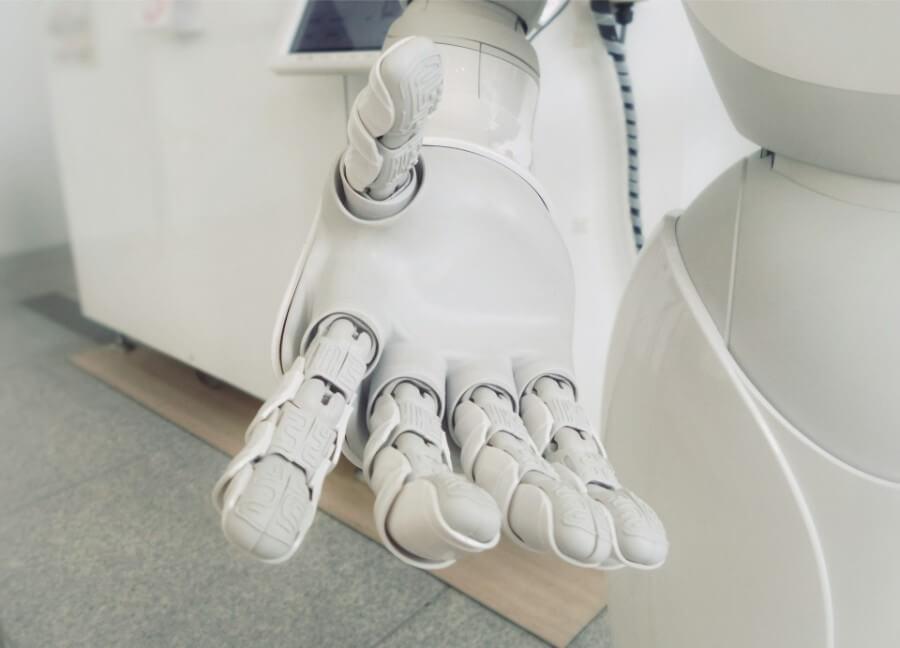
For the last few years, “AI” mostly meant software that could classify, recommend, generate text, or produce images. In 2026, that definition is no longer big enough.ction, manufacturing, and other industries.
The phrase Physical AI has started to dominate robotics conversations because the industry is moving from models that only describe the world to systems that must perceive, predict, decide, and act inside it. At CES 2026, the Consumer Technology Association explicitly framed robotics as a breakout “physical AI” category, highlighting the convergence of analytical AI, generative AI, simulation-based training, and embodied machines. Physical AI enables the integration of digital and physical worlds, allowing autonomous systems to bridge these realms for continuous learning and operational efficiency. NVIDIA centered its CES keynote and press materials around open models, world models, Jetson robotics computers, and robot-development infrastructure, while companies like Boston Dynamics, LG, and NEURA Robotics used the event to show where this is heading in practice.
That shift matters well beyond humanoids. It matters for warehouse robots, mobile manipulators, autonomous construction equipment, industrial inspection systems, smart buildings, autonomous labs, medical machines, and any cyber-physical system where software decisions change the state of the real world. In other words, Physical AI is not just “AI in a robot.” It is the emerging stack for closed-loop intelligence under physical constraints. Physical AI is expected to transform industries by enabling robots to sense, reason, and act in real time. These advances are already being seen in real world applications, where physical AI and reinforcement learning empower autonomous machines, robots, and vehicles to adapt and perform effectively in practical environments.
This article explains what Physical AI really means, how it differs from old-school robotics, what the current technical stack looks like, why world models and VLA systems matter, and what the CES 2026 announcements actually signal.
Introduction to Physical AI
Physical AI represents the convergence of artificial intelligence with the tangible, dynamic world around us. Unlike traditional AI, which often operates solely in digital environments, physical AI systems are designed to sense, interpret, and act within the physical world. This integration is made possible by combining cyber-physical systems, advanced sensor data, and machine learning techniques to create intelligent systems capable of operating autonomously in complex environments.
Applications of physical AI are already reshaping industries. In manufacturing, industrial robots equipped with sophisticated AI can handle intricate assembly tasks and adapt to changing production lines. Mobile robots navigate warehouses and hospitals, transporting goods or assisting with logistics. Autonomous vehicles use real-time sensor data and AI-driven decision-making to safely traverse roads, while humanoid robots are beginning to interact with people in homes and workplaces.
Developing effective physical AI systems requires a deep understanding of spatial relationships, physical processes, and the nuances of the physical environment. These systems must interpret sensor data, model the world around them, and make decisions that account for the unpredictability and constraints of real-world settings. As physical AI continues to advance, it is transforming industries such as manufacturing, healthcare, and transportation—ushering in a new era where intelligent machines seamlessly operate alongside humans and within our built environments.
Physical AI is not a marketing slogan, but it is often used too loosely
The cleanest way to define Physical AI is this:
Physical AI is AI that must operate through a body, in an environment, under the laws of physics, with real consequences for timing, force, uncertainty, and safety.
Physical AI enables systems to operate autonomously with minimal human intervention, creating unprecedented opportunities across various sectors.
That sounds obvious, but it is a fundamental break from most digital AI systems.
A chatbot can be wrong, verbose, or late and still be usable. A robot cannot. A manipulation policy that confuses left and right, misjudges friction, underestimates latency, or overestimates reach will fail physically. In cyber-physical systems, those failures can damage equipment, interrupt production, create safety hazards, or degrade trust.
So Physical AI is not just about adding a large model on top of a robot. It is about solving five problems at once:
Perception: understanding the world from noisy sensors.
Prediction: modeling how the world may evolve after an action.
Planning: selecting an action sequence that satisfies constraints.
Control: executing that plan reliably on real hardware.
Verification and safety: ensuring the behavior remains bounded, auditable, and recoverable.
A physical AI model is central to enabling these capabilities, as it allows systems to learn, adapt, and act effectively in real-world environments.
That is why the best way to think about Physical AI is not as a single model, but as a stack.
The old robotics stack versus the new one
Traditional robotics was heavily modular.
You had hand-engineered perception pipelines, classical planning, state estimation, SLAM, inverse kinematics, motion planning, PID loops, finite-state machines, and carefully tuned safety layers. This stack still matters. In fact, it remains essential.
What has changed is that newer AI systems can now compress parts of that stack into more general-purpose learned components, enabled by the seamless integration of hardware and software. Hardware and software work together to integrate perception, planning, and control, allowing for more flexible and adaptive robotic systems.
Instead of building a separate perception module, instruction parser, object detector, task planner, and behavior selector, a robot can increasingly rely on a vision-language-action model or a combination of world model plus policy model. These systems are trained on multimodal data: video, text, state, actions, and demonstration trajectories. Google described Gemini Robotics as an advanced VLA model for directly controlling robots, and Gemini Robotics-ER as a model focused on embodied reasoning and spatial understanding. NVIDIA’s GR00T N1 introduced a dual-system architecture, combining a fast action model with a slower reasoning model.
This does not mean classical robotics is dead.
It means the boundary between “AI layer” and “robotics layer” is moving.
A modern Physical AI system often looks like this:
Sensor layer: cameras, depth, tactile, force-torque, IMU, joint encoders, audio, lidar, radar, robot sensors. Robot sensors provide essential data for perception and control, enabling robots to interact with their environment.
World-state layer: scene understanding, object state estimation, spatial memory, map building. Advanced perception technologies allow the system to recognize objects and understand their properties and locations.
Reasoning layer: language grounding, task decomposition, constraint interpretation.
Prediction layer: world model, trajectory prediction, contact forecasting, affordance estimation.
Policy layer: VLA, imitation policy, RL policy, skill library, behavior primitives.
Control layer: MPC, whole-body control, IK, low-level controllers, safety envelopes. Robot arms, equipped with various end effectors, are controlled to manipulate objects in the environment with precision.
Runtime layer: scheduling, latency management, logging, fallback behaviors, health checks.
Simulation and data layer: digital twins, synthetic trajectories, evaluation harnesses, data curation. Computational power is critical for training and deploying physical AI models. Training physical AI often begins in a simulated environment or virtual space, where reinforcement learning enables autonomous agents to learn from trial-and-error interactions. Simulation environments provide safe, controlled spaces for training autonomous systems without real-world risks. Data generation starts with the creation of a digital twin of a space, such as a factory, to train physical AI models. Seamless integration and robust network connectivity between cloud and edge systems ensure efficient data flow and real-time operation.
Physical AI systems process multimodal inputs, including images, videos, text, and real-world sensor data, to derive insights and enable real-time decision-making.
In other words, Physical AI is the fusion of foundation-model thinking with real-time systems engineering.
Why Physical AI is harder than generative AI
The core difficulty is embodiment.
A language model works over tokens. A robot works over state transitions in the real world. Those transitions are only partially observable, physically constrained, and often irreversible. Processing real-world sensor data efficiently is crucial, as robots must interpret authentic, multimodal data from their environment to operate effectively.
That makes robotics brutally expensive in all the places software has traditionally been cheap:
Data is expensive.
Failures are expensive.
Evaluation is slow.
Edge cases are endless.
Hardware variation matters.
Timing matters.
Safety matters.
Generalization is much harder.
Physical AI systems must handle massive volumes of information from multiple sources while maintaining real-time processing.
The dream is to get robots to learn as flexibly as language models generalized over text. But real-world robotics suffers from what you could call a reality tax.
A robot has to care about:
contact dynamics
compliance
friction
sensor dropout
calibration drift
changing lighting
occlusion
actuation limits
battery constraints
thermal limits
latency spikes
network failures
humans behaving unpredictably
Operating in dynamic environments adds further complexity, as autonomous systems must adapt to constantly changing physical conditions and unpredictable scenarios.
This is exactly why CES 2026 mattered. The significance of the announcements was not “robots are solved.” It was that the ecosystem is now seriously building the infrastructure to attack the reality tax: open models, robot simulators, digital twins, synthetic data pipelines, benchmark environments, edge computers, and embodied reasoning systems. Reinforcement learning teaches autonomous machines skills in a simulated environment to perform in the real world.
The key technical idea: Physical AI needs a world model
A lot of people use the term world model loosely. In practice, for robotics, it means a model that helps predict how the environment changes over time, especially after actions. This is central to physical AI work, which integrates perception, reasoning, and action in the physical world by combining multimodal inputs like images, videos, and sensor data to enable autonomous interaction with real-world environments.
That prediction can take different forms:
next-frame video prediction
latent-state rollout
contact or affordance prediction
trajectory forecasting
goal-conditioned future-state generation
simulation-conditioned imagination
Why is that so important?
Because robots do not just need to understand what is happening now. They need to estimate what will happen if they do something. AI agents, which are autonomous and physical AI systems, rely on these predictions to perceive, reason, and act within physical spaces, using sensors, actuators, and control systems for dynamic interactions.
That is the missing ingredient in many older perception pipelines. Detecting a mug is not enough. A robot must reason about grasp points, weight, stability, collision risk, reachable approach paths, whether the mug is empty, whether the handle is visible, whether the table edge is slippery, and what other objects may move if the mug is touched. Reinforcement learning is a key technique here, allowing AI agents to learn and adapt through trial-and-error interactions, enabling autonomous decision-making and skill development in unpredictable real-world conditions.
NVIDIA has been especially explicit here. Its Cosmos platform is positioned around “world foundation models,” and its robotics material ties Cosmos Reason and synthetic trajectory generation to training generalist robots. NVIDIA says its GR00T-Dreams blueprint can generate synthetic trajectories from a single image and a language prompt, and that this workflow helped develop GR00T N1.5 dramatically faster than manual data collection alone. The use of world foundation models (WFM) is increasingly common in robotics to generate realistic, physics-aware scenarios for training physical AI.
The broader research trend points the same way. Recent work on VLA instruction tuning, world action models, and robotic world-model surveys reflects a field trying to bridge semantic understanding with physical dynamics rather than treating them as separate problems. Training physical AI models requires large, diverse, and physically accurate data about the spatial relationships and physical rules of the real world.
The deeper significance is this:
Physical AI is moving from pattern recognition to counterfactual reasoning.
Not just “what is this?” but “what happens if I push, lift, rotate, hand over, open, climb, or enter?”
That is much closer to intelligence as robotics people have always meant it.
VLA models are becoming the new interface layer
One of the most important state-of-the-art shifts is the rise of Vision-Language-Action models.
A VLA model tries to connect three things in one learned system:
what the robot sees
what the human asks
what the robot should do
This is attractive because it reduces brittle interfaces between instruction parsing, perception, symbolic planning, and action selection.
Google’s Gemini Robotics and Gemini Robotics On-Device are strong signals that major labs see VLA systems as a key route toward more useful embodied intelligence, including systems that can run efficiently on-device. NVIDIA’s GR00T line pushes in a similar direction, especially for humanoid skills and generalist-specialist transfer. Hugging Face’s LeRobot integration matters because it lowers the barrier for open experimentation and fine-tuning on real robotic platforms.
But VLAs should not be misunderstood.
They are not magic end-to-end replacements for all robotics software. They are best seen as a high-level policy and grounding layer. For real deployments, they still need:
motion planners
low-level control
collision checking
force limits
runtime guards
recovery behaviors
hardware abstraction
deterministic fallbacks
For cyber-physical systems, this distinction is critical. A VLA might decide what should happen next. It should not always be the layer that directly determines how much torque to apply right now.
That separation is one of the practical design rules that will define successful Physical AI systems.
Humanoids are getting the attention, but cyber physical systems may benefit first
CES 2026 made humanoids highly visible. Boston Dynamics publicly unveiled the product version of its electric Atlas robot at CES, with Hyundai presenting it as a general-purpose industrial humanoid designed for flexibility, safety, and eventual deployment in manufacturing. LG introduced CLOiD for household tasks under its “Zero Labor Home” vision. NEURA Robotics showcased new humanoid and quadruped systems tied to its Neuraverse platform. SwitchBot showed a household helper oriented toward home assistance.
These announcements matter. But the most immediate returns from Physical AI may come from structured cyber-physical environments before fully general home robotics.
Why?
Because factories, logistics centers, labs, hospitals, and infrastructure systems offer:
more repeatable tasks
more controllable environments
higher-quality instrumentation
clearer ROI
easier safety zoning
tighter workflow integration
Robots in these environments are particularly well-suited for repetitive tasks and for interacting with physical objects, such as moving, sorting, or assembling items. The mechanical construction of these robots—including actuators, motors, and structural elements—is crucial for enabling precise and safe interactions with their surroundings. The mechanical structure of a robot must be controlled to perform tasks, involving perception, processing, and action phases. Physical AI enhances the functionality and safety of large indoor and outdoor spaces like factories and warehouses.
That is also why the Siemens-NVIDIA message at CES 2026 was so important. Their expanded partnership around an “Industrial AI Operating System” is a strong signal that the commercial center of gravity may be industrial Physical AI, not just consumer robots. Siemens described digital twins becoming active intelligence for the physical world rather than passive simulation.
This is exactly where robotics and cyber-physical systems converge.
A modern CPS is not merely embedded software attached to sensors and actuators. Increasingly, it becomes a continuously learned, simulation-connected, model-driven system that blends:
machine perception
physics-informed prediction
real-time control
fleet telemetry
human oversight
digital-twin feedback loops
That is Physical AI in its industrial form.
The real breakthrough is the sensor data flywheel
If you strip away the hype, the most important development is not a single humanoid demo.
It is the emergence of a robotics data flywheel.
The new recipe looks like this:
Collect a modest amount of real robot data.
Build or update a simulator / digital twin.
Generate synthetic scenes and trajectories.
Train or post-train a policy or foundation model.
Evaluate at scale in simulation.
Deploy cautiously on hardware.
Log failures and edge cases.
Feed that back into training.
The data collected from real-world operations is crucial for refining Physical AI systems, as it enables a feedback loop that continuously improves autonomous capabilities over time.
NVIDIA’s GR00T and Cosmos materials describe this explicitly through synthetic data generation, open models, and evaluation frameworks such as Isaac Lab-Arena. Hugging Face’s LeRobot integration matters because it standardizes access to models, benchmarks, and hardware pathways. CTA’s CES messaging also pointed to simulation-based training as a defining force in robotics.
This is why simulation is no longer a side tool. It is becoming part of the model-development loop itself.
The winners in Physical AI will not only have better models. They will have better data pipelines, better simulators, better failure taxonomies, and better deployment discipline.
Data collection for Physical AI is time-consuming and requires robots to interact with their environments continuously.
Edge compute is becoming a first-class design constraint again
Another major CES 2026 signal was the emphasis on local robot compute.
NVIDIA announced new robotics infrastructure around Jetson, including Jetson Thor for humanoids and the Blackwell-based Jetson T4000 module, which the company said delivers much higher energy efficiency and AI compute for edge robotics. NVIDIA and partners also emphasized running VLA-style workloads locally on robots such as Reachy 2.
This matters because Physical AI cannot depend on the cloud the way pure software agents sometimes can.
Reliable network connectivity is crucial for communication between cloud and edge systems in Physical AI architectures, ensuring that components can operate with or without continuous connectivity. Additionally, sufficient computational power at the edge is necessary to enable real-time inference and decision-making for critical robotic tasks.
Robots need local inference for:
latency
resilience
privacy
bandwidth limits
intermittent connectivity
functional safety boundaries
For cyber-physical systems, this often leads to a layered deployment pattern:
On-device for perception, control, reflexes, safety, and fast action selection.
On-edge server for heavier planning, fleet coordination, multi-camera fusion, or site-wide optimization.
In cloud for retraining, analytics, simulation jobs, fleet learning, and long-horizon orchestration.
The integration of cloud and edge computing is essential for the deployment of Physical AI systems. Physical AI systems require immediate responses for critical applications, necessitating low-latency data transfer.
The technical point here is simple: **Physical AI is inherently distributed.**Anyone designing robot software as if everything can be centralized will hit hard limits.
Safety and Security in Physical AI
As physical AI systems become more integrated into our daily lives and critical infrastructure, ensuring their safety and security is paramount. Because these systems interact directly with the physical world, any malfunction or security breach can have real-world consequences, from property damage to risks to human safety.
Security risks in physical AI include unauthorized access to control systems, data breaches that expose sensitive information, and the potential manipulation of robotic behavior by malicious actors. To address these challenges, developers must implement robust security measures such as encryption, secure communication protocols, and intrusion detection systems that monitor for unusual activity. Protecting the integrity of control systems is essential to prevent unauthorized commands or tampering.
Safety is equally critical. Physical AI systems must be designed with features like collision avoidance to prevent accidents, emergency shutdown procedures to halt operations in dangerous situations, and mechanisms for human oversight to intervene when necessary. These safeguards help ensure that intelligent machines can operate reliably and safely in dynamic, unpredictable environments.
Building secure and safe physical AI systems requires a multidisciplinary approach, drawing on expertise from computer science, engineering, and beyond. By prioritizing both safety and security, the industry can foster trust in physical AI and unlock its full potential in the physical world.
What CES 2026 really means
The deepest meaning of CES 2026 is not that we suddenly have general-purpose robots in every home.
It is that the industry now has a shared narrative and increasingly a shared stack:
foundation models for robots
world models for physical prediction
VLA models for grounded action
digital twins for scalable experimentation
synthetic data for data bottlenecks
edge AI computers for local autonomy
open libraries and benchmarks for ecosystem growth
That is why Jensen Huang calling this a “ChatGPT moment for robotics” should be read carefully. It does not mean robots are at ChatGPT-level maturity. It means the field may be entering the phase where a reusable platform layer finally exists and where many more developers can build on top of it.
The presence of productized Atlas, home-assistance visions like CLOiD, open-source hardware/software combinations like Reachy plus LeRobot, and industrial AI OS messaging from Siemens and NVIDIA all point to the same macro-trend:
Physical AI is becoming an ecosystem, not a lab curiosity.
Education and Career Opportunities
The rapid evolution of physical AI is creating a wealth of education and career opportunities for those interested in shaping the future of robotics and intelligent systems. As the demand for skilled professionals grows, pathways into the field are becoming more diverse and accessible.
Students interested in physical AI can start early by focusing on STEM education—taking courses in computer science, mathematics, and physics during high school. Participating in robotics competitions, hackathons, and hands-on projects provides valuable experience in designing and programming robotic systems, as well as tackling complex tasks that mirror real-world challenges.
At the university level, undergraduate and graduate programs in computer science, engineering, and robotics offer specialized training in areas such as AI models, machine learning, and the integration of robotic systems with other devices. Research positions and industry roles span a wide range of activities, from developing advanced control algorithms and designing collaborative robots to working on autonomous vehicles and process control in industrial settings.
With rapid innovation driving the robotics industry forward, professionals in physical AI can expect dynamic careers with opportunities for advancement and impact. Whether working on the next generation of autonomous machines, improving human-robot interaction, or developing intelligent systems for civil infrastructure, those entering the field will play a key role in transforming industries and shaping the future of technology.
What engineers should do differently now
If you build robots or cyber-physical systems, the practical takeaway is not “replace everything with a giant model.”
It is this:
Design for a future where learned embodied intelligence sits inside a rigorously engineered systems stack.
That means:
keep deterministic control where determinism matters
use learned models where generalization matters
invest in simulation early
log everything
build evaluation harnesses before scaling deployment
separate reasoning latency from control latency
treat safety and recovery as core product features
architect for hybrid local-edge-cloud execution
think in terms of skills, datasets, and post-training pipelines, not just code modules
A good Physical AI architecture usually looks more like LLM/VLM/VLA + classical robotics + runtime safety + simulation flywheel than like “end-to-end magic.”
That is the sober interpretation of the state of the art.
Final thoughts
Physical AI is the point where AI stops being only about content and starts being about consequences.
The moment a model controls a gripper, a wheelbase, a conveyor, a pump, a valve, a drone, a forklift, or a surgical subsystem, intelligence becomes inseparable from mechanics, timing, safety, and system design.
That is why Physical AI is bigger than robotics marketing. It is the next major computing layer for the real world.
CES 2026 did not prove that general-purpose robotics is solved. It proved something more important: the field now has enough momentum, tooling, compute, and shared direction that embodied intelligence is moving from isolated demos to serious platform building. CTA’s framing of physical AI, NVIDIA’s open model and compute announcements, Google’s VLA push, Siemens’ industrial AI systems vision, and the increasingly public race around humanoids all point to the same conclusion.
The next wave of AI will not just answer questions.
It will move through factories, homes, warehouses, hospitals, vehicles, and infrastructure.
And the teams that win will be the ones that understand a simple truth:
in the physical world, intelligence is only real when it survives contact with reality.