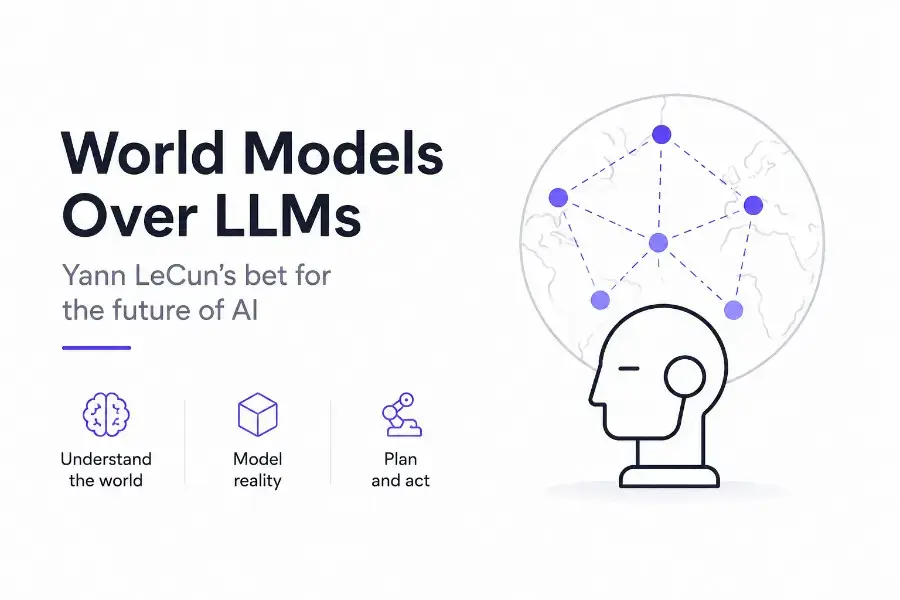
The AI industry is currently obsessed with scale.
More GPUs.
More parameters.
More tokens.
More synthetic data.
Larger clusters.
The dominant assumption seems to be:
intelligence emerges if we scale large language models far enough.
But Yann LeCun has been arguing for years that this approach has fundamental limitations.
And now, his new startup is making that bet official.
Recently, AMI Labs — the new company associated with Yann LeCun’s research circle — raised more than $1 billion to pursue a radically different direction for artificial intelligence:
world models.
Not bigger chatbots.
Not larger next-token predictors.
But AI systems designed to understand how reality itself behaves.
And honestly, I think this may become one of the most important shifts happening in AI right now.
Key Takeaways
- Yann LeCun believes current LLMs are fundamentally limited.
- AMI Labs raised more than $1B to develop world models.
- World models aim to learn how reality behaves, not just predict text.
- JEPA architectures focus on predicting abstract representations instead of tokens or pixels.
- LeWorldModel reportedly trains on a single GPU with only ~15M parameters.
- The future AI race may shift from brute-force scaling to architectural efficiency and physical reasoning.
Why Yann LeCun Thinks LLMs Are Limited
LeCun’s criticism of modern LLMs is actually surprisingly simple.
Large language models are extremely good at:
- language generation
- pattern completion
- statistical correlation
- next-token prediction
But according to him, that is not the same thing as understanding.
And honestly, he has a point.
A language model can generate convincing explanations about:
- gravity
- robotics
- physics
- cooking
- biology
without actually understanding any of those concepts.
It predicts statistically plausible continuations.
That is fundamentally different from building an internal model of reality.
LeCun summarized this idea years ago with one of his most famous quotes:
“You could memorize every cookbook ever written and still have no idea what food tastes like.”
That quote perfectly captures the limitation he sees in pure language modeling.
LLMs can memorize enormous amounts of information.
But memorization is not grounded understanding.
Definitions
What Is a World Model?
A world model is an AI system designed to learn how environments behave, including:
- causality
- spatial dynamics
- physics
- action consequences
- object persistence
- planning
Instead of only predicting text, world models attempt to learn how reality itself evolves.
What Is JEPA?
JEPA stands for:
Joint-Embedding Predictive Architecture
Official paper:
https://arxiv.org/abs/2301.08243
JEPA is a self-supervised learning framework developed by Yann LeCun and collaborators.
Instead of reconstructing exact outputs like pixels or tokens, JEPA predicts abstract representations of the world.
That distinction is extremely important.
What Is Embodied AI?
Embodied AI refers to AI systems interacting with physical or simulated environments through:
- sensors
- actions
- feedback loops
- environment dynamics
This is particularly important for:
- robotics
- autonomous vehicles
- industrial automation
- drones
- physical agents
What Are World Models?
World models are AI systems designed to understand how the world behaves.
Instead of only learning language patterns, they attempt to model:
- physical environments
- actions and consequences
- causality
- planning
- temporal dynamics
- persistence
- spatial relationships
The goal is not simply to generate plausible text.
The goal is to build systems capable of:
- reasoning about environments
- predicting outcomes
- planning actions
- adapting dynamically
- interacting with the physical world
And honestly, this becomes increasingly important as AI moves beyond chat interfaces.
Because the real world is not autoregressive text.
That distinction matters a lot.
Why LLMs Struggle With Physical Reality
Large language models are incredibly impressive.
But they also reveal important weaknesses when interacting with the physical world.
For example:
- poor long-term planning
- weak causal reasoning
- inconsistent spatial understanding
- fragile environment modeling
- difficulty handling persistent states
This is one reason why robotics still feels far behind chatbot progress.
Generating language is not the same thing as understanding physics.
Predicting tokens is not the same thing as modeling reality.
And LeCun has been repeating this point consistently for years.
LLMs vs World Models
| LLMs | World Models |
|---|---|
| Predict tokens | Model environments |
| Text-centric | Reality-centric |
| Statistical completion | Causal understanding |
| Weak planning | Stronger planning potential |
| Language-focused | Action-focused |
| Passive knowledge | Interactive understanding |
This is probably one of the most important conceptual differences in modern AI research.
How JEPA Changes the AI Paradigm
Traditional generative AI often tries to predict:
- exact pixels
- exact tokens
- exact outputs
This forces models to spend enormous amounts of capacity reconstructing irrelevant details.
For example:
- texture noise
- exact wording
- visual uncertainty
- pixel-level randomness
JEPA takes a radically different approach.
Instead of reconstructing raw outputs, it predicts abstract latent representations.
In simple terms:
JEPA attempts to teach AI how reality behaves instead of only predicting language patterns.
That means the system focuses more on:
- semantics
- object relationships
- dynamics
- structure
- causality
- spatial reasoning
rather than surface-level generation.
And honestly, this may scale much better toward autonomous intelligence.
The LeWorldModel Paper
One reason this topic suddenly exploded again is the recent release of:
LeWorldModel
Paper:
https://arxiv.org/abs/2603.19312
The paper introduces a stable end-to-end JEPA world model trained directly from pixels.
Some of the claims are genuinely fascinating.
According to the paper:
- the model contains only ~15M parameters
- trains on a single GPU
- trains in only a few hours
- performs planning tasks up to 48x faster than some foundation-model-based world models
That last point is particularly important.
Because the current AI industry mostly assumes:
more intelligence requires exponentially more compute.
LeWorldModel suggests architecture may matter far more than many people currently believe.
Why This Matters
The AI industry is increasingly constrained by:
- GPU shortages
- energy consumption
- inference costs
- scaling inefficiencies
- data limitations
World models may offer a fundamentally different path toward more efficient and autonomous AI systems.
And honestly, this is why investors are paying attention.
The AMI Labs funding round signals that sophisticated investors increasingly believe scaling laws alone may not be enough to reach more autonomous forms of intelligence.
Why This Connects Directly to Physical AI
I think world models become especially important once AI systems leave purely digital environments.
I explored this broader shift toward Physical AI and robotics in more depth here:
World Models in Robotics: Why AI Needs to Understand Physics, Not Just Language
I also wrote a deeper analysis of Physical AI architectures here:
What Physical AI Really Means for Robotics and Cyber-Physical Systems
The key challenge for physical systems is not generating text.
It is:
- understanding environments
- predicting outcomes
- planning actions
- adapting dynamically
- modeling causality
World models are much more aligned with those requirements.
Why Architecture Is Becoming More Important Than Scale
One of the most fascinating aspects of this story is the implicit critique of today’s scaling race.
Modern frontier AI increasingly depends on:
- hyperscale datacenters
- trillion-token datasets
- massive GPU clusters
- enormous energy consumption
That model may not scale forever.
World models and JEPA architectures suggest a different possibility:
smarter architectures instead of brute-force scaling.
And honestly, we are already seeing similar shifts elsewhere in AI.
I recently wrote about how inference architecture innovations like Multi-Token Prediction are transforming local AI performance:
llama.cpp Is About to Get Much Faster Thanks to Multi-Token Prediction
The broader trend is becoming clearer:
Architecture matters again.
A lot.
Important Reality Check
At the same time, it is important to stay realistic.
World models are extremely promising.
But many hard problems remain unsolved:
- long-term memory
- robust planning
- embodied learning
- scalable reasoning
- real-world reliability
- autonomous action
And world models themselves are not entirely new.
Researchers have explored similar ideas for years in:
- reinforcement learning
- robotics
- self-supervised learning
- model-based control
What is changing now is:
- scale
- multimodal learning
- industrial investment
- compute availability
- deployment potential
What I Think Happens Next
I do not think LLMs are going away.
Far from it.
Language models are extraordinarily useful.
But I increasingly suspect they are only one layer of future AI systems.
Future architectures will probably combine:
- LLMs
- world models
- planning systems
- memory
- multimodal perception
- reasoning modules
- tool use
- embodied interaction
And honestly, that makes far more sense to me than the idea that next-token prediction alone somehow leads directly to AGI.
Humans do not understand reality by predicting the next word.
We build mental models of environments.
We simulate outcomes.
We reason spatially.
We understand causality through interaction.
That is much closer to the direction LeCun is pushing.
Final Thoughts
The most interesting part of Yann LeCun’s new bet is not the funding amount.
It is the underlying philosophy.
For years, the AI industry has mostly optimized for:
- larger models
- bigger datasets
- more GPUs
- more generated text
LeCun is effectively asking a different question:
What if intelligence is not primarily about generating language?
That may turn out to be one of the most important questions in AI over the next decade.
Because if world models actually work at scale, the future winners of AI may not be the companies burning the most compute.
They may be the ones building systems that genuinely understand how reality behaves.
And honestly, that is a much more interesting future.
FAQ
What is a world model in AI?
A world model is an AI system designed to learn how environments behave, including causality, physics, and action consequences, instead of only predicting text.
What is JEPA?
JEPA stands for Joint-Embedding Predictive Architecture, a self-supervised learning framework developed by Yann LeCun and collaborators.
Why does Yann LeCun criticize LLMs?
LeCun argues that predicting the next token is fundamentally different from understanding the world and reasoning about reality.
What is LeWorldModel?
LeWorldModel is a recent JEPA-based world model paper claiming highly efficient planning using only ~15M parameters trained on a single GPU.
What is AMI Labs?
AMI Labs is a new AI company associated with Yann LeCun’s research direction focused on world models and autonomous machine intelligence systems.